8 Crypto Trading Tips for Beginners: Step-by-Step Guide to Trade Crypto Better
Master crypto trading tips for beginners with 8 actionable strategies covering risk management, chart basics, indicators, backtesting, and emotional control.
GeckoScreener Team
Aug 10, 2026 · 21 min read
Updated about 2 months ago
Why do so many new crypto traders focus on finding the “perfect” coin, when the key advantage often comes from how they trade crypto better, not what they trade? That's the gap most beginners miss. Crypto moves fast, runs 24/7, and punishes emotional decisions, so the smartest path is to build a simple process first, then add tools like screeners, chart patterns, and soon, backtesting and alerts.
Good crypto trading tips for beginners always start with structure. You don't need to predict every move. You need a repeatable way to spot setups, manage risk, and avoid the mistakes that wipe out accounts before traders ever get comfortable. Beginner guidance from major venues keeps pointing to the same core habits, risk small, use a stop-loss before entry, and trade with a favorable risk-reward ratio 3Commas beginner crypto trading guide, WEEX risk management overview.
That's why this guide starts with the basics and moves step by step toward practical execution. You'll see how traders use RSI, MACD, EMA, candlesticks, support and resistance, and screeners to narrow the market down to a few actionable ideas. You'll also see how a platform like GeckoScreener fits into that workflow, especially for beginners who want one place to filter coins, spot patterns, and build strategies without code. Backtesting and alerts aren't live yet, but they're part of the broader workflow beginners should already be preparing for.
Table of Contents
- 1. Start with Technical Analysis Fundamentals RSI, MACD, and EMA
- 2. Recognize Candlestick Patterns to Identify Entry and Exit Points
- 3. Implement Stop Loss and Take Profit Orders to Protect Capital and Lock in Gains
- 4. Start Small and Scale Gradually as You Build Confidence and Track Record
- 5. Develop and Backtest a Clear Trading Strategy Before Risking Real Capital
- 6. Use Screeners to Identify Coins Meeting Your Criteria Rather Than Manual Analysis
- 7. Understand Market Structure Support and Resistance Levels Guide Your Entries and Exits
- 8. Maintain Detailed Trading Journals and Monitor Key Metrics to Continuously Improve
- 8-Point Comparison: Beginner Crypto Trading Tips
- Next Steps Put Your New Skills to Work
1. Start with Technical Analysis Fundamentals RSI, MACD, and EMA
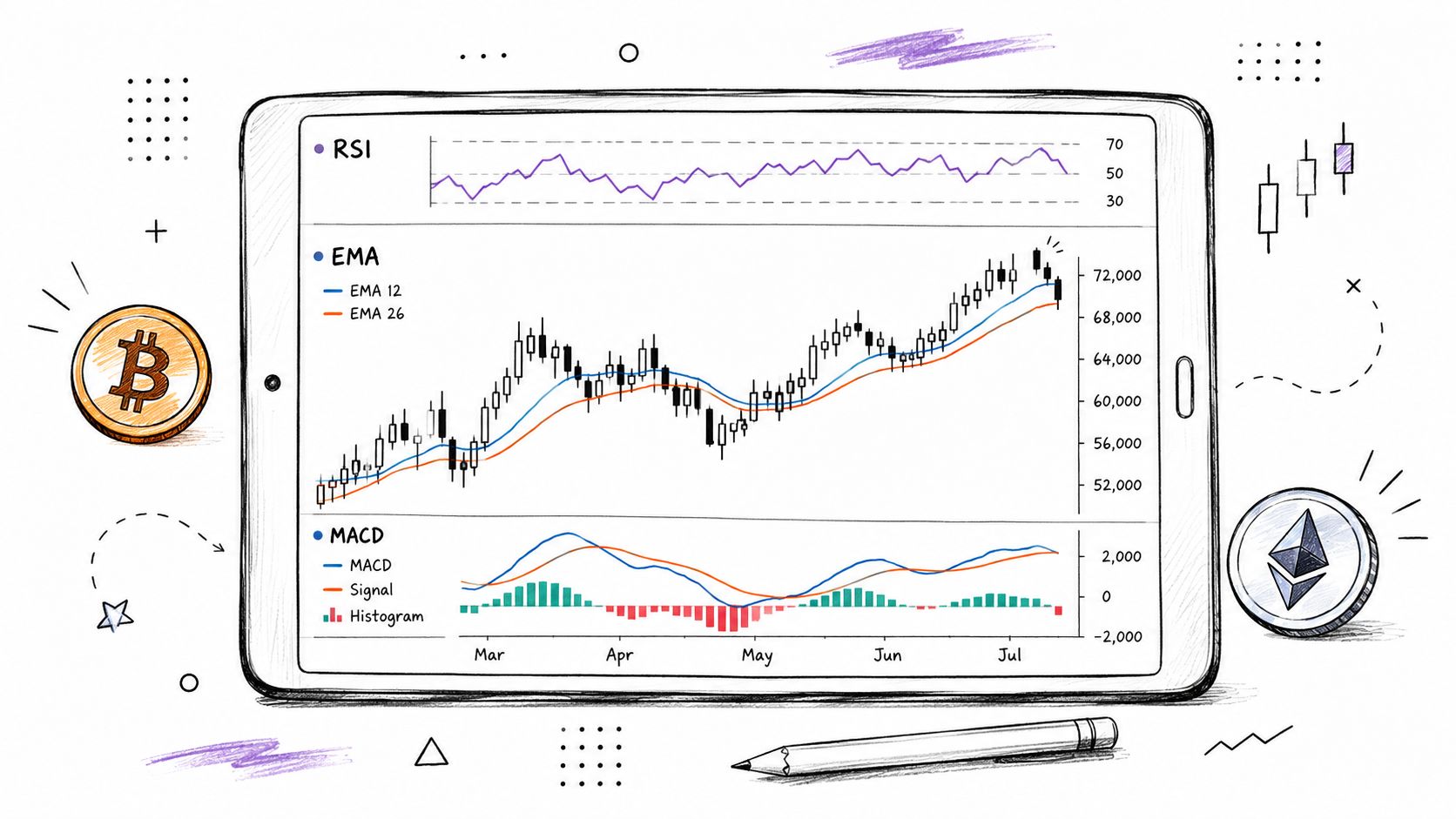
Technical analysis gives beginners a way to read price behavior instead of guessing. Three of the most useful starting points are RSI, MACD, and EMA, because they help traders judge momentum, trend direction, and possible turning points. Beginner materials from major crypto education venues also emphasize checking a higher timeframe first, such as the daily or 4-hour chart, and then using tools like RSI, EMA, and SMA for structure, not certainty CAIA crypto chart patterns guide, Binance Academy trading strategies guide.
A simple example helps. If Ethereum pushes above the upper RSI zone, a beginner can treat that as a sign the move may be extended rather than a reason to buy blindly. If Bitcoin's MACD histogram turns negative, that can warn that momentum is fading. On a 4-hour chart, an EMA 12/26 crossover can help a swing trader notice an early trend shift without staring at every one-minute candle. The point isn't to chase every signal. It's to filter the market down to a few coins worth a closer look.
Use indicators together, not in isolation
GeckoScreener's filtering setup is useful here because beginners can scan a broader universe of coins instead of opening chart after chart by hand. A practical workflow is to combine RSI, MACD, and EMA in one screen, then save that setup as a reusable watchlist. You can also adjust indicator periods to match your style, shorter for day trading, longer for swing trading.
Practical rule: Treat indicators like a cluster of clues. One signal can mislead you, but several aligned signals make the trade easier to justify.
A strong beginner habit is to pair indicator signals with candlestick confirmation. If RSI says a coin is stretched but the candles still show strong buying, wait. If the chart gives you RSI pressure, a MACD turn, and a clean EMA structure, you've got a much more disciplined setup than a pure gut feeling. That's the kind of habit that keeps beginners from overtrading.
2. Recognize Candlestick Patterns to Identify Entry and Exit Points
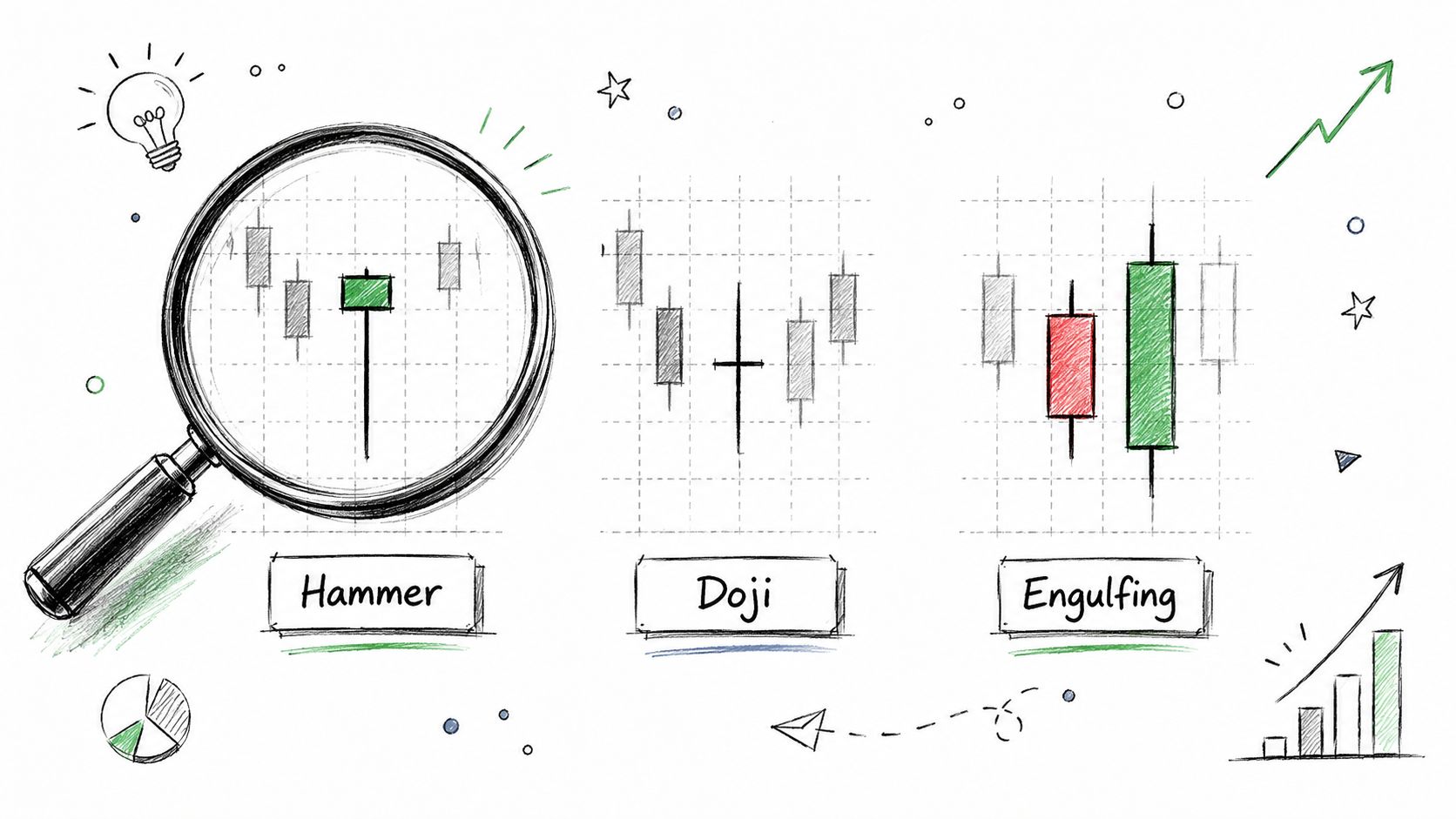
Candlestick patterns show how traders behaved during a specific time window, and that makes them useful for timing. A Doji often signals indecision, a Hammer can point to a bullish reversal after a decline, and an Engulfing pattern can show that one side of the market just took control. For beginners, these shapes are valuable because they translate messy price action into something visible and repeatable.
A simple scenario makes this clearer. If a Bitcoin chart prints a Hammer on the 4-hour timeframe after a multi-day decline, that long lower wick suggests buyers stepped in at support. If Ethereum prints a Doji on the daily chart, the market may be balancing between buyers and sellers, which often means a larger move could follow. A Morning Star on Ripple after a long downtrend can point to a possible shift in direction, while an Evening Star on Solana can warn that an uptrend is running out of steam. These are not guarantees, but they give beginners a sensible framework.
Narrow the pattern set before you expand
Beginners usually get better results by learning a small group of patterns first. GeckoScreener's pattern navigation makes that easier because you can scan many coins at once instead of hunting manually. A significant edge comes when you combine pattern detection with volume and support or resistance, not when you treat a candle shape as a stand-alone answer.
- Learn the core patterns first: Focus on a few high-probability formations, such as Doji, Hammer, Engulfing, Morning Star, and Evening Star, before trying to memorize everything.
- Confirm with volume: A pattern with strong participation is more trustworthy than one forming on weak interest.
- Trade at key zones: A Hammer at support means more than a Hammer floating in the middle of nowhere.
- Cross-check with momentum tools: RSI or MACD can help confirm whether the pattern has backing from the broader move.
A short video can help make those shapes easier to recognize in real time. Look for how candles behave near support, near resistance, and after sharp runs. That visual memory matters, because beginners often lose money not from bad ideas, but from mistaking random candle noise for a real setup.
3. Implement Stop Loss and Take Profit Orders to Protect Capital and Lock in Gains
Risk control is the part of crypto trading that keeps a small mistake from becoming a huge one. Major beginner guides commonly recommend risking only 1% to 2% per trade, placing a stop-loss before entry, and keeping a favorable risk-reward ratio 3Commas beginner crypto trading guide, WEEX risk management overview. One beginner guide even explains that if an account has $1,000, the maximum loss on a single trade should be only $10 to $20, which means the account could survive roughly 10 to 20 losing trades without being wiped out 3Commas beginner crypto trading guide.
That logic matters in crypto because prices can move hard and fast. A trader who enters Bitcoin at $45,000 and sets a 5% stop loss at $42,750 and a 10% take profit at $49,500 is defining the trade before emotion gets involved. The risk is clear, the reward is clear, and the position size can be matched to the account. The same idea works on shorter timeframes too. An Ethereum day trader might use a tighter stop and a nearby target, while a swing trader may set stops just below support and aim for the next resistance zone.
Stop-loss and take-profit orders work best when they're placed before the market starts moving against you. Once the trade is live, hesitation usually costs more than a slightly imperfect entry.
Keep the structure consistent
A good beginner habit is to treat the stop and the target as part of the setup, not as afterthoughts. That means defining them at the same time you choose the entry. It also means using support and resistance as your guide, not random percentages. A stop below support is usually more meaningful than a stop chosen just because it “feels” right.
GeckoScreener's strategy-building workflow is designed around this kind of discipline. A clear ruleset can define where a trade enters, where it exits if wrong, and where it locks gains if right. That gives beginners a better path to consistency, especially when the market is moving too fast to improvise. If you're serious about protecting capital, this is one of the first habits to lock in.
4. Start Small and Scale Gradually as You Build Confidence and Track Record
The fastest way to blow up as a beginner is to trade too large before you understand your own process. That's why beginner education from multiple sources keeps stressing small risk, liquid assets, and disciplined sizing 3Commas beginner crypto trading guide, Blockchain Council first 30 days strategy guide. One beginner guide recommends a daily loss cap of 2% to 3% of account equity, a 1% per-trade risk rule, and a 1:2 risk-reward target early on Blockchain Council first 30 days strategy guide. Another recommends starting with highly liquid assets like Bitcoin, Ethereum, and Solana to reduce slippage and execution risk WEEX risk management overview.
A practical beginner example is simple. A new trader with a $10K account might risk 0.5% per trade at first, then keep a journal and review whether the process is working before increasing size. Another trader may start with a single swing setup on one liquid coin, then add exposure only after the pattern proves itself over repeated trades. The point is not to stay tiny forever. The point is to earn the right to scale.
Grow the size after the process proves itself
Scaling should follow evidence, not excitement. If a strategy works across repeated trades and the journal shows controlled losses, then size can rise gradually. If the results are inconsistent, bigger positions only magnify the problem.
- Risk by percentage, not impulse: A fixed share of account equity is easier to manage than random dollar sizing.
- Track every trade: Record entry, stop, target, and outcome so you can see what's really happening.
- Review before scaling: Increase size only after a meaningful sample of trades shows discipline, not after one good week.
- Keep the same rules: Small trades deserve the same management as larger ones.
Bravos Research also makes the broader point that position sizing decides survival more than trade accuracy Bravos Research trading tips. That's true for beginners because the market doesn't reward confidence, it rewards control. If you build the habit of staying small while you learn, you'll give yourself time to improve without unnecessary damage.
5. Develop and Backtest a Clear Trading Strategy Before Risking Real Capital
A trading strategy is just a set of rules, but those rules need to be precise enough that you could repeat them without guessing. Beginner guides often mention indicators and setups, but they don't always explain the missing step, validating the rules before risking money. That matters because a strategy can look good on historical charts and still fail live if it was tuned too tightly to the past Binance Academy strategy guide.
A simple example looks like this. A trader defines a plan where RSI below 30, a Hammer pattern, and EMA 12 above 26 on the 4-hour chart trigger a buy, then RSI above 70 triggers an exit. That's concrete. It's testable. It's far better than saying “buy when it looks strong.” Another trader might test Morning Star + positive MACD histogram + volume spike across several altcoins to see which assets perform well with that setup. That's the kind of process that exposes whether a rule is reliable or just lucky on one chart.
Test the rules before you trust them
Backtesting is the bridge between an idea and a live trade. It tells you how a strategy behaved in the past, what drawdowns looked like, and whether the rules held up across different coins and timeframes. One beginner-oriented guide explicitly recommends using out-of-sample data to validate a strategy, which is a more disciplined step than merely checking a chart and feeling optimistic Binance Academy strategy guide.
- Write the rules clearly: Entry, stop, target, and exit conditions should be readable without interpretation.
- Test across several coins: A setup that works on one asset might fail on others.
- Keep the strategy simple: Fewer moving parts make it easier to know what's working.
- Don't change rules midstream: Once you go live, keep the original system intact long enough to judge it fairly.
GeckoScreener already supports strategy design and historical evaluation, and that makes it a natural fit for this stage of the process. Backtesting isn't about proving you're right. It's about finding out whether your edge survives contact with real market history before you risk real capital.
6. Use Screeners to Identify Coins Meeting Your Criteria Rather Than Manual Analysis
Manually checking dozens of charts every day is a bad use of time for beginners. A screener solves that by filtering the market down to the coins that already match your setup, which is exactly how you reduce noise. A trader can search for coins with RSI under 30, a bullish candlestick pattern, and a volume condition, then focus only on the results that matter.
A more advanced workflow is to start broad and narrow fast. For example, a screener can surface coins that show MACD positive histogram, EMA 12 above 26, and a trend filter, or coins printing a Doji while RSI sits in a neutral zone. That's faster than opening chart after chart and guessing where to start. It also keeps you from missing a setup just because you weren't looking at that coin at the right moment.
Practical rule: Let the screener do the first pass. Use the chart only after the coin has already earned attention.
Build small filters first
Beginners often add too many conditions too early. That can make the screener so restrictive that it stops being useful. Start with two or three criteria, then tighten the rules only if the results are too broad.
- Save separate screeners: Create one for oversold dips, another for breakout attempts, and another for reversal patterns.
- Run scans consistently: Check the same time each day so you learn what your setup looks like in different market conditions.
- Combine structure and momentum: Pattern plus RSI or MACD is more useful than a single signal alone.
- Sort by strength: Look at the strongest matches first, not the longest list.
LiteFinance's scalper checklist also points out that tight spreads and strong liquidity matter because thin markets increase slippage and weaken stop execution LiteFinance crypto day trading strategies. For beginners, that's a useful reminder that a screener is not just about finding signals. It's also about filtering for tradable conditions, where execution won't distort the setup before it has a chance to work.
7. Understand Market Structure Support and Resistance Levels Guide Your Entries and Exits
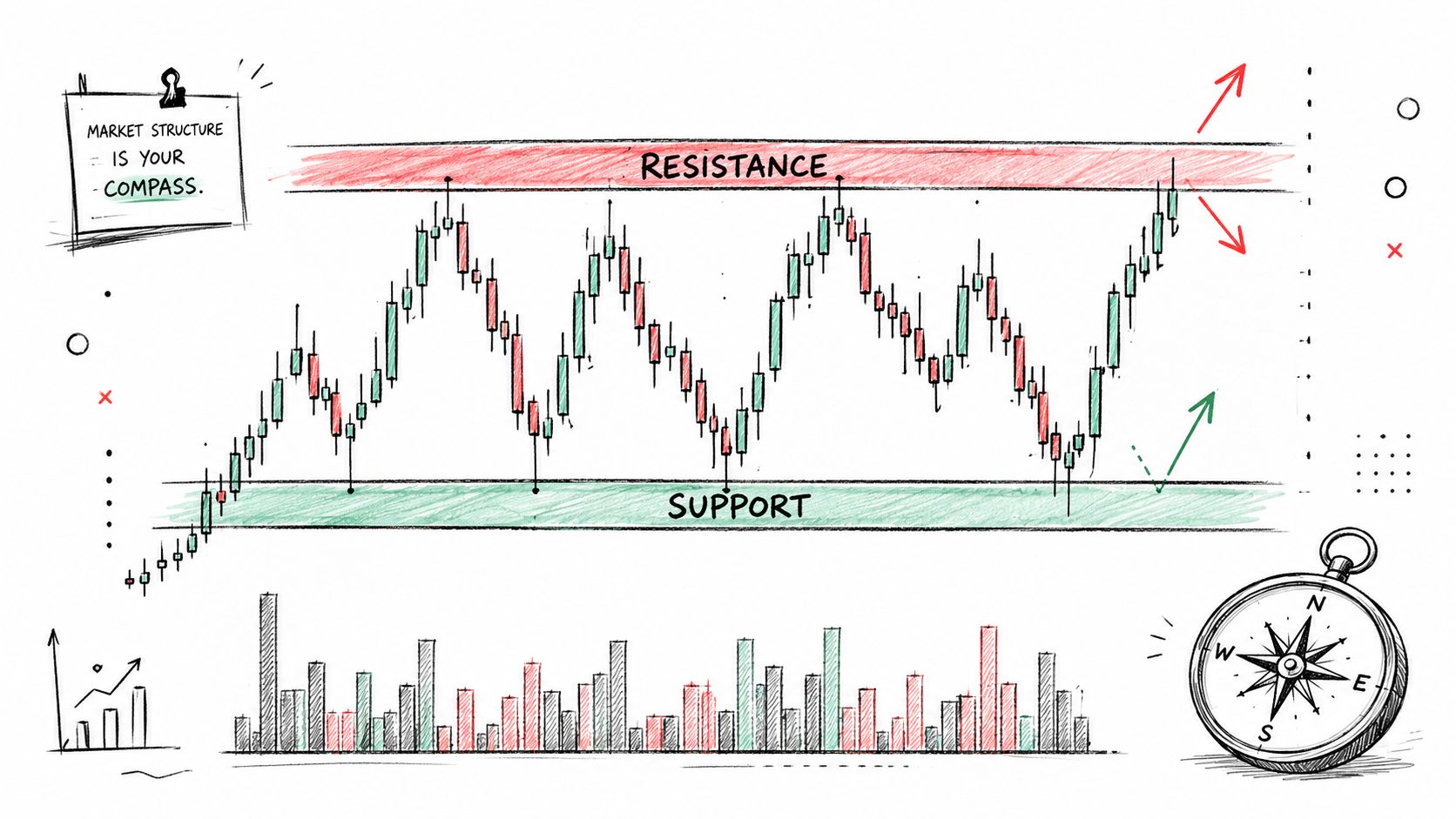
Support and resistance are the simplest building blocks of market structure, and beginners should learn them early. Support is a zone where buyers have historically stepped in. Resistance is a zone where sellers have often pushed back. A lot of beginner mistakes happen because traders buy in the middle of a range instead of waiting for price to approach a level where the market has already shown interest before CAIA crypto chart patterns guide.
A straightforward example is Bitcoin with support near $42,000 and resistance near $50,000. A trader might buy closer to support, place a stop below that zone, and aim for the resistance area as the exit. On Ethereum, a 4-hour chart might show a bounce zone around $2,200 and resistance around $2,500. If a Hammer forms near support, the setup becomes more meaningful because the candle and the level are pointing in the same direction. An altcoin that consolidates between $0.85 and $1.10 works the same way, breakouts matter most when price clears resistance with stronger volume.
Mark the levels before you think about the trade
A lot of traders do this backward. They see the candle first, then start looking for a level to justify it. That usually leads to bad entries. The cleaner approach is to map the chart from the top down, then watch for alignment.
- Start on the weekly and daily charts: Major levels usually show up there first.
- Refine on the 4-hour and 1-hour charts: Use lower timeframes for entry timing, not for inventing levels.
- Watch round numbers: Big levels like $40,000, $45,000, and $50,000 often matter because many traders focus on them.
- Combine with candles: A Hammer at support or a bearish pattern at resistance adds structure to the trade.
IG's workflow for crypto trading breaks the process into practical steps, including identifying an opportunity, deciding whether to go long or short, and then managing risk before placing the trade IG crypto trading guide. That sequencing is useful because support and resistance help you decide where the opportunity exists. Without those levels, even a decent indicator signal can become a low-quality trade.
8. Maintain Detailed Trading Journals and Monitor Key Metrics to Continuously Improve
A trading journal turns random experience into usable information. Without one, beginners keep repeating the same mistakes because every trade feels separate. With one, patterns start to appear, which setups work, which timeframes fail, and where emotions keep interfering. Beginner guides consistently recommend writing down the entry reason, stop-loss, take-profit, and position size before each trade, because the act of writing forces clarity Blockchain Council first 30 days strategy guide.
That habit also makes performance easier to measure. One trader might discover that RSI-based entries behave better than MACD-based entries, while another may find that Doji setups only work near major levels. The exact lesson will be different for each person, but the mechanism is the same, review the data, not the emotion. A journal also helps you compare live results with backtest expectations, which is important if execution or slippage changes the outcome later.
Keep the journal honest. If the trade was late, impulsive, or oversized, write that down too. Those details usually explain more than the chart itself.
Review the numbers on a schedule
A journal should not sit in a folder unread. The value comes from regular review, monthly, quarterly, and after major market changes. That's when you can identify which setups deserve more attention and which ones should be cut.
- Record the full trade context: Entry time, exit time, setup type, and reason for taking the trade.
- Track win rate and average trade quality: A strategy can look active but still be weak if the results are inconsistent.
- Group trades by setup: Separate RSI entries, pattern trades, and breakout attempts so comparisons are meaningful.
- Compare live trades with tested expectations: If actual results differ from your plan, note whether execution, slippage, or hesitation caused the gap.
Bravos Research also stresses that emotional trading and lack of discipline lead to heavy losses, while journaling helps traders spot recurring mistakes and refine decision-making Bravos Research trading tips. That's the deeper reason the journal matters. It doesn't just document trades. It helps you become the kind of trader who learns from them.
8-Point Comparison: Beginner Crypto Trading Tips
| Item | Complexity 🔄 | Resources Required ⚡ | Expected Outcomes ⭐ | Ideal Use Cases 💡 | Key Advantages 📊 |
|---|---|---|---|---|---|
| Start with Technical Analysis Fundamentals: RSI, MACD, and EMA | Moderate, learning indicator theory and parameter tuning | Charting platform, real-time data, basic screener, backtesting capability | Clear momentum/trend signals when calibrated; reduces emotional trades ⭐ | Trend identification, momentum screening, multi-timeframe analysis | Systematic entry/exit signals; applies across pairs; speeds up filtering |
| Recognize Candlestick Patterns to Identify Entry and Exit Points | Low–Moderate, pattern rules easy to learn but interpretation subjective | Pattern detector or charting tool, volume data, timeframe selection | Intuitive visual reversal/continuation signals; moderate reliability ⭐ | Timing entries/exits, confirming reversals at key levels | Fast visual confirmation of market psychology; automatable across many coins |
| Implement Stop Loss and Take Profit Orders to Protect Capital and Lock in Gains | Low, simple orders but requires discipline to enforce | Exchange order types, strategy builder, backtesting for levels | Consistent risk control and capital protection; preserves gains ⭐ | All trade types; critical in volatile markets and for position sizing | Limits downside, enforces discipline, enables consistent position sizing |
| Start Small and Scale Gradually as You Build Confidence and Track Record | Low, straightforward but requires patience and rules | Account with adjustable position sizing, backtesting results, trading journal | Controlled drawdowns, preserved capital while learning; builds track record ⭐ | Early strategy validation, live learning, gradual scaling of winners | Minimizes early losses, provides real experience, enables evidence-based scaling |
| Develop and Backtest a Clear Trading Strategy Before Risking Real Capital | High, requires rule definition, testing and parameter optimization | No-code strategy builder or backtester, historical data (months), portfolio-mode tests | Validated edge, measurable metrics (win rate, drawdown); higher long-term reliability ⭐ | Pre-live validation, systematic trading, strategy optimization | Reveals expectancy and weaknesses; reduces chance of untested failures |
| Use Screeners to Identify Coins Meeting Your Criteria Rather Than Manual Analysis | Low–Moderate, set filters thoughtfully to avoid noise | Real-time screener covering 100+ coins, saved queries, alerting | Rapid idea generation and consistent rule application; saves hours ⭐ | Daily market scans, finding qualified setups across large universes | Greatly accelerates discovery; prevents missed opportunities; repeatable scans |
| Understand Market Structure: Support and Resistance Levels Guide Your Entries and Exits | Moderate, requires practice to mark meaningful zones | Multi-timeframe charts, volume profile, price-history tools | Better entry/exit placement and tighter stops; context for all signals ⭐ | Placing limit orders, stop placement, validating breakouts/false breaks | Provides objective price zones; improves risk-reward and signal reliability |
| Maintain Detailed Trading Journals and Monitor Key Metrics to Continuously Improve | Moderate, disciplined recording and analysis required | Journal or spreadsheet, exported trade history, backtest outputs | Identifies winning setups and mistakes; measurable improvement over time ⭐ | Performance review, strategy refinement, psychological control | Reveals edge/weaknesses, enforces accountability, guides data-driven changes |
Next Steps Put Your New Skills to Work
The best crypto traders don't try to master everything at once. They start with a few indicators, a few patterns, a clear stop-loss habit, and a simple journal, then improve one piece at a time. That approach is calmer, cheaper, and far more realistic than chasing every new coin or signal that shows up on social media.
If you're just starting out, keep your process tight. Pick a liquid coin, map support and resistance, scan for one or two patterns, and only take trades that fit your rules. Use your journal to see what happens after entry, not what you hoped would happen, and be patient enough to let your own data teach you.
GeckoScreener fits naturally into that workflow because it's built for screening, pattern detection, and strategy design in one place. Its charts and screens can help beginners narrow the market, while upcoming backtesting and alert features should make it even easier to validate ideas and react to setups without staring at charts all day.
If you want a clearer way to find setups, test ideas, and keep your crypto trading process organized, visit GeckoScreener. It brings screening, strategy building, and chart review into one workflow, which makes it easier to apply these crypto trading tips for beginners with discipline.
GeckoScreener Team
Written for the GeckoScreener community. Join us on Telegram →
Related Articles
Start screening cryptocurrencies for free
Apply strategies like this one in real-time across 250+ coins.
Try GeckoScreener →