5 Crypto Strategies, Tested Against Real Numbers
5 crypto strategies (DCA, trend following, breakout, range trading, arbitrage) with the actual backtested returns, win rates and drawdowns behind each one.
GeckoScreener Team
Sep 1, 2026 · 9 min read
Updated about 2 months ago
Search "crypto strategies" and you get the same five words rearranged across a dozen sites: trend following, swing trading, dollar-cost averaging, breakout, arbitrage. Almost none of them show you what any of these actually returned, or lost, or how often they were even right. A strategy is not a vibe. It's a rule you can write down and test against history, and once you actually test one, the ranking rarely matches the listicle.
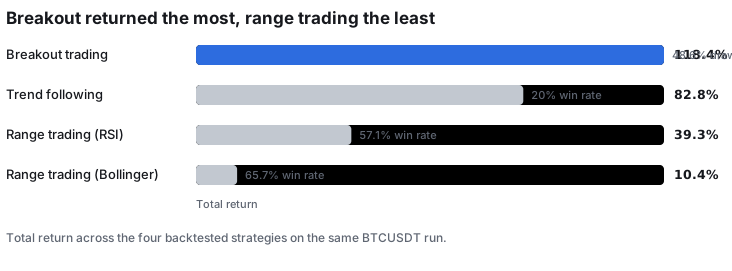
In short: a backtest on Bitcoin from January 2021 to August 2026 puts real numbers on four of the five strategies below. Breakout trading returned the most (+118.4%) but came with the worst drawdown (48.6%). Trend following won the fewest trades (a 20% win rate) but the best return per dollar risked (a 2.02 profit factor). Range trading won the most trades and made the least money. Dollar-cost averaging and arbitrage sit outside that backtest. One isn't a timing strategy at all. The other needs infrastructure most retail traders don't have.
What one real backtest actually showed
The numbers below come from a single, disclosed backtest on BTCUSDT spot on Binance, daily candles, January 2021 to August 2026. Starting capital was $10,000, with Binance's standard 0.1% taker fee, one position at a time, no leverage. That's one asset, one set of rules, one stretch of history. It's not proof any of these strategies will do the same thing next year, on Ethereum, or in your hands. Treat it as a real data point, not a guarantee, and confirm the logic on your own timeframe before you risk anything on it.
Ranked by total return, breakout trading came out on top, followed by trend following, a moving-average crossover, and then two flavours of range trading.
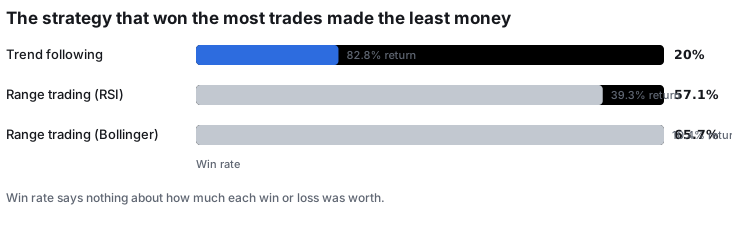
📌 Practical rule: a high win rate is not the same as a profitable strategy. The range-trading approach below won 65.7% of its trades and returned 10.4%. Trend following won just 20% of its trades and returned 82.8%. What decides a strategy isn't how often you're right, it's how much you make when you are against how much you lose when you aren't.
1. Dollar-cost averaging: the one that skips the chart
Dollar-cost averaging (DCA) buys a fixed amount on a fixed schedule, weekly or monthly, no matter what the price is doing. There's no entry signal, no exit signal, and nothing to screen for. It's the only strategy on this list that doesn't need you to read a chart at all.
It isn't free, though. One analysis of six years of Bitcoin price data found lump-sum investing beat DCA in roughly two-thirds of simulations. Bitcoin has spent most of that stretch trending up, and money fully invested on day one benefits longer from an uptrend than money drip-fed in over months. What DCA buys you instead is a lower worst case: it can't put your entire stake in at the top the way a single lump-sum buy can. It also removes the decision of when to buy, the decision most people get wrong anyway.
This video walks through what DCA actually returned starting from the worst possible entry point, which is the honest way to stress-test it.
*Dollar-Cost Averaging into Bitcoin with Absolute Worst Timing? How Good Was It? · denome*DCA suits someone who doesn't want to watch a screener at all: set the schedule, automate the buy, check in occasionally. That's it.
2. Trend following: lose small a lot, win big rarely
The trend-following rule in the backtest is about as plain as they get: buy when price closes above its 200-day average, sell when it closes back below. No pattern reading, no prediction of a top or bottom, just staying on the side the market is actually on.
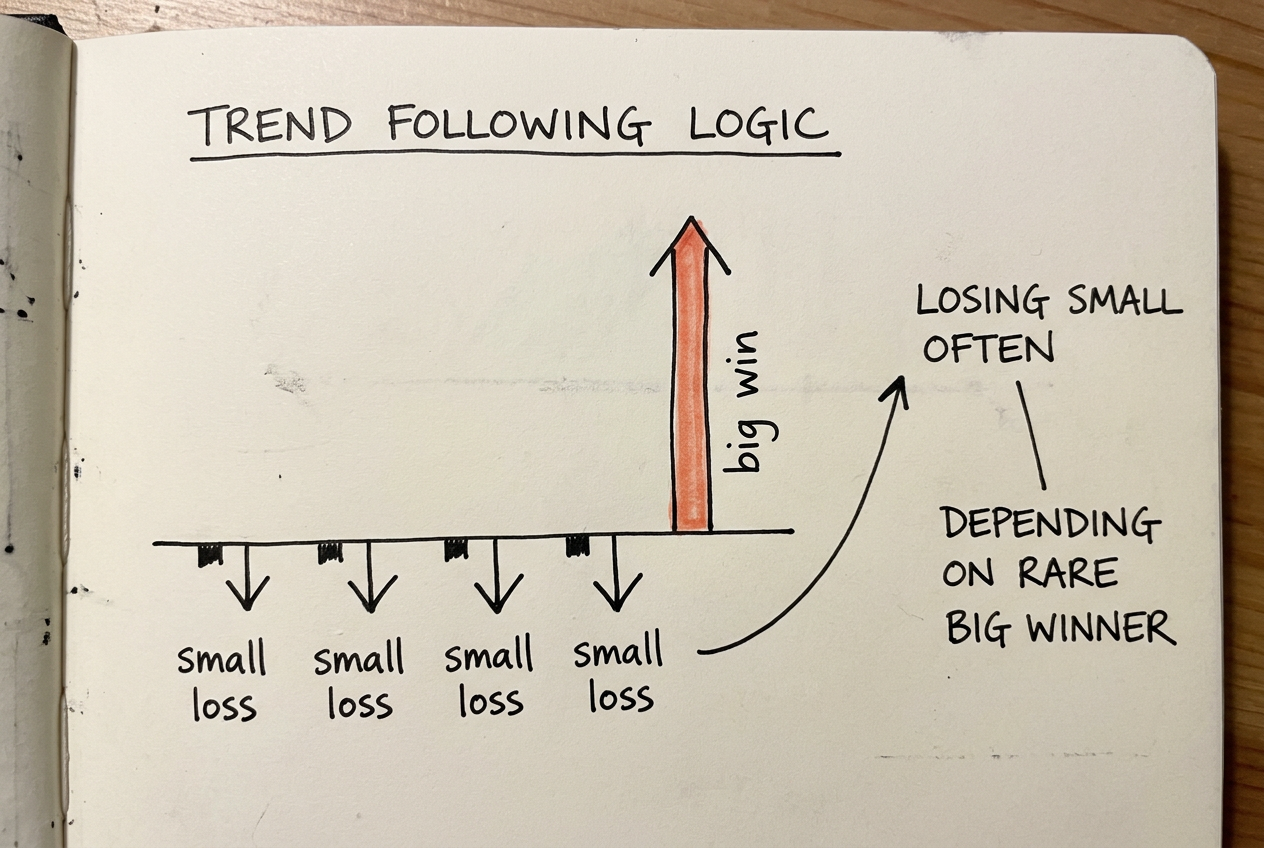
It won only 1 in 5 trades. What made it the second-best performer anyway is what happened on the trades it did win: a 2.02 profit factor means every dollar lost on the four losing trades was matched by just over two dollars made on the one that worked. That's the standard shape of a trend-following strategy. It loses often, in small amounts, and depends entirely on being in the room for the rare move that pays for all of them.
The hard part isn't the rule. It's sitting through a long run of small losses without abandoning the rule right before the move that was going to pay for them.
3. Breakout trading: the biggest number, and the biggest gut check
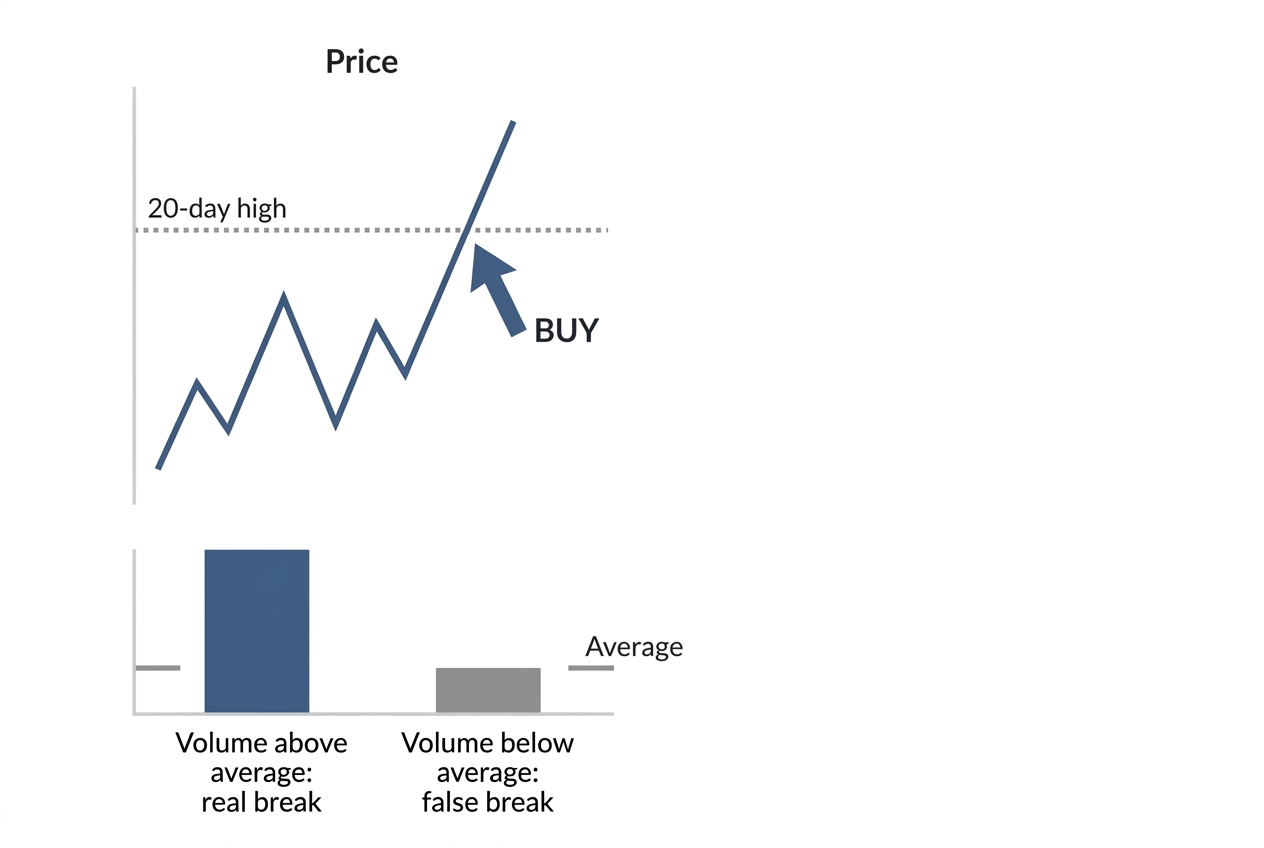
The breakout rule in the backtest buys when price closes above its highest close of the past 20 days, and sells when it closes below the lowest close of the past 20. It's a bet that a price finally escaping a range keeps going, not that it reverses.
It produced the best return of the five: +118.4%. It also produced the strategy's worst drawdown short of the weakest range-trading variant, 48.6% off the peak at the low point. That's the trade-off breakout trading always makes. Ranges get broken constantly, and most of those breaks fail and snap back, so a strategy built to catch the real ones has to sit through a lot of fake ones first.
Traders commonly filter for this by checking volume on the breakout candle. A break on volume well below the recent average is more often a brief liquidity sweep than the start of a real move; traders generally want to see volume meaningfully above average before trusting the break. That won't remove every false signal, but it removes a chunk of the low-probability ones.
4. Range trading: winning most of your trades, making the least money
Range trading, also called mean reversion, bets on the opposite of a breakout: that price snaps back toward its average rather than running away from it. The backtest ran two versions. One bought when the 14-day RSI dropped below 30 and sold when it climbed back above 50. The other bought at the lower Bollinger Band and sold at the middle one.
Both won more of their trades than any other strategy here, 57.1% and 65.7%. Both also made the least money: +39.3% and +10.4%. The Bollinger version's profit factor of 1.07 is barely above break-even once the 0.1% fee on every trade is counted. Range trading works when a market is genuinely going sideways. It works badly the moment a "reversion" trade catches the start of a real move instead of a bounce, which is exactly the kind of stretch trend following and breakout trading are built for.
5. Arbitrage: real, small, and not really built for you
Arbitrage buys an asset on the exchange where it's cheaper and sells it, at the same moment, on the exchange where it's more expensive. No direction needed. Done right it isn't a bet on price at all, just on the gap between two prices closing.
The gap has been real money. A widely cited study of Bitcoin arbitrage across exchanges, published in the Journal of Financial Economics, found more than $1 billion captured just between December 2017 and February 2018, with daily profits on some days reaching $30 million.
The largest spreads weren't between exchanges in the same country, they were across borders, driven by capital controls rather than fees: the "kimchi premium" between Korean and US exchanges averaged around 15% through that period and peaked near 40%.
Those specific numbers are from one extreme, fast-moving stretch of the market and shouldn't be read as a normal month. What hasn't changed is who captures the gap today: automated systems trading in milliseconds, holding capital on several exchanges at once, dominate this now. A retail trader watching two browser tabs is competing against that infrastructure, not against the market.
So which one
Picking a strategy only answers what you'll do. It doesn't answer which lens you're reading the market through when a signal fires, and that's a separate question worth getting straight first. Match the strategy itself to how much time and drawdown you can actually tolerate, not to which one sounds the most sophisticated. Nothing here needs sophistication. No interest in charts at all: dollar-cost averaging. Comfortable holding through long stretches of nothing for one trade that pays for the rest: trend following. Can stomach a near-50% drawdown and you check volume before you trust a break: breakout trading. The market's gone quiet and sideways: range trading. Arbitrage is worth understanding as a concept; running it yourself, against automated systems, mostly isn't.
Four of these five strategies are really the same job done differently: watching a lot of coins for one specific condition to become true. That's the part a real-time screener is built for. GeckoScreener watches 100+ coins against technical indicators and 19 candlestick pattern detectors, refreshed every 60 seconds, and lets you describe a setup in plain language instead of writing the rule in code. Turning any of these five into a backtested, verified track record is a separate job, and on GeckoScreener that part is on the roadmap rather than something live today. Check what's actually shipped before you rely on it for that step.
Whichever one you pick, the number that matters isn't the win rate on the label. It's what happens to your money on the trades where the label was wrong.
GeckoScreener Team
Written for the GeckoScreener community. Join us on Telegram →
Related Articles


Start screening cryptocurrencies for free
Apply strategies like this one in real-time across 250+ coins.
Try GeckoScreener →