Morning Star Reversal Pattern: The Three-Candle Bottom
What the three candles of a morning star reversal pattern mean, what the backtests really show, and the volume filter that lifts its win rate.
GeckoScreener Team
Apr 1, 2026 · 9 min read
Updated about 1 month ago
Quick Summary
- Three candles: large red, then a small indecision candle, then a large green one.
- The small middle candle, the "star", gaps away from the prior close and shows hesitation.
- The third candle pushes deep into the first candle's body. The more it recovers, the stronger the signal.
- At the bottom of a downtrend, near support: the textbook version and the most reliable.
- On daily or weekly charts: far more reliable than on lower timeframes.
- The third candle is the confirmation, so this pattern does not need a fourth.
- Strength: 90/100.
Pattern Anatomy
BullishSignal
BullishStrength
Structure
3 candles · Reversal
Best timeframe
1D · 1W
Key rule
3 candles: large red → small star → large green. Transition from sellers to buyers.
A morning star reversal pattern is the strongest bullish signal in GeckoScreener's detection library, rated 90 out of 100. It takes three candles to complete, and each plays a specific part in the story of a trend turning: candle one shows bears in control, candle two shows neither side winning, candle three shows buyers taking over.
It is also rare enough to be worth waiting for. A study of 4,120 markets across 59 years found 22,863 morning stars, roughly one every 682 candles (LuxAlgo). That is frequent enough to screen for. It is not so frequent that every chart becomes an excuse to trade.
What the Morning Star Reversal Pattern Is
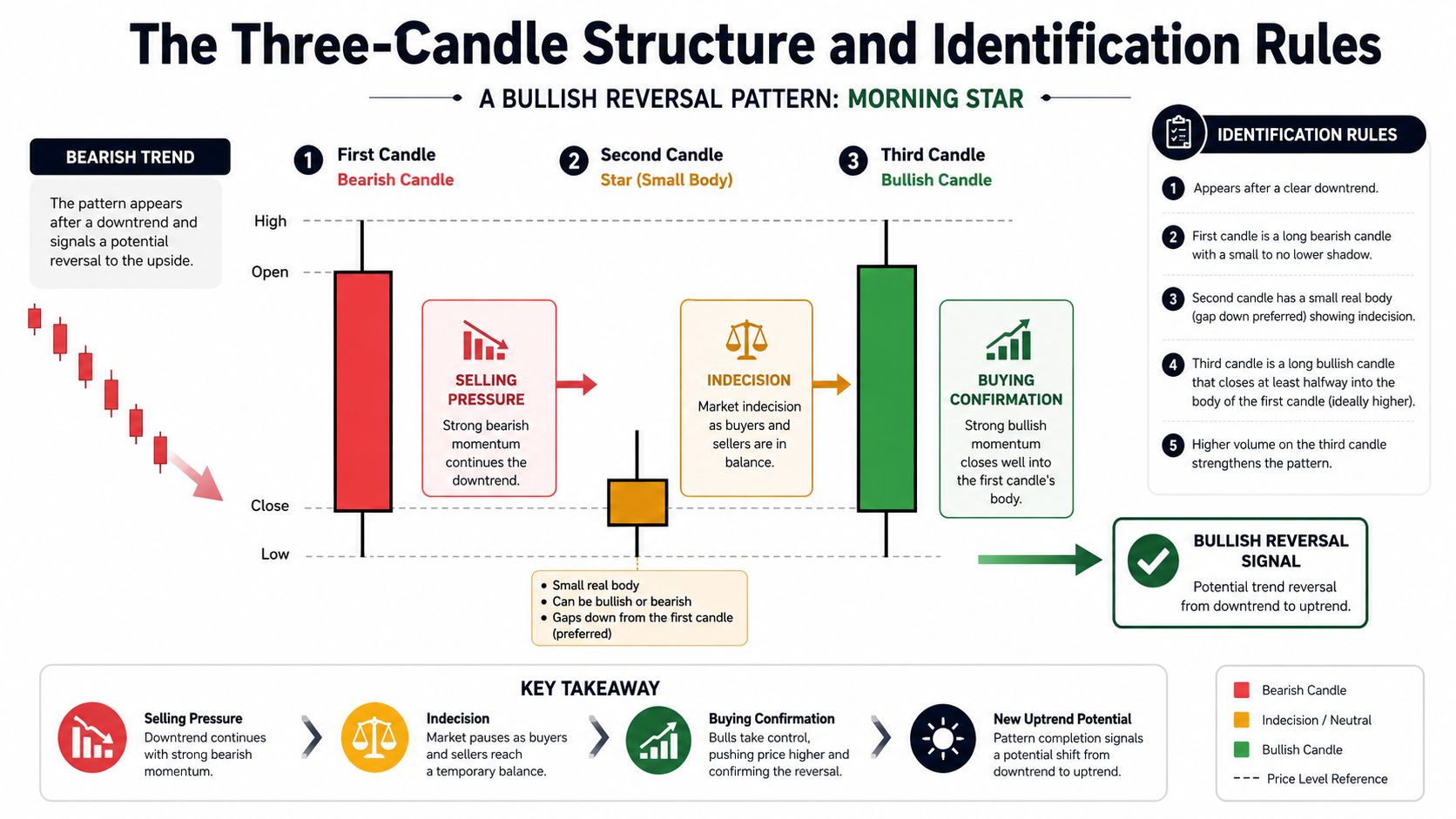
Three candles mark the transition from a downtrend to an uptrend, and each represents a phase in the sentiment shift.
Candle 1, the decline: a large bearish candle. Selling in full force, bears in control.
Candle 2, the star: a small-bodied candle, either a doji or a spinning top. Traditionally it gaps away from the first candle's close. That gap is not mandatory in crypto, where markets never shut. Neither side wins the session, and a small body after a large red candle shows that selling momentum has evaporated.
Candle 3, the takeover: a large bullish candle that opens above the star's close and pushes deep into the first candle's body. The practical confirmation level is the midpoint: the third candle should close at least halfway into candle one's real body. A close approaching the upper part of that body signals a far stronger recovery than a marginal penetration.
Formation rules:
- Three consecutive candles
- Candle 1: large bearish, body more than 50% of the pattern's overall range
- Candle 2: small body, ideally gapping away from candle 1's close, any colour
- Candle 3: large bullish, closing at least 50% into candle 1's body
- Context: appears after a downtrend or a significant decline
What the Data Says
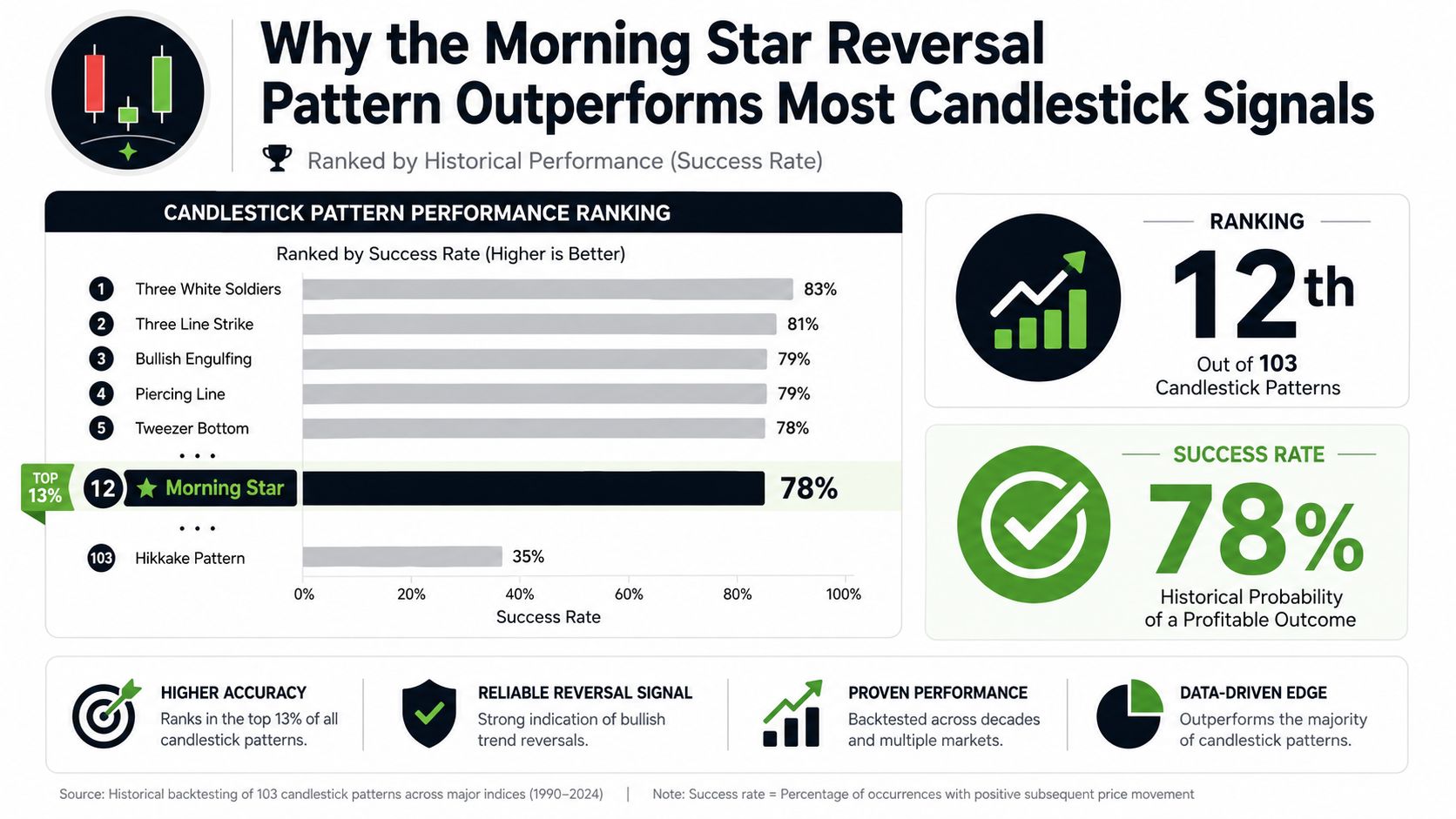
Bulkowski's research classified the morning star as a bullish reversal that behaved as expected 78% of the time, ranking it 12th of 103 candlestick patterns by performance (ThePatternSite). That is a strong placing, and it still does not mean every formation deserves a long position. "Behaved as expected" describes a historical outcome, not a guaranteed profit.
A modern statistical review of the same broad sample reported a 74.2% confirmation rate, with confirmation typically arriving within 3.4 candles and invalidation within 8.4 candles (LuxAlgo). That window is the part to respect. A setup that has not confirmed within a few candles is drifting, not developing.
Crypto shows a different baseline, because lower timeframes carry more noise and fewer clean trend transitions. One public backtest of 312 occurrences across BTC, ETH, SOL and BNB reported a 68.3% baseline success rate, while broader guides put raw pattern performance nearer 55% to 60% (YouPattern). Do not blend those into one universal win rate. They describe different samples under different rules.
Market regime matters too. In one bear-market down-breakout scenario in Bulkowski's data, the best 10-day average move after the breakout was a drop of 8.53%, even though the morning star is categorised as bullish. Memorise the label while ignoring where price actually sits, and you will apply a bullish pattern at exactly the wrong moment.
The Psychology, in Three Acts
Act one, bearish control. The market has been falling and the large red candle extends the decline. Sellers are confident and long positions are stopped out.
Act two, hesitation. Something changes. The session opens lower but neither side dominates. Price oscillates and closes with a small body. That large red candle told a story of conviction; this small star tells a story of uncertainty. The bears have lost their certainty.
Act three, takeover. The third session settles who won the hesitation. It opens above the star and buyers push through the session, recovering a substantial part of what the first candle lost. Every short taken during the first two candles is now losing money, and the squeeze adds fuel.
Three candles are more reliable than one precisely because they narrate the full transition: dominance, then uncertainty, then reversal.
Where It Works, and Where It Does Not
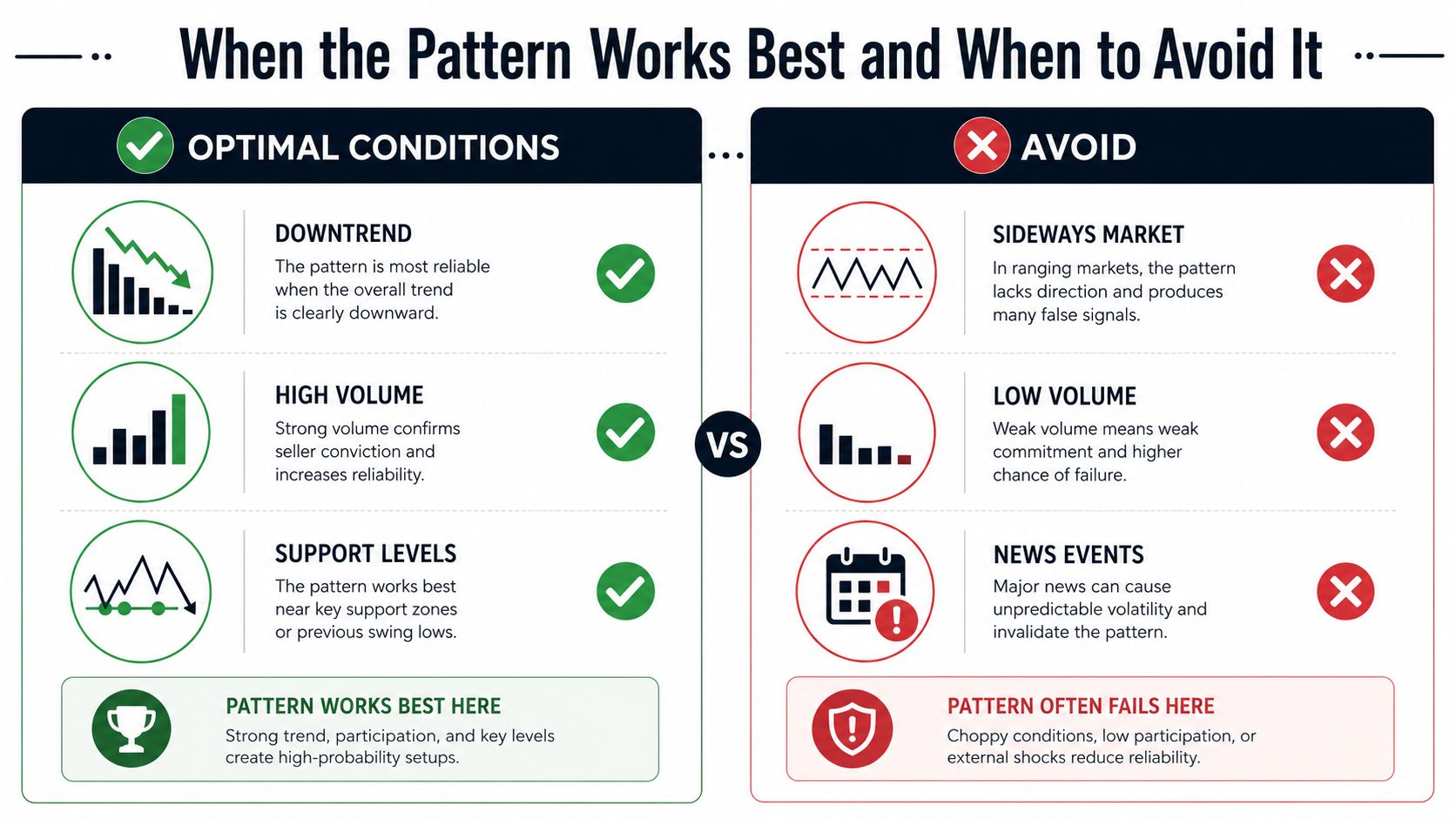
At the bottom of a downtrend, near support
This is the ideal context. An extended decline means there was real selling pressure to exhaust. Support is where buyers were expected to return, and it gives the formation a tradeable explanation rather than a shape to admire.
Several of crypto's major bottoms, including BTC in Q4 2022 and the ETH bear market lows, printed morning stars on weekly or monthly charts at major support.
On daily and weekly charts
A morning star on the daily chart represents three days of market action. The hesitation is a genuine 24-hour indecision period, and the third candle's recovery spans a full day of buying. On the 1-hour chart it represents three hours, and it means proportionally less.
Mid-trend, after a short pullback
A morning star forming after a brief pullback within an uptrend signals continuation rather than reversal. The pullback is over and buyers are resuming control, which makes it a clean re-entry.
When to stand aside
Sideways chop, or a third candle that barely clears the midpoint. Each removes the thing the pattern is supposed to be measuring.
Confirmation That Separates Real Signals From Noise
The third candle is the confirmation, but confirmation should not stop at colour and body size.
Compare participation across all three candles. The star usually shows lower volume as downside momentum fades. The third candle should expand on above-average volume, showing fresh demand. Some guides use roughly 1.5 times the prior average volume on the reversal candle as a threshold (Phemex). Treat that as a filter to test, not a law, since volume behaviour varies by exchange and by timeframe.
That filter is worth testing because it moves the number. In the 312-occurrence crypto backtest, adding a breakout-day volume filter improved the 68.3% baseline by roughly nine points, to about 77% in that sample.
Build the rest in layers. Avoid stacking five indicators that measure the same momentum condition, because that is one reason to trade, not five. The best indicators for crypto trading is a reasonable starting point for choosing ones that disagree with each other.
Plan for a retest, too. That same review reported a 97% retest rate of the entry level after confirmation, so entering at the third candle's close is not the only option. A retest can offer better placement, though waiting always carries the risk that price does not come back.
How to Trade It
Entry: the close of the third candle, or the open of the candle after it. A retest of the entry level is common enough to be worth waiting for.
Stop loss: below the low of the star, or the pattern low if the star is the lowest point. A close below that low means the reversal has failed.
Take profit: previous resistance or the prior swing high for a conservative target; a measured move equal to the pattern's height for an aggressive one.
Volume: the third candle should carry equal or higher volume than the first. A third candle on thin volume is a recovery without conviction.
Timeframe: match it to your holding period. A daily morning star is a multi-day to multi-week trade; a 4-hour one is a multi-hour to multi-day trade.
Screening is what makes this practical. Scan for the shape, then layer support and volume filters on top so you only review candidates that still match the larger structure, and test the whole thing before risking anything. This guide to backtesting trading strategies covers how to do that without fooling yourself.
Live Morning Star Scanner
Open full screen ↗Switch timeframes (1H · 4H · 1D · 1W) to see which coins are showing this pattern right now.
GeckoScreener Team
Written for the GeckoScreener community. Join us on Telegram →
Related Articles
Start screening cryptocurrencies for free
Apply strategies like this one in real-time across 250+ coins.
Try GeckoScreener →