What Is a Crypto Screener? The Complete 2026 Guide
A crypto screener filters thousands of altcoins by indicators, patterns, and volume in real time. Learn how screeners work, what to look for, and how to build your first scan free.
GeckoScreener Team
Apr 1, 2026 · 13 min read
Updated about 1 month ago
Every day, more than 5,000 altcoins trade across crypto markets. You have one monitor, one brain, and 24 hours. By the time you finish manually checking your fourth chart, the opportunity on your ninth has already moved.
That's not a skill problem. That's a volume problem.
The traders consistently catching early moves aren't smarter or faster. They've automated the scanning part — so their attention goes to the setups that already meet their criteria, not the hunt itself.
A crypto screener is the tool that does the hunting for you. This guide covers exactly what a screener is, how it works under the hood, what separates a good one from a mediocre one, and how to build your first live scan — free, in under five minutes.
What You'll Learn
- What a crypto screener is: A tool that scans hundreds of cryptocurrencies simultaneously and filters them by technical indicators, candlestick patterns, and volume criteria you define.
- Why screeners matter in 2026: Manual chart analysis at scale is impossible. Screeners turn 5,000 assets into a shortlist of 5–15 that match your exact trading criteria.
- How they work: Screeners pull real-time price and volume data, apply your conditions (e.g., RSI < 30 + volume spike), and surface only the coins that pass every filter.
- What to look for: Indicator breadth, alert speed, backtesting capability, and a community library of proven strategies.
- How to start: GeckoScreener's builder lets you create and run your first scan without an account, in under 60 seconds.
What Is a Crypto Screener?
A crypto screener is a tool that scans a large universe of cryptocurrencies in real time and filters the results based on technical conditions you specify — indicators like RSI or MACD, candlestick patterns like hammer or engulfing, or volume and price thresholds. Instead of checking coins one by one, you define the rules once and let the screener surface only the assets that match.
Think of it as a search engine for trading setups. You don't browse — you query.
The screener continuously monitors price action, volume, and technical signals across every coin in its database. When a coin meets all your conditions simultaneously, it surfaces in your results. You review candidates instead of hunting for them.
This shift — from browsing to querying — is why professional traders and quant funds have used screeners for decades in equities. Crypto caught up late, but the mechanics are identical: define your edge, automate the scan, trade the signal.
Why Crypto Traders Need Screeners in 2026
The Manual Scanning Problem
In equity markets, a serious trader might monitor 100–300 stocks. In crypto, the tradable universe on Binance alone exceeds 400 spot pairs. Add other exchanges and small-cap altcoins and you're looking at 3,000–8,000 assets, each with its own 1H, 4H, daily, and weekly chart.
Manual scanning at that scale isn't slow — it's statistically impossible to do well. By the time you've visually checked 50 charts, the market has moved. Your attention is your scarcest resource. Screeners protect it.
The second problem is bias. Manual scanning has a well-documented flaw: you tend to look at coins you already know or recently heard about. Community hype, Twitter trending sections, and Telegram alpha groups all funnel attention toward the same assets. Screeners are filter-first — they surface coins purely on the criteria you set, not on social proof or recency bias.
The third problem is consistency. Human chart review is variable. Your RSI threshold today is slightly different from your RSI threshold when you're tired at 11pm. A screener applies your exact criteria without fatigue, emotion, or drift.
What Screeners Actually Track
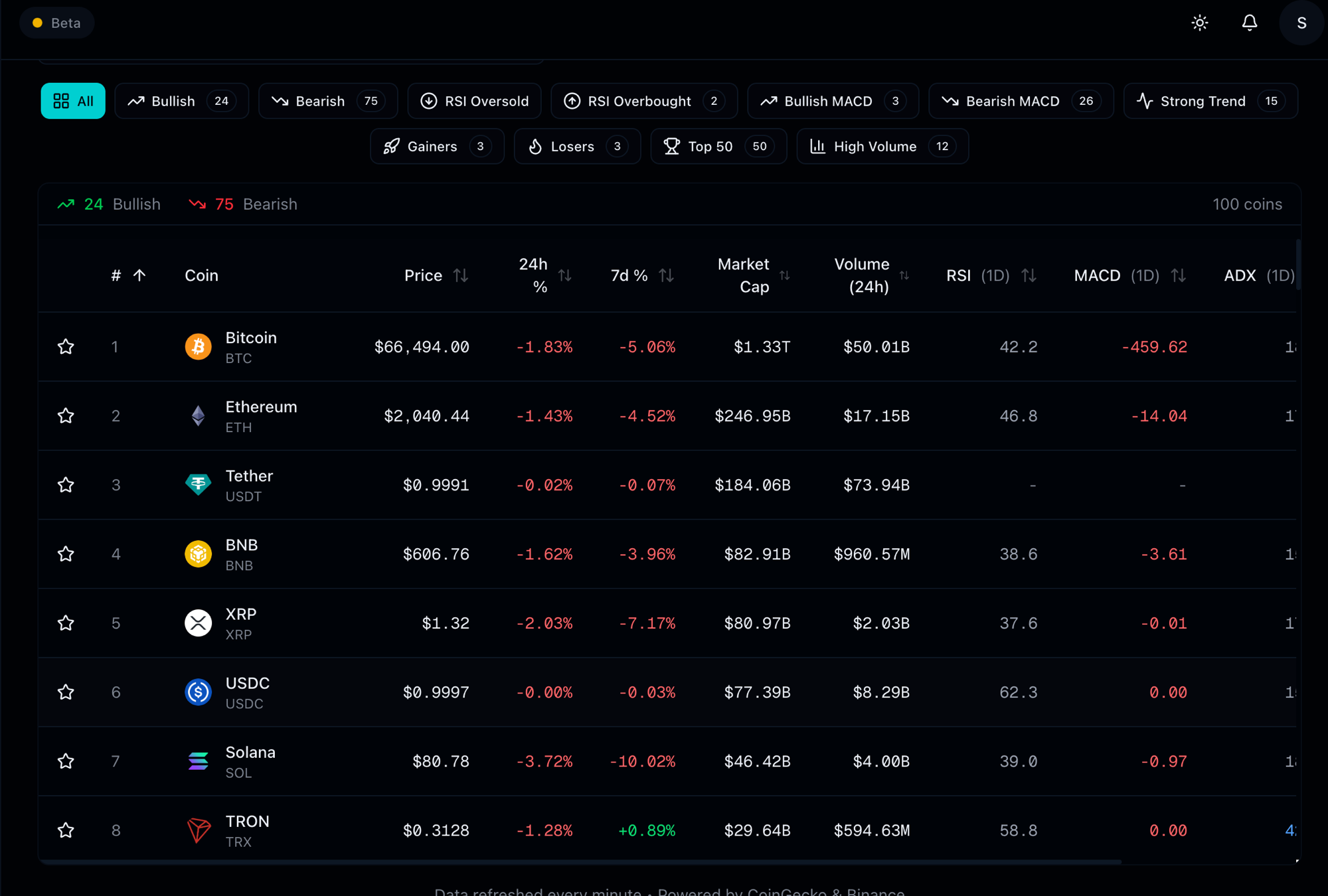
A crypto screener monitors three primary data categories:
Price action metrics: Current price, percentage change over specific periods (1H, 4H, 24H, 7D), distance from moving averages, and proximity to key levels.
Technical indicators: Calculated values derived from price and volume history — RSI (momentum), MACD (trend/momentum), ADX (trend strength), Stochastic oscillator, Bollinger Band position, EMA/SMA crossovers.
Volume signals: Raw trading volume, volume relative to 30-day average, volume spikes, and unusual activity flags.
Candlestick patterns: Recognized formations in the price bars themselves — hammers, engulfing patterns, morning stars, doji, and 15+ other multi-candle signals that indicate potential reversals or continuations.
Most screeners let you combine these across multiple timeframes simultaneously — for example: RSI oversold on the 4H and a bullish engulfing pattern on the daily and volume 150% above the 30-day average. That triple-filter might reduce 400 Binance pairs down to 2 or 3 candidates worth examining.
How Crypto Screeners Work Under the Hood
Data Sources and Refresh Rates
A screener is only as good as its data pipeline. High-quality screeners pull from multiple sources:
Exchange data (Binance, Coinbase, Bybit): Live order book and trade data, the most granular and real-time source for price and volume. This is what GeckoScreener uses for scanning logic.
Aggregator data (CoinGecko, CoinMarketCap): Cross-exchange aggregated pricing and market cap data, useful for broader market metrics like BTC dominance or market cap rank.
On-chain data (advanced screeners): Wallet activity, DEX volume, and protocol-level signals — increasingly important for DeFi tokens.
Refresh rate matters enormously. A screener updating every 60 seconds is meaningfully different from one updating every 5 minutes on a volatile day. GeckoScreener caches screener results with a 60-second TTL — fast enough to catch emerging setups, slow enough not to generate noise from micro-fluctuations.
Real-Time vs. Delayed Screening
Free tiers on most screeners introduce a data delay — typically 15 minutes. This is a deliberate upgrade incentive, but it has real consequences: a 15-minute delay on a fast-moving altcoin is often the difference between entry at support and entry at the breakout high.
GeckoScreener's free tier includes a 15-minute delay on alerts specifically — but the screener builder itself runs on live data, so you can scan manually in real time without a subscription. Real-time push notifications (Telegram, webhooks) require a Pro subscription.
From Raw Data to Screener Results
When you run a scan, here's what happens in sequence:
- The screener fetches current OHLCV (open, high, low, close, volume) data for every coin in its universe
- It calculates the indicator values you've specified (RSI, MACD, etc.) for the selected timeframe(s)
- It evaluates each coin against every condition in your filter — all conditions must pass (AND logic)
- Coins passing all conditions appear in your results, ranked by a signal strength or recency metric
- If you've set up alerts, passing coins trigger a notification via your configured channel
The entire process takes seconds. A universe of 400 coins with 5 conditions resolves in under 3 seconds on a properly optimized screener.
What to Look for in a Crypto Screener
Not all screeners are built equally. These are the criteria worth evaluating before committing to a platform.
Indicator and Pattern Coverage
The wider the indicator library, the more trading styles the screener supports. A screener with only RSI and MACD is functional for momentum traders but useless for candlestick pattern traders. Comprehensive coverage includes:
- Momentum indicators: RSI, Stochastic, Williams %R
- Trend indicators: MACD, ADX, EMA/SMA (multiple periods), Supertrend
- Volatility indicators: Bollinger Bands, ATR, Keltner Channels
- Volume indicators: OBV, volume relative to average
- Candlestick patterns: Minimum 10–15 recognized patterns
GeckoScreener covers 19 candlestick patterns and 11+ technical indicators across 4 timeframes — one of the widest free-tier libraries available.
Speed and Data Freshness
As discussed above: look for screeners that are explicit about their data refresh rate. "Real-time" is often marketing language for "30-second cache." Ask or test it directly by watching a fast-moving pair during high-volatility hours.
Alert Capabilities
A screener without alerts requires you to keep it open and watch. Useful for manual sessions, but it misses the core value proposition: automated monitoring.
Look for:
- Telegram alerts: Best for mobile and group sharing
- Email alerts: For lower-frequency, non-time-sensitive signals
- Webhook support: For connecting to custom bots, Discord, or trading automations
🚧 Coming Soon on GeckoScreener — Telegram, Discord, and webhook alerts are in development and will be available soon.
Backtesting Capability
A filter is a hypothesis. Backtesting is how you test whether the hypothesis had merit historically.
A screener with built-in backtesting lets you run your exact conditions against months of historical data to see how the strategy would have performed. Without it, you're trading a theory. With it, you're trading a validated framework (with appropriate caveats about past performance).
Look for screeners that support:
- Multi-coin backtesting (not just single-coin)
- Portfolio mode (shared capital, realistic position sizing)
- Configurable time ranges (1 week to 12+ months)
- Equity curve visualization and trade log
🚧 Coming Soon on GeckoScreener — The backtesting engine is in development. Once live, it will support multi-coin backtests across Top 10/25/50/100 coins with portfolio mode and an equity curve.
Community Strategy Library
If you're building from scratch, you're starting from zero. A community library lets you browse, copy, and adapt strategies that other traders have built and validated.
This is particularly valuable for beginners — rather than guessing which indicator combinations work, you can look at what the community's most-liked and most-used strategies look like, and run them yourself before customizing.
GeckoScreener: A Walkthrough
GeckoScreener was built specifically to solve the problems above. Here's what using it actually looks like.
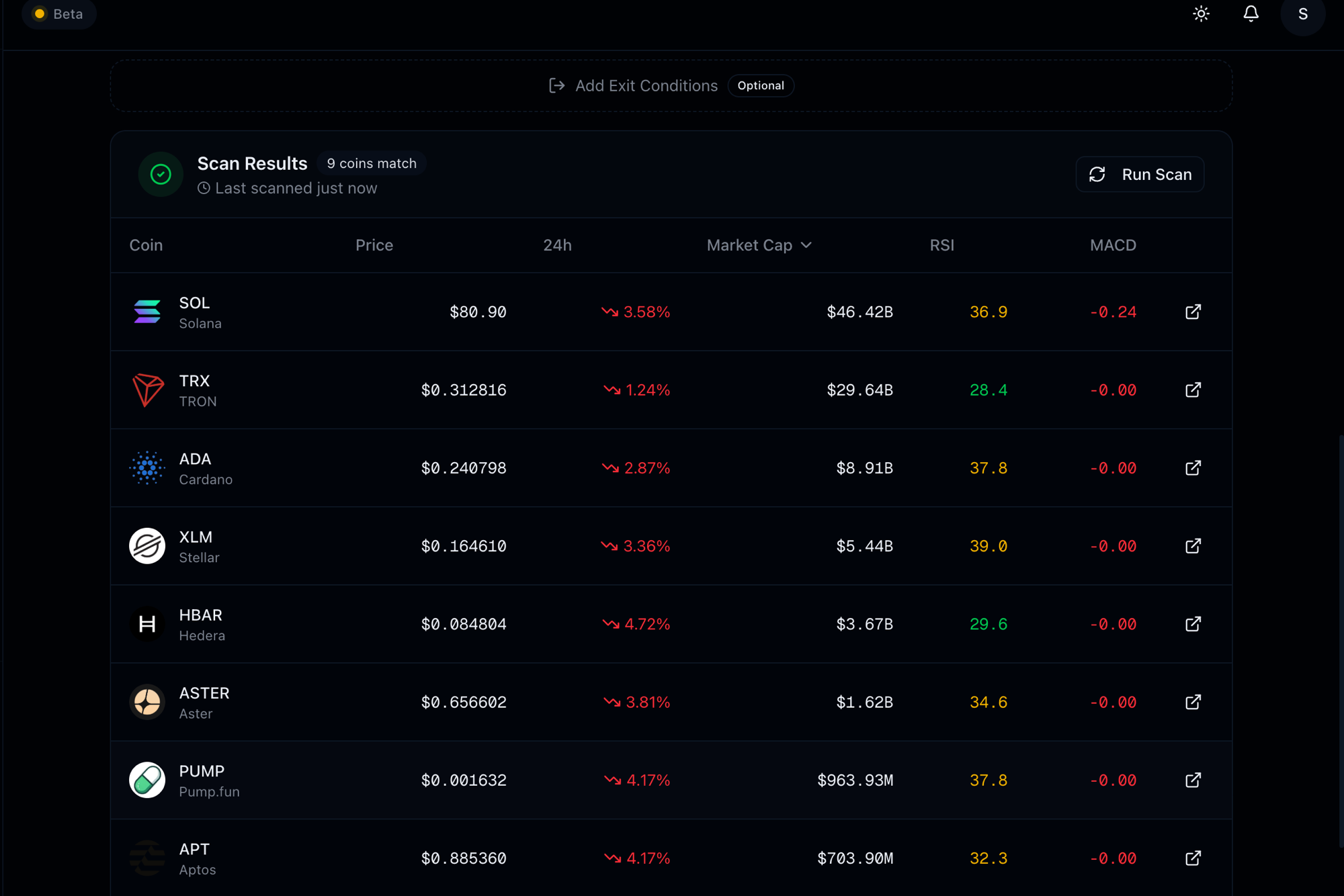
The screener builder is a visual condition editor. You add conditions one at a time — choose an indicator, set a threshold and comparison operator, choose a timeframe — then combine them into a multi-condition filter. No coding required.
Example setup — a simple momentum + volume breakout filter:
Condition 1: RSI (14, 4H) is below 35
Condition 2: Volume (24H) is above 150% of 30-day average
Condition 3: Price is above EMA (20, Daily)
That filter, run against all Binance pairs, might return 4–8 candidates on a given day. Each one is oversold on the 4-hour timeframe, showing unusual volume activity, and above its daily trend line — a combination consistent with an emerging reversal setup.
The community library lists the most-liked and most-used public strategies. You can apply any of them to your screener in one click or copy them as a starting point.
The backtest engine (coming soon) — will let you run those same conditions against Top 10, Top 25, Top 50, or Top 100 coins by market cap, over periods from 1 week to 9 months. Results will include an equity curve, per-trade breakdown, win rate, and average return.
Alerts (coming soon) — will notify you on Telegram or your configured channel the moment a coin passes all your screener conditions, with the coin name, signal, price, and a link to the chart.
Common Screener Mistakes to Avoid
Over-Filtering Your Results
Adding more conditions feels rigorous. In practice, adding 8–10 conditions usually means your screener returns zero results because no coin satisfies every constraint simultaneously. Start with 2–3 high-signal conditions and only add a fourth when you have clear logic for why it improves results.
Ignoring Volume as a Confirmation Layer
Price signals without volume confirmation are unreliable. A hammer candle on RSI < 30 is interesting. That same setup with 3× normal volume is significantly more meaningful. Volume is the market's conviction signal. Always include at least one volume condition.
Treating Backtest Results as Guarantees
Backtesting tells you how a strategy would have performed if you'd traded it historically. It does not tell you how it will perform going forward. Markets evolve, conditions change, and crypto is subject to regime shifts (bear/bull cycles, regulatory events) that no backtest can predict. Use backtesting to eliminate obviously bad strategies, not to guarantee future performance.
Changing Filters Too Frequently
If your screener returns zero results on a quiet day, the instinct is to loosen the conditions. Resist it. A well-designed screener should sometimes return nothing — that's the filter working correctly. Changing conditions after every dry spell trains the screener to fit noise rather than signal.
Frequently Asked Questions
What is a crypto screener used for? A crypto screener is used to automatically scan a large universe of cryptocurrencies and filter them based on technical criteria you set — such as RSI levels, candlestick patterns, or volume thresholds. It replaces manual chart-by-chart analysis and surfaces only the coins meeting your exact trading conditions.
Is a crypto screener free to use? Most crypto screeners offer a free tier with core scanning functionality. GeckoScreener's free tier includes the visual strategy builder, live scanning across 100+ coins, 19 candlestick patterns, 11+ indicators, the community strategy library, and backtesting with up to 3 runs per day. Real-time push alerts require the Pro tier ($19/month).
How is a crypto screener different from a crypto chart tool like TradingView? A chart tool shows you the price history of one asset at a time — you decide which asset to look at. A crypto screener inverts this: you define the conditions, and it tells you which assets currently meet them across hundreds of coins simultaneously. They're complementary — screeners find the candidates, charts provide the deeper analysis.
Can a crypto screener predict which coins will pump? No. A screener identifies coins that currently match specific technical conditions — patterns and indicators that, historically, have correlated with favorable price moves. It cannot predict the future. Every screener signal should be treated as a hypothesis requiring further analysis, not a guaranteed trade.
What indicators should a beginner use in a crypto screener? Beginners do best starting with 2–3 conditions: RSI (a momentum indicator showing overbought/oversold conditions), volume relative to average (confirming the signal), and one price reference (e.g., price above EMA 20). These three are widely understood, cover momentum and trend, and are available on every major screener.
How often should I update my screener filters? Only update filters based on new information or a deliberate strategy change — not because a specific day was quiet. Run a strategy for at least 4–6 weeks or across 20+ signals before evaluating whether it needs revision. Frequent changes to avoid dry spells are the primary cause of screener performance degradation.
Where to Go From Here
A crypto screener changes the structure of how you trade — from reactive browsing to systematic filtering. The difference compounds over time: each session you spend reviewing 5 high-quality candidates rather than 50 random charts is a session where your attention is protected and your decision-making is better.
The best way to understand this concretely is to build your first scan and watch what it surfaces over 24 hours.
Ready to start? Open the GeckoScreener builder — no account required. Build your first filter in under 5 minutes and run it against 100+ live crypto pairs.
Want to go deeper? Read our Complete GeckoScreener Guide to learn how to backtest your strategy, set up Telegram alerts, and tap into the community library of top-rated strategies.
This content is for educational purposes only and does not constitute financial advice. Cryptocurrency trading involves significant risk of loss. Past performance of any screener strategy does not guarantee future results. Always conduct your own research before making trading decisions.
GeckoScreener Team
Written for the GeckoScreener community. Join us on Telegram →
Related Articles
Start screening cryptocurrencies for free
Apply strategies like this one in real-time across 250+ coins.
Try GeckoScreener →