Crypto Clarity Act News: What Happened and What Comes Next
Crypto clarity act news: the Senate's vote on the CLARITY Act failed 49–50 on September 15. What the bill does, why it failed, and what happens next.
GeckoScreener Team
Sep 8, 2026 · 9 min read
Updated about 1 month ago

Crypto clarity act news changed on September 15. The Senate held the vote this post was waiting for, and the CLARITY Act failed it, 49 to 50. Since then the story has moved to the agencies, to the lame-duck session, and to one open question: is the bill actually dead?
In short: The Senate rejected the CLARITY Act's procedural vote 49–50 on September 15, 2026. Ethics rules broke the deal. A lame-duck retry is possible, with no date announced, and the SEC and CFTC are moving without Congress.
That's the headline. Below is what the bill does, why this vote failed, and what changes for you now.
Table of contents
- What the CLARITY Act actually does
- Crypto clarity act news: what happened on September 15
- What passing would have changed
- What happens now that it failed
- So what should you actually do with this?
What the CLARITY Act actually does
Its full name is the Digital Asset Market Clarity Act, also filed as H.R. 3633. Strip away the procedural noise and it's solving one specific problem: for over a decade, the SEC and the CFTC have both claimed authority over crypto, and neither claim was ever settled by Congress. The SEC treated most tokens as unregistered securities, while the CFTC treated Bitcoin and Ether as commodities. Companies were left guessing which rulebook applied to them, and a lot of them guessed by leaving the US instead.
If crypto currency itself is still a fuzzy concept, what it actually is and how it got here is worth reading before the regulatory detail below.
The bill sorts digital assets into three buckets. Digital commodities are tokens whose value comes from a working blockchain network rather than a company's promises, and these move to CFTC oversight. Investment contract assets are tokens sold to raise money the way a security is sold, so the SEC keeps authority over the fundraising itself. Permitted payment stablecoins are currency-pegged tokens, regulated separately, with both agencies keeping anti-fraud power over their own patch.
The Clarity Act, Explained (ft. Miles Jennings) · a16z crypto · Watch on YouTube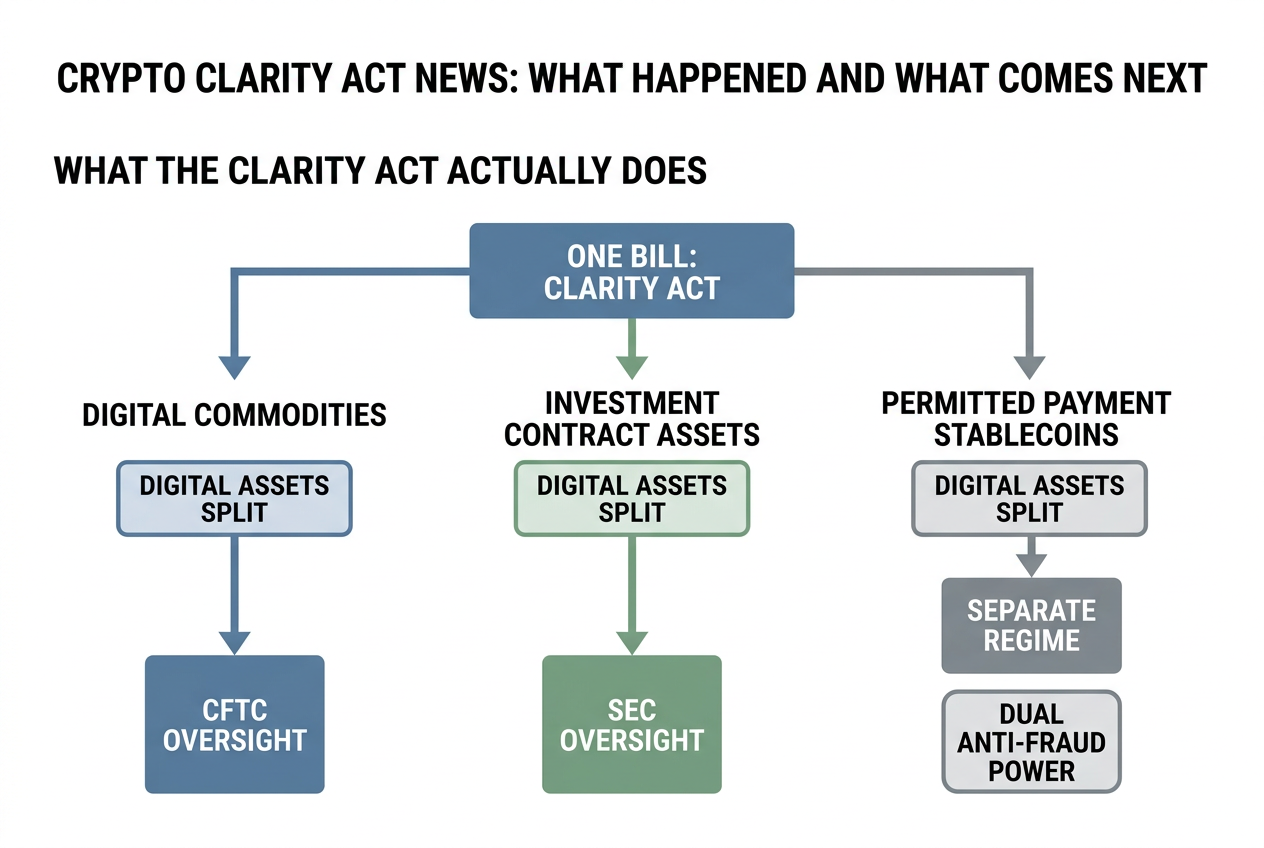
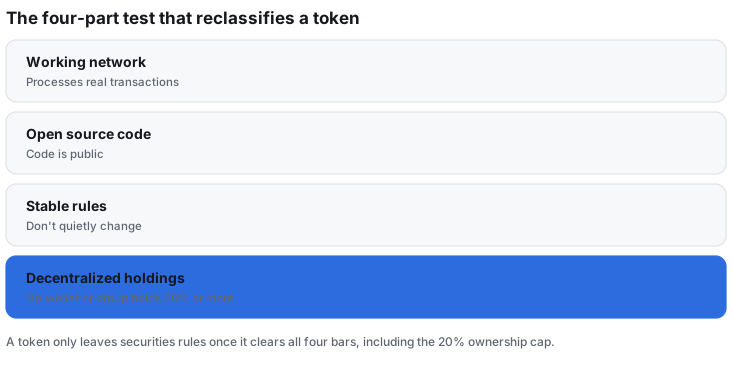
What's worth understanding, because it's the part that will actually move token prices if this passes, is the maturity test. A network only qualifies as a digital commodity once it meets four conditions. It works and processes transactions. Its code is open source. It runs on rules that don't quietly change. And no single wallet or coordinated group holds 20% or more of the tokens. Clear that bar, and a project's insiders can sell holdings without the SEC treating every sale as an unregistered securities offering. Miss it, and the token stays under securities rules indefinitely.
Crypto clarity act news: what happened on September 15
The bill isn't new. It passed the House back on July 17, 2025, by a wide bipartisan 294–134 vote. The Senate was always the hard part.
If you'd rather catch the next shift as it breaks instead of waiting for a weekly wrap-up, these are the crypto news platforms worth actually watching.
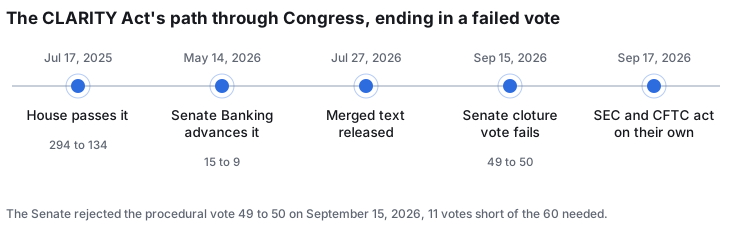
Senate Banking advanced its own version on May 14, 2026, in a 15–9 vote. All 13 Republicans on the committee voted yes, and only two Democrats, Ruben Gallego and Angela Alsobrooks, joined them. That was already a warning sign about the floor, because a full Senate needs 60 votes to move anything past a filibuster, and Republicans hold 53 seats.
On July 27, 2026, Senate leadership released a merged version combining the Banking and Agriculture Committee texts, with a new government ethics title added after negotiation with the White House. Majority Leader John Thune filed cloture on the motion to proceed on August 8.
Then came the vote. On Tuesday, September 15, the Senate voted on cloture on the motion to proceed to H.R. 3633. It was not invoked, 49 to 50, eleven short of the 60 needed. Every Democrat who voted, including Gallego and Alsobrooks, voted no. Republicans Susan Collins, Josh Hawley and Jerry Moran voted no as well. Sen. Thom Tillis also voted no, but procedurally, so he could file a motion to reconsider.
Practical rule: A cloture vote isn't the bill becoming law, and a failed one isn't the bill being repealed. It decides whether Congress is even allowed to keep arguing about it. Headlines tend to flatten that.
Three fights were still unresolved going into the vote.
| Sticking point | Republicans wanted | Democrats wanted |
|---|---|---|
| Government ethics | A narrower rule, expiring January 2029 | A permanent bar on officials owning crypto businesses |
| DeFi developer liability | An exemption for open-source developers | Law enforcement warns it's a compliance-free lane for laundering |
| Stablecoin yield | Letting exchanges pay yield on stablecoin balances | Banks worry it pulls deposits toward exchanges |
Republicans needed at least 10 Democrats to cross over. None did. The ethics fight is what broke it: CoinDesk reported that the final sections meant to curtail senior officials' crypto business ties "turned out to feature insurmountable rifts."
Crypto markets took it badly. By that evening, CoinDesk's live coverage had Bitcoin near $75,850, down 4.2% over 24 hours, and Ether down 3.9% to $2,407. Crypto-related stocks fell too. Those are September 15 figures. They move by the minute.
What passing would have changed
The bill hasn't been repealed, and a revival isn't ruled out, so it's still worth knowing what it would do.
For an exchange or a token issuer, passage would have meant an actual rulebook instead of a decade of enforcement actions used as case law. Digital commodity exchanges and broker-dealers would need to register with the CFTC, segregate customer funds, use qualified custodians, and meet trade-surveillance and capital standards that don't exist in statute yet. Issuers would get a new exemption to raise up to $75 million a year with defined disclosure requirements, instead of guessing whether an SEC lawyer will later call the raise an unregistered offering.
For a trader, the more interesting effect sits downstream of the maturity test. Tokens that clear the four-part bar would move out from under securities rules and into a regime built for commodities. That's a real classification shift, not a cosmetic one. It changes which platforms can legally list a token. That kind of shift usually shows up first as a listing announcement or a sudden move in trading volume, well before any headline explains why.
There's a trade-off buried in that shift, too. Historically, the CFTC regulated derivatives and futures markets, not retail spot trading. Handing it spot-market oversight for the first time is new territory for the agency. Critics on the investor-protection side have said so plainly.
What happens now that it failed
Two things are open at once: whether Congress tries again, and what the agencies do meanwhile.
Is the bill dead? Depends who you ask. Sen. Cynthia Lummis said, "I think we're done. It's over." Sen. John Kennedy said a renewed attempt may have to wait for the lame-duck session, the weeks after the November 3 election. Sen. Ted Cruz put it as "a big difference between dead and mostly dead." Tillis's motion to reconsider is on file, but no timeline for a retry has been reported. Treat all of that as positions, not forecasts.
The agencies aren't waiting. On September 16, SEC Chairman Paul Atkins said, "with or without legislation, we will act decisively within the SEC's statutory authority to deliver certainty for American investors." CFTC Chair Michael Selig said the agency is "locked in and ready to ship its rules". Then came action.
- On September 17, the SEC issued an "Innovation Exemption" for trading tokenized stock onchain. It runs for five years.
- The same day, CFTC staff issued a no-action position for providers of passive trading software, so they don't have to register as introducing brokers.
- The Block reported that by September 18 the CFTC had filed a crypto asset rulemaking with the White House's Office of Information and Regulatory Affairs. The agency declined to comment on details.
- The SEC's Regulation Crypto Assets proposal, made on August 18, is still open for comment until October 20, 2026. It includes an offering exemption of up to $75 million per 12 months, the same headline figure the bill had.
That's regulation by whichever agency gets there first. It's the exact patchwork the bill was written to end, and it lacks the legal permanence a statute provides. A future administration, or a future lawsuit, can unwind an agency framework in a way it can't unwind an act of Congress.
So what should you actually do with this?
None of this is a reason to trade the headline. The vote is over, and it didn't tell you which specific tokens clear the maturity test, or when. Bills get brought back after a first failure. Agencies can also change course.
Separately from all of it, it's the GENIUS Act's stablecoin framework that already governs whether you can pay with crypto using a dollar-pegged token today.
What's worth watching is simple. A reconsider vote or a lame-duck attempt, if one is ever scheduled. The SEC comment deadline on October 20. The CFTC's rules as they appear. Know which bucket the assets you hold or watch would likely fall into, the same way you'd want to know before any crypto investment. Keep an eye on volume and listing news around majors, since that's usually where a classification shift shows up first, long before it gets written up. If you're already running your watchlist through one of the crypto market analysis tools built for that job, that's the same workflow you'd use to notice it. Nothing about this changes how you'd look for the signal, only what the signal might mean once it appears.
Here's the honest summary of where things stand on September 21, 2026: the Senate rejected the CLARITY Act 49 to 50, a motion to reconsider is on file with no retry timeline reported, and the agencies are moving without it. Read anything claiming certainty about the next step with that in mind.
GeckoScreener Team
Written for the GeckoScreener community. Join us on Telegram →
Related Articles



Start screening cryptocurrencies for free
Apply strategies like this one in real-time across 250+ coins.
Try GeckoScreener →