Crypto Investment: How to Actually Buy and Hold
Crypto investment just means buying and holding. Here's how much to put in, where it should sit, and how to make the first buy without the usual mistakes.
GeckoScreener Team
Sep 3, 2026 · 9 min read
Updated about 2 months ago

Crypto investment means one specific thing: buying a coin and planning to hold it, not reacting to the next candle. That sounds obvious until you try it. The exchange app wants you to trade. The price ticks every few seconds. And the coin you spent a week researching can drop 8% before your ID verification even clears.
In short: crypto investment is buying and holding, not trading, and the mechanics matter more than picking the right coin. Most professional allocators who touch crypto at all keep it small: BlackRock suggests 1-2% of a portfolio, Fidelity around 2%, Morgan Stanley 2-4%. Custody is the part beginners skip, and shouldn't. Exchange hacks and collapses have cost holders over $4 billion since 2011. That includes the $1.5 billion Bybit theft in February 2025 and the roughly $8 billion FTX customers were short in 2022. Buying in one go beats spreading it out, in most rising markets. But spreading it out, dollar-cost averaging, cuts how bad your worst month can get. None of this tells you whether a coin is worth holding. It just keeps you from losing money to your own process before that question even comes up.
What counts as crypto investment, and what's just trading
Trading and investing use the same app and the same coins, so it's easy to blur them, but the questions they answer are different. A trade asks "is this a good moment to be in or out of this position." An investment asks "is this worth holding regardless of this week's price." Leverage trading and a tested entry strategy both live on the trading side. Crypto investment is the other one: you buy, you hold, and the daily chart stops being the thing you check every hour.
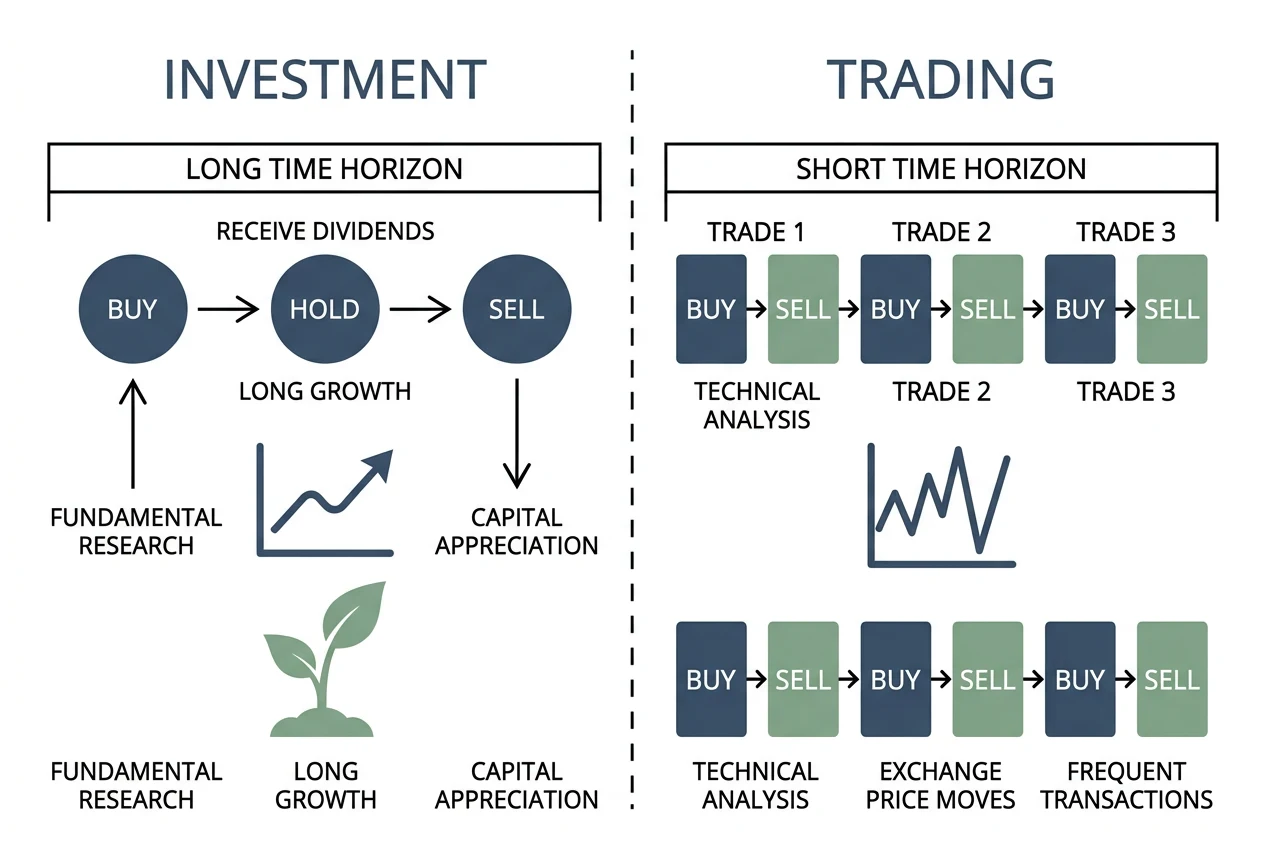
That's the whole split.
Most of what goes wrong for a beginner isn't picking the wrong coin. It's treating an investment like a trade. Checking the price hourly. Panic-selling on a normal 15% pullback that Bitcoin has had dozens of times. Leaving the coins sitting somewhere they were never supposed to sit long-term. Fix that first. The rest of this post is about getting the mechanics of investing right, so the coin you picked actually gets a fair test.
How much to actually put in
There's no single right number, but there's a real range, and it's smaller than the hype suggests. Fidelity's own guidance sits around 2%. BlackRock has floated 1-2% within a standard 60/40 stock-and-bond portfolio. Morgan Stanley's range runs from 2% in a balanced portfolio up to 4% in an aggressive one. Grayscale and VanEck, both of which sell crypto products, land higher, at roughly 5% and 6%.
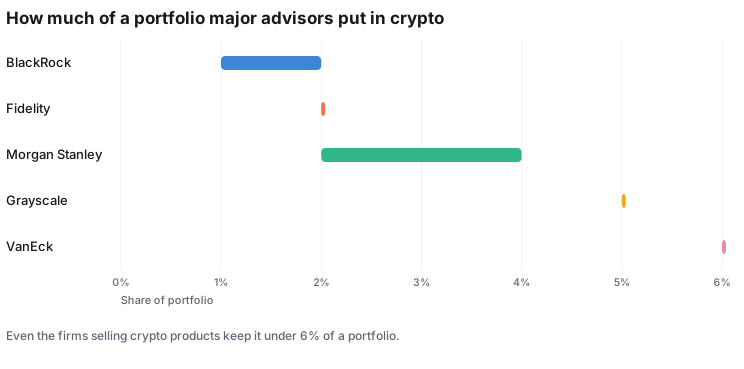
One outlier is worth naming: financial advisor Ric Edelman argues for 10-40%, on the logic that longer life expectancies mean investors need more long-term growth than a 60/40 portfolio delivers. That's a real position, held by a licensed advisor, not a fringe opinion, but it sits well outside where the large asset managers land. A separate piece of research found that a 5% Bitcoin allocation, rebalanced monthly, added about 1.7 percentage points of annual return to a 60/40 portfolio from January 2018 to May 2026, while also reducing the portfolio's overall volatility.
📌 Practical rule: treat crypto as the part of your portfolio you could watch go to zero without changing your rent payment. That's not pessimism. It's the number that lets you actually hold through a real drawdown instead of selling at the bottom of one.
Where the coins actually live: custody
This is the part beginners skip past to get to the buying, and it's the part that has cost people the most money. When you buy on an exchange and leave the coins there, the exchange holds the private keys, not you. That's custodial. A hardware wallet or another form of self-custody means you hold the keys yourself.
Custodial is simpler and it's where almost everyone starts. It is also where almost every large crypto loss in history happened. FTX collapsed in November 2022 with customers short roughly $8 billion, across around 130 affiliated entities that filed for bankruptcy. In February 2025, the exchange Bybit was hacked for about $1.5 billion in ether, the largest single crypto theft on record, attributed to a North Korea-linked group. Across roughly 60 documented exchange hacks since 2011, total losses run in the $4 to 5 billion range.
Read those numbers twice.
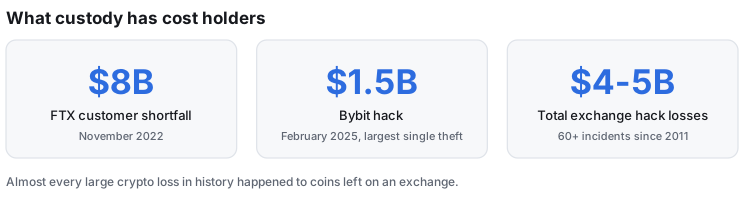
None of that means exchanges are unsafe to use for buying. It means leaving a large, long-term crypto investment sitting on one is a choice with a real, documented failure rate, not a theoretical one. For a small first buy, custodial is fine while you learn the basics. Past a certain size, moving it to a wallet you control is the boring, unglamorous step that has actually protected people.
How to Self-Custody Crypto (Ethereum-Based Tokens) in a Ledger, MetaMask, or Trezor Wallet · Chainlink · Watch on YouTubeOpening the account and making the first buy
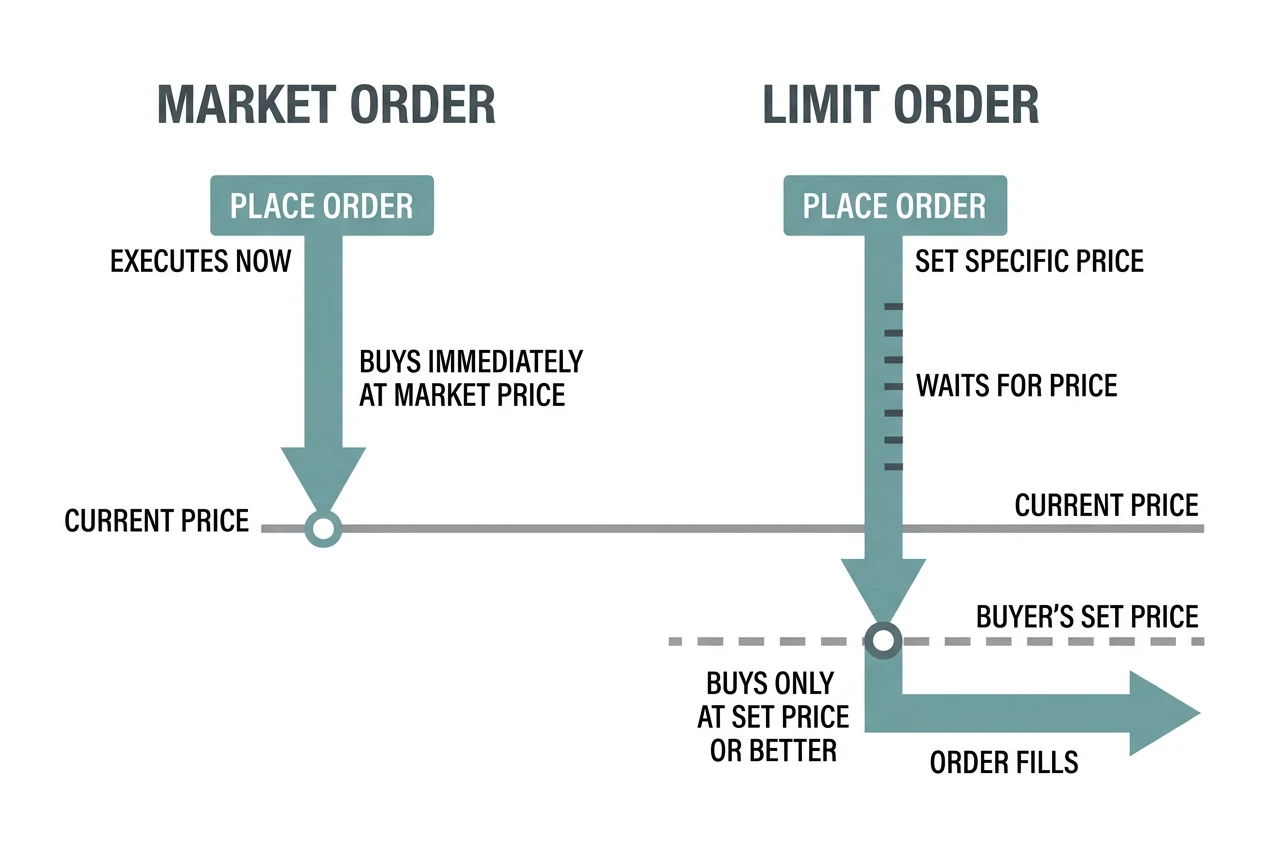
Every regulated exchange asks for identity verification before you can buy, usually a photo ID and sometimes a selfie. They need to know who's trading on their platform. That step can take minutes, or a couple of days. Fund the account, and you're choosing between two kinds of order. A market order buys immediately at whatever the current price is. A limit order only fills at a price you set. For a first crypto investment, a market order is the simpler choice. The full breakdown of order types is worth reading before you're placing a larger one.
Two-factor authentication isn't optional. It's the single cheapest thing you can do to stop someone else from moving your coins if your password ever leaks, and it takes about two minutes to set up.
Timing it: all at once, or a bit every week
Once the account and the security are sorted, the question becomes when to actually buy. The two options are lump sum, putting the whole amount in at once, and dollar-cost averaging, splitting it into smaller purchases on a fixed schedule.
The data has a genuine answer, and it's less tidy than either side of that argument likes to admit. Lump sum has beaten dollar-cost averaging over most four-year stretches since 2014, because crypto has spent most of that time trending up, and getting your money in earlier means it has longer to grow. But dollar-cost averaging does something lump sum doesn't: it lowers your worst-case drawdown, because you're never fully exposed to a crash that happens to land right after you bought. In one stretch from April 2021 to March 2025, splitting the purchases into smaller ones actually outgrew a once-a-year lump sum, at +154% against +106% on the same total money in.

Neither is wrong. Lump sum is the better bet if you're confident you won't panic and pull out early. Dollar-cost averaging is the better bet if you know you would, because the smaller drawdowns make it easier to actually stay in.
What crypto investment doesn't protect you from
Buying and holding is a strategy for how you enter and where the coins sit. It does nothing to change how far the price can fall while you're holding it. Bitcoin's worst drawdowns, measured from peak to trough, were 93% in 2011, 86% in 2015, 84% in 2018 (a fall from $19,783 to $3,122 that took fourteen months) and 77.5% in 2022 (from $68,789 down to $15,476, following the Terra/Luna collapse, the FTX implosion, and the fastest Fed rate hikes in decades).
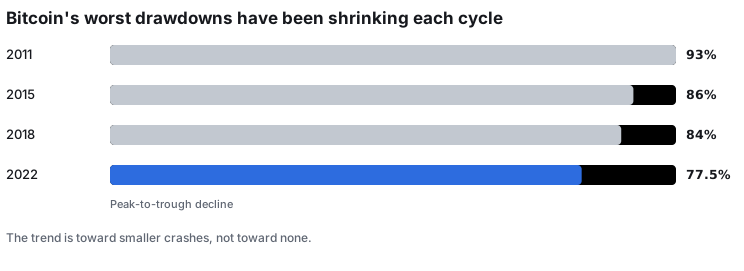
The trend is toward smaller crashes as the market matures, not toward none. Anyone telling you crypto investment is safe once you're "in for the long term" is skipping that a 77% drawdown, applied to real money, is still real money. Size the position using the rule above, and this stops being a reason to sell at the bottom and starts being a number you already planned for.
One more thing that isn't optional: in the US, the IRS has treated crypto as property since 2014's Notice 2014-21, which means selling, swapping, or spending it is a taxable event, not just cashing out to a bank account. Rules vary by country. Check yours before you sell, not after.
Once you're holding something
Buying and holding doesn't mean never looking again. It means the checking stops being reactive. That's where a screening tool like GeckoScreener fits, not for placing the buy itself, but for watching what you already hold: real-time screening across 100+ coins, refreshed every 60 seconds, with pattern detection built in, so a real move in something you own shows up without you needing to stare at a chart to catch it. If you want to understand what those patterns and indicators are actually telling you once you're watching, the five ways of analysing a coin is the next read, and it covers the layer, fundamentals, that decides whether something's worth holding in the first place, separately from the chart.
The mechanics in this post don't tell you which coin to buy. They tell you how to make sure the coin gets a fair test: sized so a bad month doesn't wreck you, held somewhere with a real security track record, bought in a way that matches how you actually behave under pressure. Get those right first. The rest is the part everyone wants to skip straight to.
GeckoScreener Team
Written for the GeckoScreener community. Join us on Telegram →
Related Articles

Start screening cryptocurrencies for free
Apply strategies like this one in real-time across 250+ coins.
Try GeckoScreener →