The 7 Best Crypto Trading Platforms for 2026
Find the best crypto trading platforms for your strategy. We compare 7 top exchanges on fees, features, charts, and security to help you trade smarter in 2026.
GeckoScreener Team
Jul 27, 2026 · 16 min read
Updated about 1 month ago

You're probably staring at three tabs right now, one exchange for the coin list, one charting app for signals, and one spreadsheet or notes app trying to keep the whole plan from falling apart. That's the core problem with picking among the best crypto trading platforms, the platform itself is only part of the workflow, and the gap between discovery and execution is where trades usually get messy. The crowded market, with about 194 active cryptocurrency exchanges tracked globally as of 2026, makes that split even more obvious, because you're not choosing between two obvious names, you're choosing a full trading setup in a fragmented market (CoinLaw's 2026 exchange statistics).
The fastest way to compare platforms is to treat them as a system, not a logo. A good setup starts with screening and strategy validation, then moves into execution with the right charting, order controls, and fee structure. That's why the list below focuses on what matters most in the seat, including chart quality, data flow, jurisdiction fit, and how much friction each platform adds once you're ready to trade.
Table of Contents
- 1. GeckoScreener
- 2. Coinbase Advanced
- 3. Kraken Pro
- 3. Kraken Pro
- 4. Bitstamp Bitstamp USA
- 5. Gemini ActiveTrader
- 6. Robinhood Crypto
- 7. Interactive Brokers IBKR Crypto
- Top 7 Crypto Trading Platforms Comparison
- Your Platform Is Your Edge Making the Final Call
1. GeckoScreener
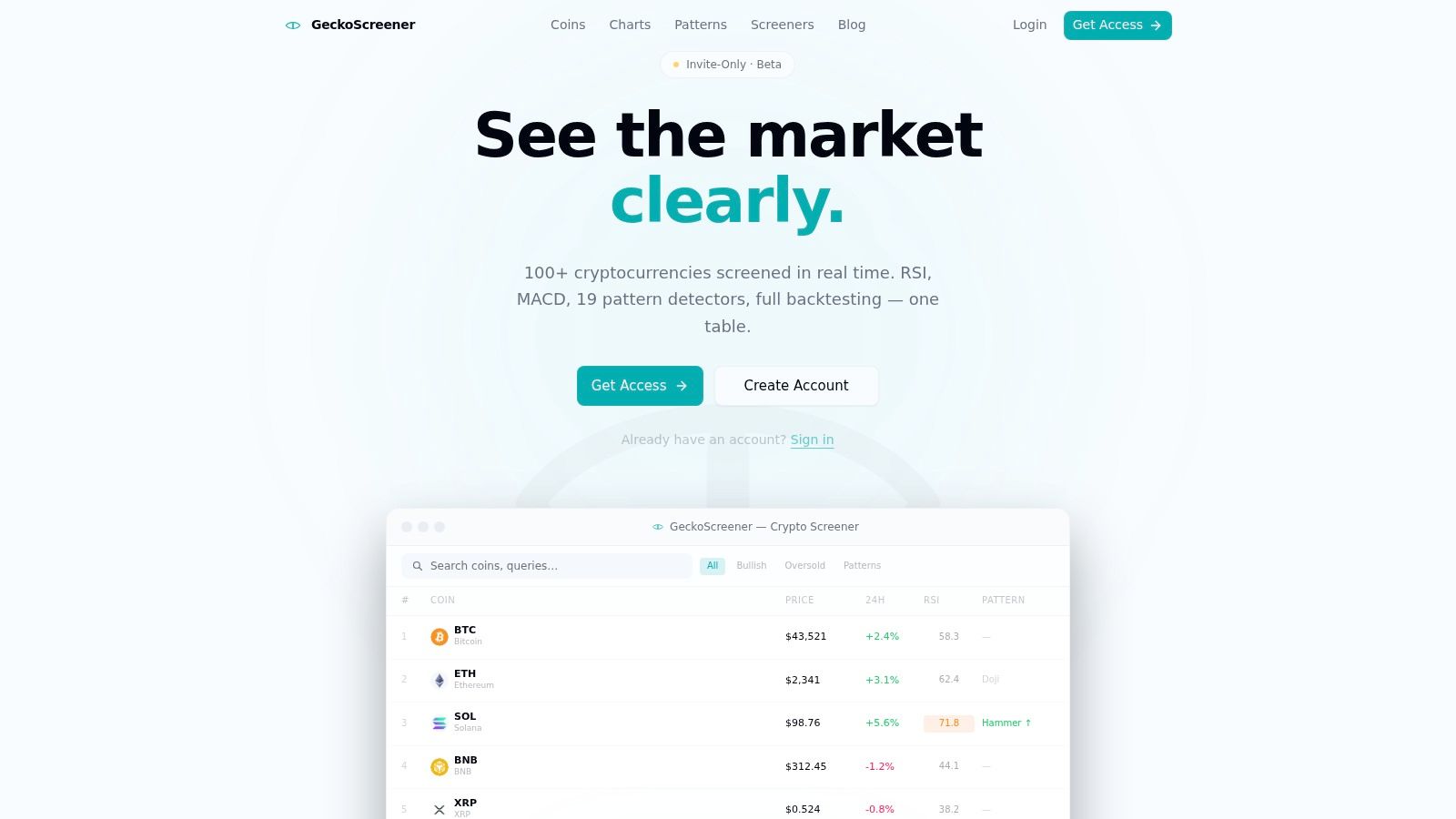
GeckoScreener belongs at the front of the workflow because it handles the part many traders waste the most time on, finding a setup worth acting on before they touch an exchange. It is a no-code screening and strategy-validation tool for crypto traders who want to turn an idea into a rule set, then test it without jumping between separate apps. The practical value is simple. Screening, rule building, and testing stay in one place, so the decision to trade starts with cleaner inputs. If you want a fuller walkthrough of how the workflow works, see the GeckoScreener complete guide.
The core issue is that a trading platform by itself does not solve discovery. GeckoScreener does that front-end work by monitoring 100+ top coins with data refreshed every 60 seconds, combining indicator filters like RSI, MACD, ADX, EMA, volume, and price action with 19 candlestick pattern detectors, and letting you express a strategy in plain language. A query like the generated example, rsi(14) < 35 AND close crossed_above ema(20) AND volume > volume[1] * 1.5 AND hammer = true, shows the appeal. It removes syntax friction and turns an idea into something you can test. For traders who build rules before they route orders, that saves time and reduces bad setups.
That matters because the choice of a crypto platform is really part of a larger system. You still need an execution venue, but GeckoScreener helps you decide which opportunities deserve attention in the first place. It also fits traders who care about chart quality and data visualization, since weak visuals slow down pattern recognition and make it harder to compare setups across coins. In practice, that means fewer random entries, cleaner watchlists, and a better handoff from analysis to execution.
Pros
- Keeps screening and strategy testing in one workflow
- Supports rule-based setup building without code
- Tracks a broad coin set with frequent data refreshes
- Uses indicator filters and candlestick pattern detection together
- Helps traders narrow the list before opening an exchange
Cons
- It is not an execution venue, so you still need an exchange for orders
- It works best for traders who already know what they want to scan for
- A strong screen still needs discipline, because good filters do not replace trade management
2. Coinbase Advanced
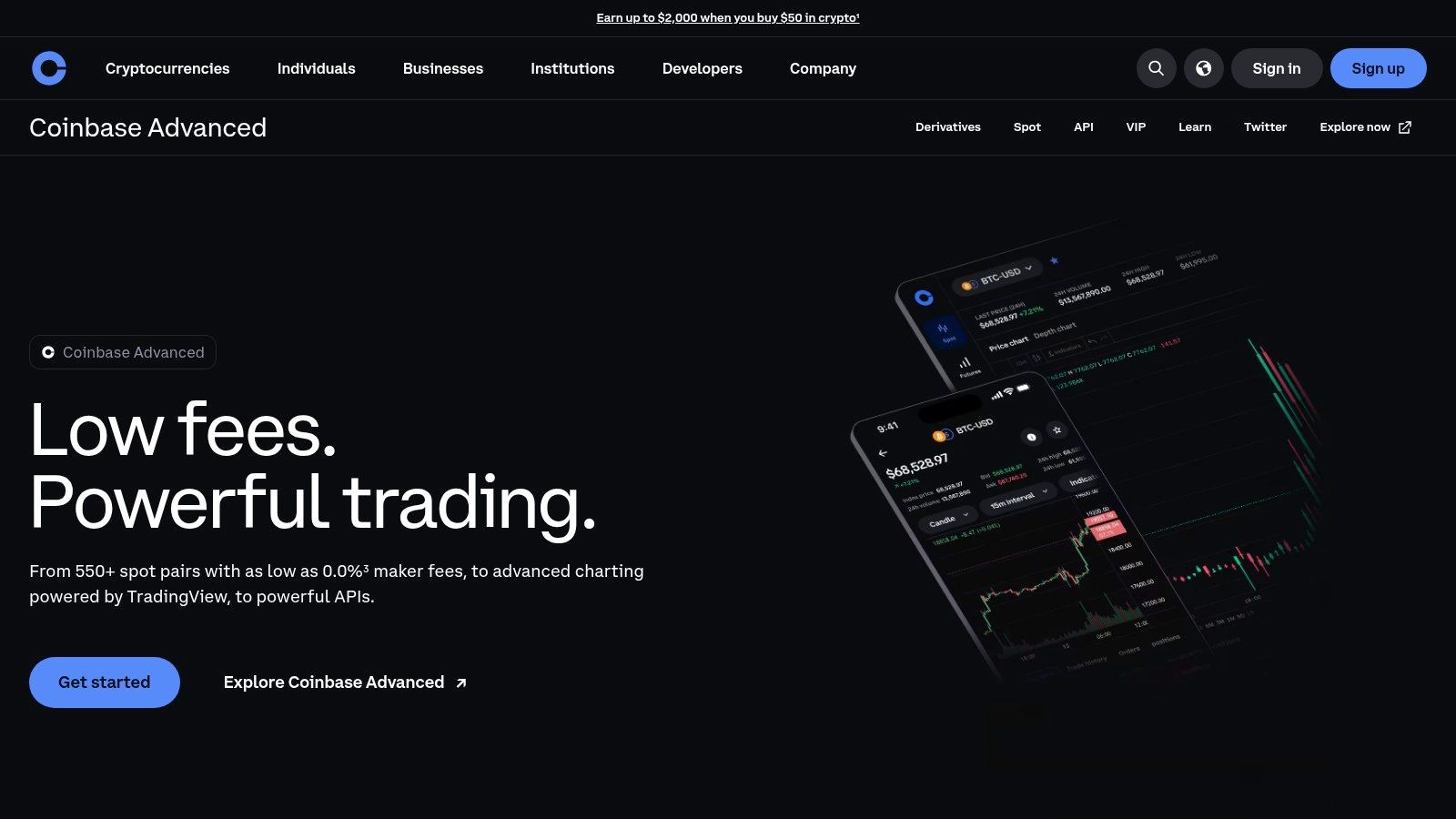
A trader who wants a familiar app on one side and a serious order screen on the other will usually understand Coinbase Advanced quickly. It sits inside the Coinbase ecosystem, but the trading view is built for people who care about TradingView-powered charts, advanced order types, APIs, and cleaner execution than the standard retail interface. That matters because a platform has to fit your workflow, not just advertise low fees, and the best choice is usually the one you can use consistently without friction.
The charting setup is practical rather than flashy. You get clean candles, drawing tools, indicators, and a layout that supports real analysis instead of constant menu hunting. For traders who start with a screen and then move to execution, that reduces mistakes, because the visual read on the chart stays close to the decision process. If you build your setups around indicator confirmation, the guide to the best indicators for crypto trading is a useful companion before you place orders.
Coinbase also keeps security and custody inside its own system, which appeals to U.S. traders who want regulated access and a straightforward path from basic account use to more active order flow. The trade-off is familiar to active traders. Coinbase Advanced gives you a polished interface and a strong charting experience, but fee levels and available pairs depend on the tier and the asset. That means it works well for disciplined traders who value usability and clean execution more than chasing the lowest possible cost on every order.
Best fit and trade-offs
This platform fits U.S. users who want a regulated venue, a polished interface, and enough depth for active trading without giving up the simplicity of the wider Coinbase environment. The main trade-off is cost structure and market breadth. You may get a smoother experience, but you still need to check the pair, the fee tier, and whether the asset you want to trade is available with the liquidity you expect.
Pros
- Familiar Coinbase ecosystem with a trader-focused interface
- TradingView-powered charts with the tools active traders expect
- Advanced order types and API access for more structured workflows
- Security and custody are handled inside one platform
- Good fit for traders who value chart clarity and execution discipline
Cons
- Fee tiers and pair availability vary
- Less appealing if your main goal is the lowest possible trading cost
- Better for users who want structure and usability than for those who need a very broad, niche market list
3. Kraken Pro
Kraken Pro is the platform many active traders end up respecting after they've outgrown entry-level interfaces. It's built for people who care about order control, uptime, APIs, and precise execution, not just a nice-looking dashboard. Kraken also shows how specialized platform choices have become, because traders now often pair a discovery tool with an execution venue instead of expecting one app to do everything. A screener like GeckoScreener's free crypto screener guide helps with idea generation, while Kraken Pro handles the order entry side.
The pro interface is clean without being shallow. Spot, margin for eligible clients, and derivatives sit in one place, and the advanced order set includes stop loss, take profit, reduce-only, and IOC. Kraken's REST and WebSocket APIs make it a strong candidate for traders who automate parts of their workflow, while the chart and book view help you read liquidity instead of guessing from the candle alone.
Where Kraken Pro fits
This is a good home for technical traders who want tighter control over execution than a standard app gives them. It also works well for traders who need stable infrastructure and a market structure that does not fight them during fast moves. The trade-off is access, since margin and futures depend on jurisdiction and KYC status, and the simpler recurring-buy flow is not the point of the product.
Kraken Pro makes the most sense when chart quality, order-book depth, and execution discipline matter more than a polished consumer experience. If your process starts with screening and ends with a precise entry, it fits that workflow well.
3. Kraken Pro
Kraken Pro is the platform many active traders end up respecting after they've outgrown entry-level interfaces. It's built for people who care about order control, uptime, APIs, and precise execution, not just a nice-looking dashboard. Kraken also illustrates how specialized platform leadership has become, because the market now splits by region and product type instead of one exchange trying to satisfy everybody (Kraken's 2026 platform roundup).
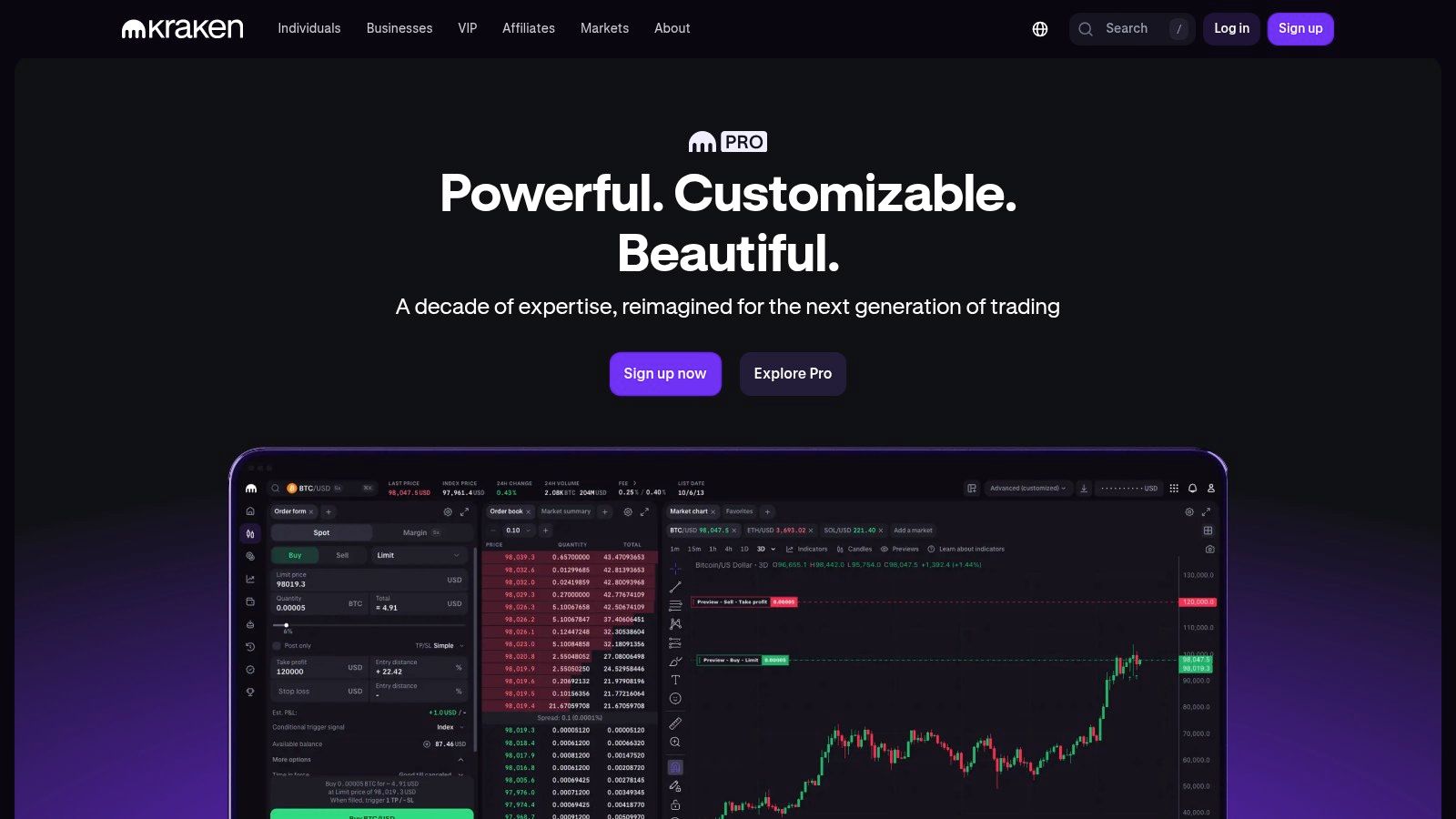
The pro interface is clean without being shallow. Spot, margin for eligible clients, and derivatives sit in one place, and the advanced order set includes stop loss, take profit, reduce-only, and IOC. Kraken's REST and WebSocket APIs make it a strong candidate for traders who automate parts of their workflow, while the chart and book view help you read liquidity instead of guessing from the candle alone.
Where Kraken Pro fits
This is a good home for technical traders who want tighter control over execution than a standard app gives them. It also works well for traders who need stable infrastructure and a market structure that doesn't fight them during fast moves. The compromise is access, since margin and futures depend on jurisdiction and KYC status, and the simpler recurring-buy path isn't the same thing as working the order book.
Practical rule: if your strategy depends on entries, exits, and repeatable order logic, use the pro venue, not the convenience flow.
The chart view pairs well with a screening tool because it's execution-oriented. You can validate a setup elsewhere, then move into Kraken Pro when you're ready to place the trade with more granular control. That's the right sequence for active traders.
4. Bitstamp Bitstamp USA
Bitstamp is one of the more conservative choices on this list, and that's a compliment. Traders who value regulatory clarity, a long operating history, and simple pro tools often prefer platforms that feel less promotional and more operationally disciplined. Bitstamp's U.S. presence and licensing footprint make it especially relevant for traders who want a platform that doesn't try to be everything at once (Javi Linares's 2026 broker overview).
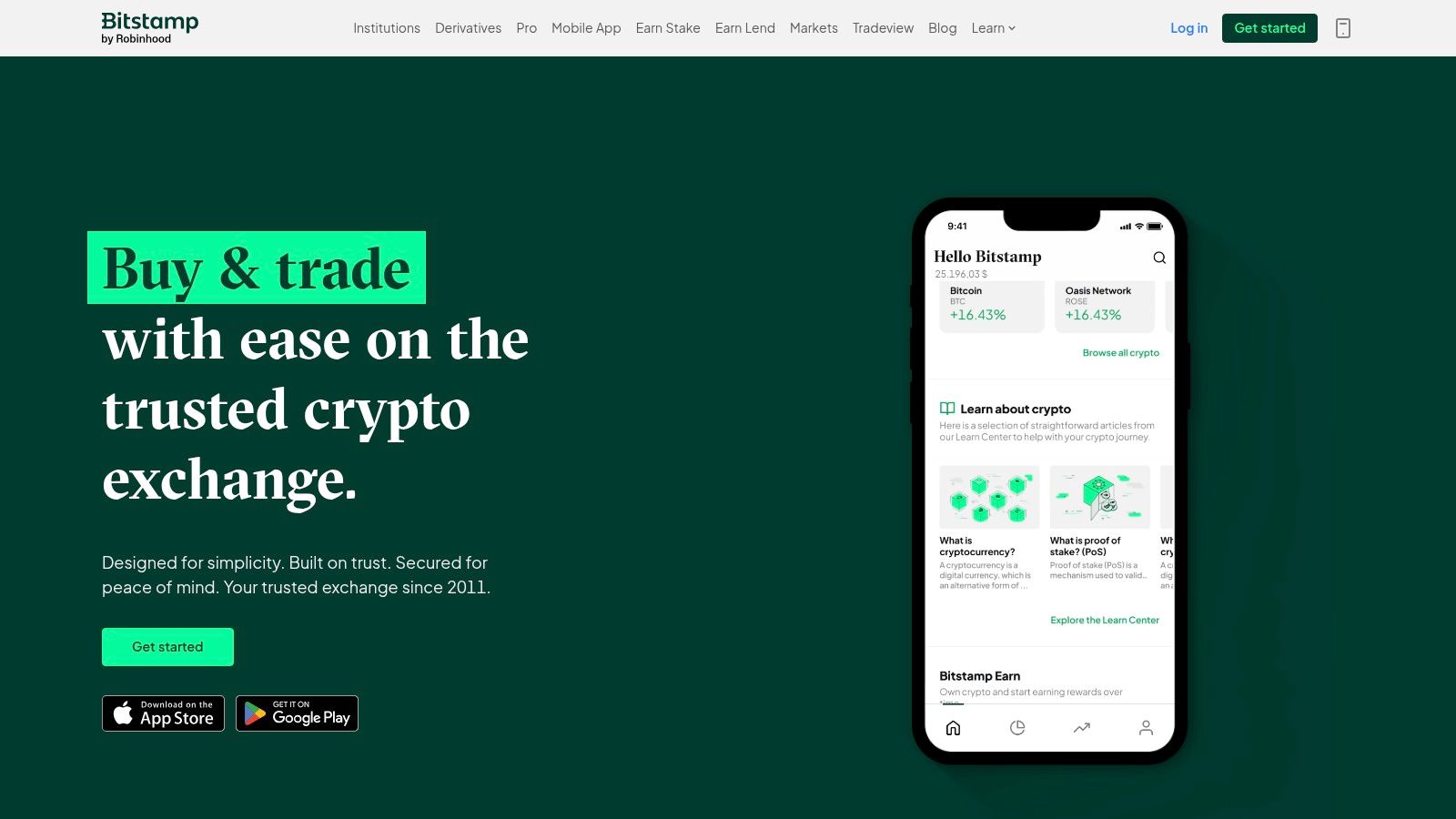
The pro interface is restrained in the right way. You get transparent maker-taker pricing tied to 30-day volume, REST and WebSocket APIs, and a layout that appeals to traders who care about the order book and market depth more than flashy design. Bitstamp also supports a VIP program and occasional promotions, although promotions should never be the main reason to choose an exchange.
Strengths and limits
Bitstamp is strongest when you want a platform with a clear operational footprint and a straightforward execution model. It's a sensible option for traders who don't need a giant altcoin catalog, and for those who prefer to work through APIs or a cleaner pro layout. The main limitation is breadth, because the asset list is smaller than the largest exchanges and some advanced features are still limited in the U.S.
If your workflow starts with screeners and ends with a disciplined, low-drama execution venue, Bitstamp makes sense. It doesn't try to impress you with excessive complexity, which is exactly why some traders trust it.
5. Gemini ActiveTrader
Gemini ActiveTrader is built for users who want the feel of a more institutional venue without losing retail accessibility. The platform's biggest selling point is that it puts security, compliance, and publishable fee tiers ahead of hype, which is the right priority if your main concern is safeguarding capital while trading actively. That matters because industry guidance still puts security standards and platform transparency at the center of exchange selection (Kraken's 2026 roundup).
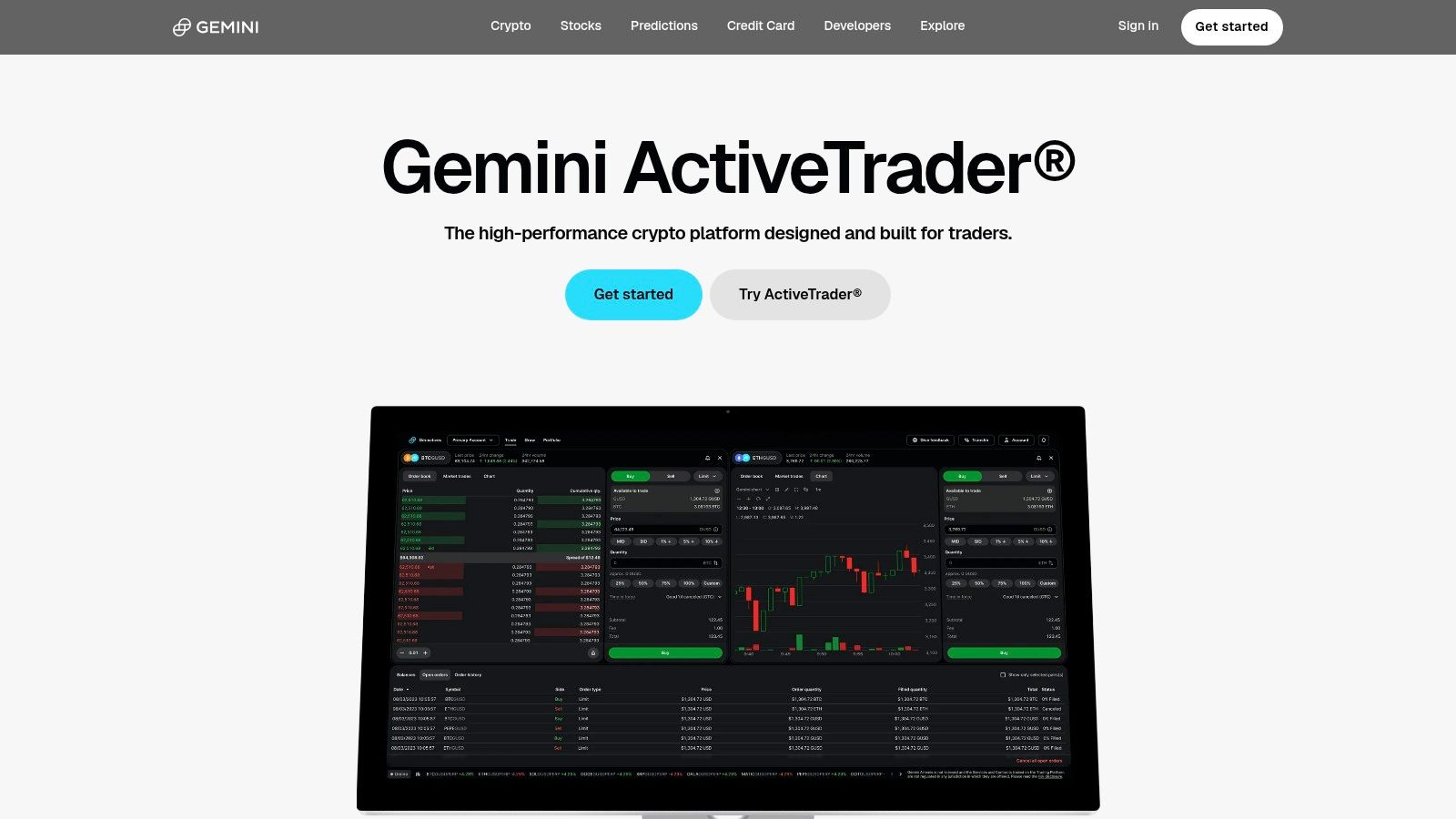
The charting and order interface feel clean, with a more institutional tone than many retail apps. ActiveTrader supports advanced order types, a maker-taker fee schedule that scales with volume, and connectivity options including FIX and APIs. That makes it suitable for both individual traders and teams that want a more formal trading stack.
Why traders choose it
Gemini works best for people who'd rather trade a curated set of assets on a platform with a strong compliance posture than chase every new listing. The downside is simple, the low-volume fee experience can be less attractive than some competitors, and the token list is more selective than what you'll see on offshore venues.
Practical rule: if security and compliance are your first filter, start with the platform that treats them like core features, not marketing copy.
Gemini ActiveTrader is a good fit when your screeners have already narrowed the field and you want an execution venue that stays out of the way. It's not built for bargain hunters searching for every obscure coin, and that's part of the trade-off.
6. Robinhood Crypto
Robinhood Crypto is the easiest platform on this list to understand if you already use Robinhood for stocks or options. Its real strength is the unified brokerage experience, where crypto sits next to traditional assets inside one app, with advanced charts and ladder trading available for users who want more than the basic buy button. That kind of integration speaks directly to the practical question many traders ask, which platform fits my country, order type, and asset access needs (Investing.com's crypto trading platform coverage).
The interface is simple enough for first-time crypto traders, but the ladder and chart tools give it more depth than the old retail stereotype suggests. Robinhood also offers a transparent, volume-based crypto fee schedule and no separate withdrawal fees, though network fees still apply. For traders who want quick funding and a low-friction starting point, that simplicity is a real advantage.
Best use case
Robinhood Crypto makes sense when crypto is one sleeve inside a broader retail portfolio. It's less compelling if you need a deep coin universe, advanced derivatives access, or the same level of crypto-native market depth you'd find on a dedicated exchange. Availability also depends on state-level access in the U.S., so it's not universally usable.
The biggest advantage is onboarding speed. The biggest limitation is that convenience often comes with narrower crypto selection, so it's better for straightforward spot activity than for complex, multi-venue execution plans.
7. Interactive Brokers IBKR Crypto
Interactive Brokers brings crypto into a platform that already feels built for serious multi-asset traders. If you manage stocks, futures, and other positions in IBKR, adding crypto through the same environment can simplify reporting, risk management, and day-to-day oversight. The case for IBKR is not flashy product design, it's consolidation and control, which is often what experienced traders value most.
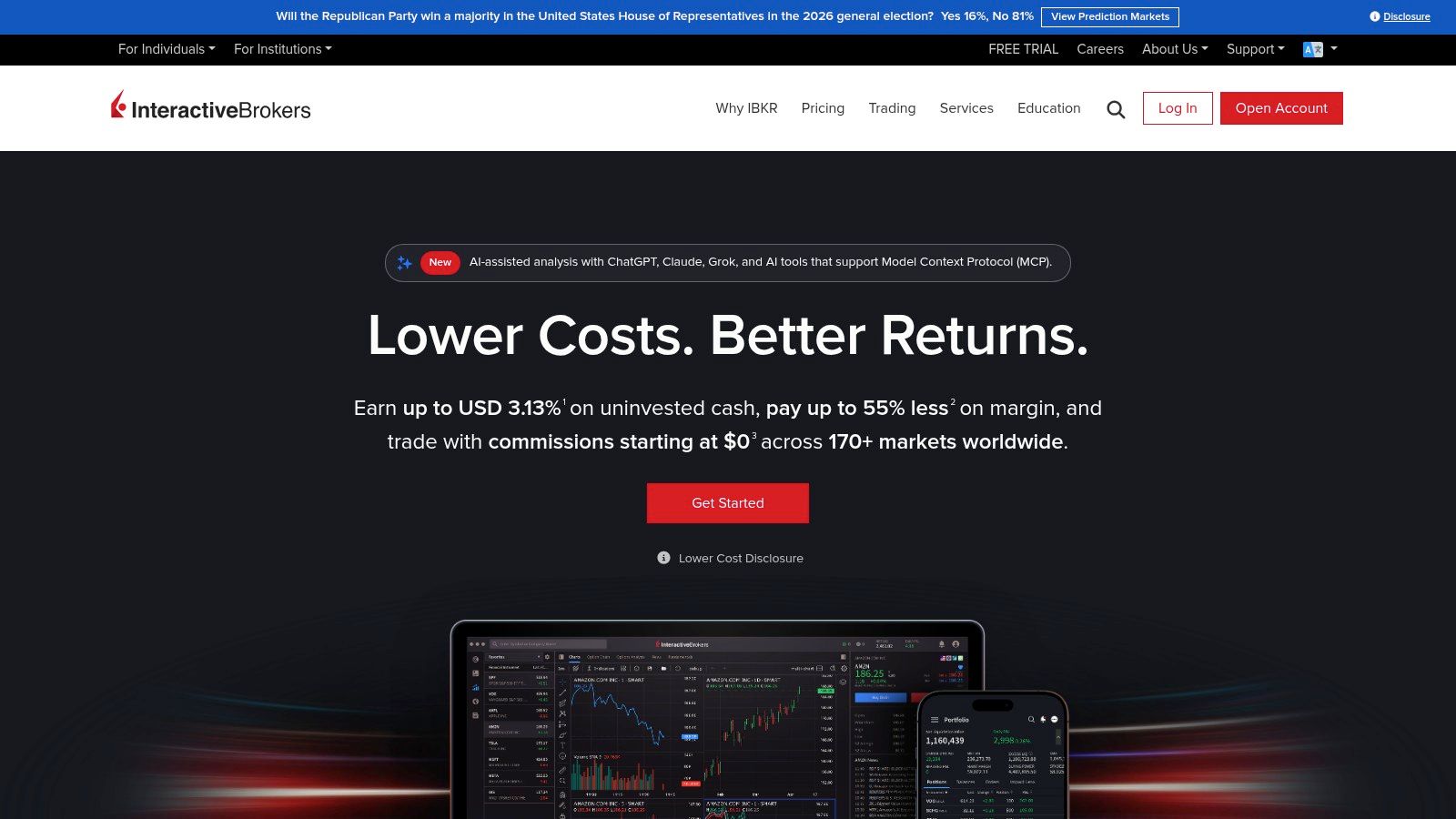
IBKR's Trader Workstation is known for deep analytics and customization, and that same philosophy carries into its crypto offering. Eligible U.S. clients can trade major coins through regulated partners, while keeping their portfolio view, analytics, and reporting in one place. The commission structure is transparent, although the exact pricing varies by volume and routing.
Who it suits
This is the right choice for seasoned traders who already live in IBKR and want crypto to behave like another line item in a professional book. It's less suitable for people who want a long-tail token selection or a crypto-native interface with a huge list of coins. The access model also depends on jurisdiction and partner availability, so it's not the universal answer some traders hope for.
For pure crypto execution, IBKR may not be the most agile venue. For multi-asset discipline, it's one of the cleanest ways to keep everything under one roof.
Top 7 Crypto Trading Platforms Comparison
| Product | Implementation complexity 🔄 | Resource requirements ⚡ | Expected outcomes 📊 | Ideal use cases 💡 | Key advantages ⭐ |
|---|---|---|---|---|---|
| GeckoScreener | Low, no-code, plain-language strategy builder | Low–Moderate, browser access; limited to 100+ coins, up to 9m backtests | Fast idea→runnable-query; transparent equity curves & trade logs | Technical traders validating setups without coding | End-to-end no-code workflow; near‑real‑time data; pattern detection |
| Coinbase Advanced | Medium, TradingView UI; advanced order setup | Moderate, account/KYC, fiat funding; deep liquidity | Professional-grade execution and charting for retail | Serious retail traders seeking regulated exchange + charting | TradingView charts, deep liquidity, integrated custody/compliance |
| Kraken Pro | Medium–High, advanced order controls and APIs | High, low‑latency APIs, broad pair coverage (1,400+) | Precise execution, stable uptime, good for automation | Programmatic traders needing execution quality and derivatives | Robust APIs, granular order/risk controls, strong performance |
| Bitstamp (Bitstamp USA) | Low–Medium, simple pro interface | Moderate, fiat ramps, U.S. regulatory footprint | Conservative, transparent trading with clear fees | Traders prioritizing regulatory clarity and fiat on/off ramps | Long track record, NYDFS presence, clear API endpoints |
| Gemini ActiveTrader | Medium, ActiveTrader UI, onboarding for advanced features | Moderate–High, institutional custody, FIX/APIs | Secure, compliant trading with predictable fee tiers | U.S. users requiring institutional-grade custody and compliance | Strong security/compliance, published fee tiers, institutional tooling |
| Robinhood Crypto | Low, retail-first, unified brokerage app | Low, instant deposits (limits), simpler asset list | Easy unified access to crypto alongside equities | New retail traders wanting simple onboarding and one account | Streamlined UX, unified assets, transparent volume-based fees |
| Interactive Brokers (IBKR) – Crypto | High, integrates with Trader Workstation, advanced config | High, professional platform, regulated partners, advanced analytics | Consolidated multi-asset reporting and professional analytics | Multi-asset traders already on IBKR or institutional users | Unified portfolio/reporting, strong risk controls, competitive commissions |
Your Platform Is Your Edge Making the Final Call
Choosing a crypto trading platform is really about choosing a workflow. The right setup connects discovery, strategy validation, and execution without forcing you to translate the same idea across three different systems. If you screen a setup in one place, test it in another, and trade it on a venue with the right charting and order controls, you'll spend less time fighting the interface and more time managing the trade.
That's why the most useful comparison isn't just “which platform is cheapest.” It's which platform fits your country, your order style, your asset access, and your tolerance for friction. Industry guidance keeps returning to the same pillars, security, customer service, trading fees, and transparency, because those are the features that hold up when you trade regularly, not just when you open the account (Kraken's exchange guidance).
The other part of the decision is chart quality and data flow. A clean chart can help, but a platform becomes much more useful when it lets you read liquidity, place orders precisely, and connect that execution back to a screening process that already filtered the noise. That's where a tool like GeckoScreener fits naturally into the system, it handles the discovery and validation side so your trading platform can focus on execution.
If you're still comparing options, start with your actual routine. Ask which venue you'll use every day, which one fits your region, and which one lets you act on a signal without hesitation. The best crypto trading platform is the one that makes your process sharper, not the one with the loudest homepage.
If you want to tighten the front end of your trading workflow, start with GeckoScreener. It gives you screening, plain-language strategy building, and backtesting in one place, which makes platform choice a lot easier because you're comparing execution venues with a tested setup in hand. Visit it now, build a strategy, and see how much cleaner your next trade idea becomes before it ever reaches an exchange.
GeckoScreener Team
Written for the GeckoScreener community. Join us on Telegram →
Related Articles



Start screening cryptocurrencies for free
Apply strategies like this one in real-time across 250+ coins.
Try GeckoScreener →