10 Crypto Backtesting Tool Options for Strategy Testing
Compare 10 crypto backtesting tool options for exchange data, coin coverage, portfolio tests, usability, integrations, and practical limitations.
GeckoScreener Team
Aug 25, 2026 · 19 min read
Updated about 2 months ago
A rising equity curve doesn't prove that a crypto strategy works. It may only prove that the test used a favorable coin, a narrow historical window, optimistic fills, or information that wasn't available at the time of entry. A useful crypto backtesting tool must make the result reproducible, then expose the assumptions behind it.
Compare exchange and coin coverage, historical depth, per-asset versus portfolio testing, execution costs, integrations, and the technical effort needed to recreate the test. The market-data problem is larger than many retail workflows suggest. CoinDesk Data's normalized history reaches back to 2010 and spans more than 10,000 coins, over 300,000 crypto and fiat trading pairs, and more than 300 exchanges, with daily, hourly, and minute-by-minute coverage.
The 10 resources below solve different testing problems. TradingView and TrendSpider prioritize visual iteration, QuantConnect and Freqtrade provide coding depth, Bitsgap and Cryptohopper focus on bot validation, while GeckoScreener targets no-code screening and strategy design. Each example should be read alongside its chart image, trade output, and execution assumptions. A chart is evidence of a simulation, not proof of live tradability.
GeckoScreener currently provides screening and strategy-design workflows. Its trading and backtesting features are not live yet, and its published roadmap says backtesting and alerts are expected soon. That distinction matters throughout this comparison.
Table of Contents
- 1. GeckoScreener
- 2. TradingView
- 3. TrendSpider
- 4. QuantConnect and LEAN
- 5. Freqtrade
- 6. Jesse
- 7. Kryll and KryllOS
- 8. Bitsgap
- 9. HaasOnline TradeServer Cloud
- 10. Cryptohopper
- Top 10 Crypto Backtesting Tools, Feature Comparison
- Choose the Testing Workflow You Can Reproduce
1. GeckoScreener
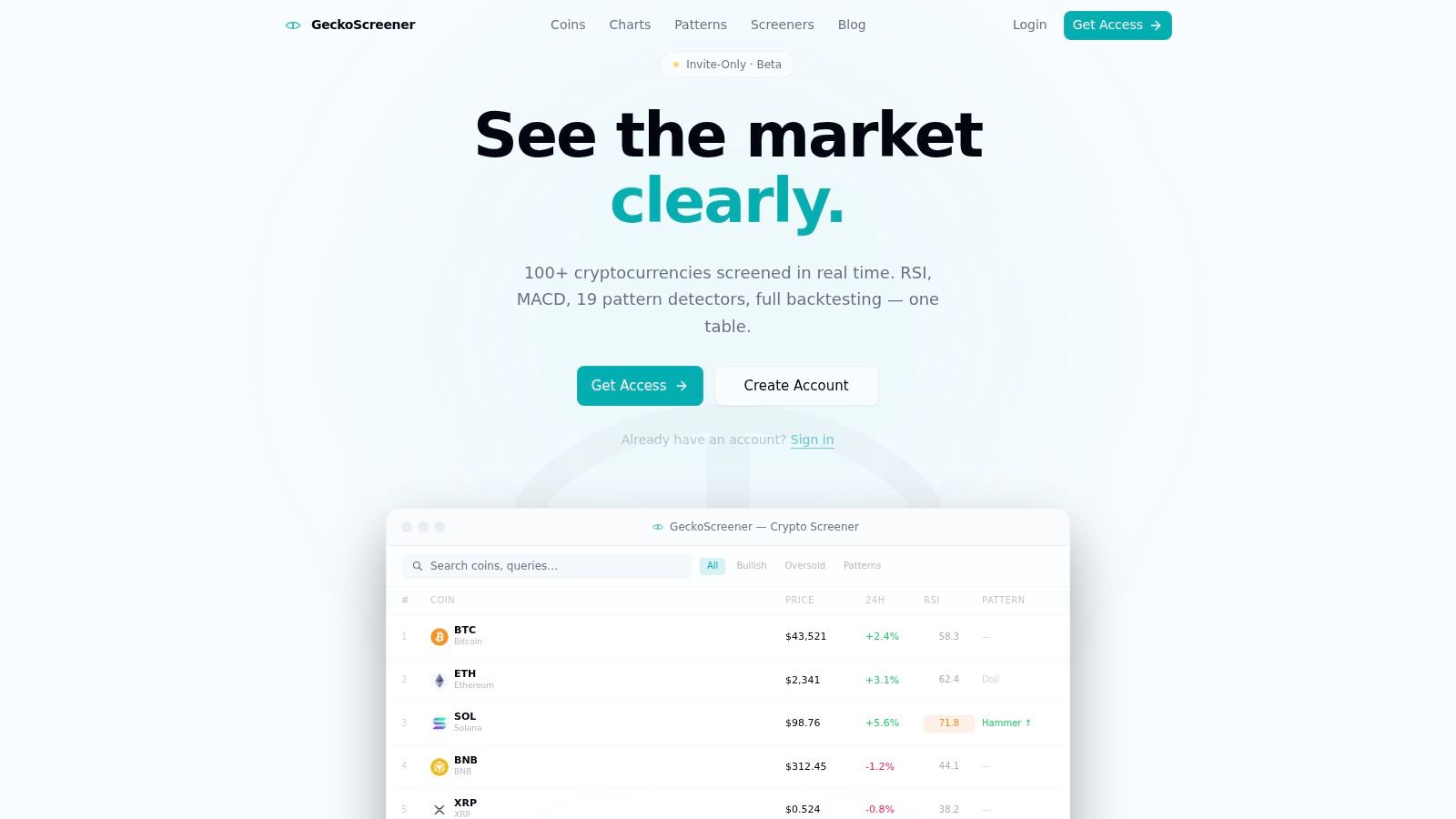
GeckoScreener is the most direct fit for traders who want to move from market discovery to rule definition without switching interfaces. Its screening workflow covers 100+ coins, refreshes data every 60 seconds, and combines filters for RSI, MACD, ADX, EMA, volume, price action, and 19 candlestick patterns, including Doji and Hammer. Those capabilities support strategy research, but the backtesting functions described on the product pages aren't currently live.
The platform's strategy workflow lets a trader express an idea in plain English and turn it into a precise query. Users can save and share strategies, define entry and exit conditions, and work with stop-loss and take-profit parameters. The published homepage describes testing across the top 100 coins over up to 9 months, with both per-coin and portfolio modes, equity curves, and trade histories. See this practical guide to backtesting a crypto trading strategy for the intended workflow.
The testing problem it solves
GeckoScreener is strongest at no-code idea translation and portfolio-oriented screening. A trader can start with a condition such as an RSI setup combined with an EMA filter and a candlestick pattern, then preserve the logic as a reusable strategy rather than manually rebuilding it across charts.
That workflow reduces configuration drift. It also makes community comparison more practical because saved strategies can be shared and discussed. The limitation is equally important: up to nine months of history may be insufficient for long-term research, and the top-100 universe may exclude smaller or delisted assets. Pricing and detailed plan limits aren't publicly specified, so access to advanced or longer-term features should be confirmed directly.
Practical rule: Treat GeckoScreener's current screening and strategy builder as available research tools. Treat portfolio backtesting, trading, and alerts as upcoming capabilities until the site confirms they're live.
2. TradingView
TradingView remains a strong choice for visual strategy testing and fast iteration. A trader can inspect a chart, modify a Pine Script strategy, run the built-in Strategy Tester, and compare the resulting equity curve with the underlying price. Its broad exchange coverage and large community script library make it easy to find examples, but a shared script still needs to be audited before its output is trusted.
Pine Script provides more control than a purely visual interface, while the chart keeps entries and exits visible. Premium users can access Deep Backtesting across the full stored history available for a symbol, according to the platform's product positioning. Forward testing on live charts can then help separate historical behavior from current execution.
Where the result can mislead
TradingView is excellent for single-symbol rule validation, but it isn't a complete portfolio research environment by default. It's also not tick-level, so trailing stops, intrabar sequencing, and fills may differ from what occurs on an exchange. That matters most when a strategy depends on precise execution rather than broader candle movement.
Use the chart image to check whether markers appear where the rules say they should. Then inspect the report, including trade sequence and drawdown, rather than relying on the headline return. Crypto backtesting guidance from ChartBacktest emphasizes candle-by-candle execution and realistic cost assumptions, a useful standard when reviewing TradingView results.
A clean TradingView equity curve is a hypothesis. It becomes stronger evidence only after delayed execution, fees, slippage, and out-of-sample testing survive review.
3. TrendSpider
TrendSpider targets traders who want no-code technical-analysis testing across multiple symbols. Its visual strategy builder supports rapid condition design, and the platform connects scanning, backtesting, alerts, and bot-oriented workflows through webhooks. That makes it useful for a trader whose process begins with technical conditions and ends with an automation trigger.
The platform lists real-time crypto coverage across 28,000+ pairs, a scale that can help researchers test whether a rule is specific to a familiar asset or behaves more broadly. The number is provided in the product plan supplied for this comparison, so it should be treated as platform-listed coverage rather than a guarantee that every pair has identical history or liquidity.
Best use and limitation
TrendSpider solves the rapid visual construction problem. A trader can build a technical setup, test it across symbols, and convert the result into a bot or webhook workflow without writing a conventional strategy engine. That's valuable for scanning-heavy approaches, especially when multi-symbol behavior matters.
The important limitation is execution granularity. TrendSpider isn't tick-level, so a fill-sensitive setup should be checked against the actual exchange or broker conditions before deployment. A backtest that works because both a stop and target were touched inside one candle may depend on an assumed fill sequence the live venue won't reproduce.
Use TrendSpider to identify promising rule structures, then record the symbol universe, timeframe, entry delay, costs, and chart output. Don't treat its automation path as evidence that the strategy has already survived live execution.
4. QuantConnect and LEAN
QuantConnect is designed for code-based, portfolio-level research. Its open-source LEAN engine supports cloud and local workflows, while Python and C# let users express custom indicators, position sizing, portfolio logic, and execution rules. Crypto data feeds and exchange integrations support research that goes beyond one chart or one asset.
The same-code pipeline is its most important advantage. A trader can research a strategy, run a backtest, monitor it out of sample, and use paper trading with the same underlying logic. That reduces the risk that a live implementation differs from the historical test.
Why serious researchers choose it
QuantConnect solves the custom research and validation problem. It's suitable when a trader needs multiple assets, exchange-specific data, optimization, research notebooks, or a controlled transition to paper trading. The cost is complexity. You'll need to understand Python or C#, data structures, engine behavior, and the platform's seats and compute model.
A useful companion is this guide to the best platform for backtesting trading strategies, especially when deciding whether the research burden is justified by the strategy's complexity.
QuantConnect is not the fastest route for a simple RSI rule. It becomes more compelling when portfolio construction, out-of-sample monitoring, or deployment consistency matters more than immediate convenience.
5. Freqtrade
Freqtrade is an open-source Python framework for traders who want bot-oriented validation with full local control. It runs command-line backtests against historical OHLCV data, supports strategy templates and indicators, and offers optimization and result exports for further analysis.
The framework's strength is transparency. You manage the strategy code, the historical files, the configuration, and the infrastructure instead of accepting a hosted platform's hidden defaults. That also creates the main burden. Data collection, cleaning, storage, exchange differences, and server maintenance are your responsibility.
A practical developer workflow
Start with a clearly defined strategy class and a fixed dataset. Run a baseline test, export the trade results, then add fees, slippage, position sizing, and risk controls before changing indicators. This order matters because optimization can otherwise reward a rule set that only exploits unrealistic assumptions.
Freqtrade solves the customizable bot research problem better than a no-code interface, but it isn't beginner-friendly. The command line and Python requirements slow the first test, while the lack of managed data means two traders can produce different results from nominally identical strategies.
For a broader explanation of the process, use this guide on how to backtest trading strategies. The key comparison is simple: Freqtrade gives you control, while a hosted platform gives you convenience. Choose control when exchange-specific behavior and reproducibility matter more than setup speed.
6. Jesse
Jesse is built for traders who want statistical validation beyond a basic profit curve. Its Python framework and desktop app support multi-timeframe and multi-symbol backtesting, optimization, Monte Carlo analysis, rule-significance testing, and machine-learning helpers.
That focus changes how you review a result. Instead of asking only whether the strategy made money historically, you can examine whether the rules appear statistically meaningful and whether different trade sequences produce materially different outcomes. Monte Carlo analysis is particularly useful for separating one favorable trade order from a broader range of plausible equity paths.
Strong analysis, uneven deployment access
Jesse solves the robustness-testing problem. Its free tier supports backtesting, which gives new users a way to explore the framework before paying for advanced functionality. Full live trading capabilities require paid plans or licenses, and live trading on the free tier is limited to testnets.
That distinction makes Jesse more useful as a research environment than as an immediate production path for every trader. A sensible workflow is to build the rules, run multi-symbol and multi-timeframe tests, examine Monte Carlo results, then paper trade before considering live deployment.
Jesse is also a good reminder that strength isn't the same as complexity. More statistical tools can reveal weaknesses, but they can also encourage repeated experimentation. Keep the original rules recorded so optimization doesn't replace the strategy you intended to test.
7. Kryll and KryllOS
KryllOS focuses on visual, no-code strategy construction. Drag-and-drop blocks let users assemble logic without traditional programming, while AI-assisted “vibecoding,” integrated backtesting, paper trading, and a marketplace extend the workflow from design to community discovery.
The marketplace is its distinctive angle. Traders can find strategies or reusable blocks, inspect how others structure a workflow, and potentially share or monetize their own components. That creates convenience, but it also introduces a review obligation. A marketplace strategy is an example to investigate, not independent evidence of performance.
Review the cost model before testing at scale
KryllOS is suited to a non-programmer who wants bot-oriented experimentation without writing code. Its paper-trading path gives users a way to compare historical assumptions with live-market behavior before deploying capital.
The platform has historically relied on the KRL token for fees, and marketplace items or platform usage may carry costs even though KryllOS is positioned as free software. Check the current model before assuming that a large batch of tests is free.
The most useful comparison is between a self-built block strategy and a marketplace template. Keep the same data scope, timeframe, risk settings, and execution assumptions for both. If the result changes only because one workflow uses different costs or fill logic, the comparison isn't fair.
8. Bitsgap
Bitsgap is designed for traders testing GRID and DCA bot parameters. Its one-click backtests use historical crypto data to evaluate bot settings, while exchange integrations, paper trading, and analytics create a relatively direct path from configuration to simulated deployment.
That narrow focus is an advantage for the right user. A trader deciding between grid spacing, DCA behavior, or exchange connections doesn't need a general-purpose rule engine. Bitsgap keeps the test close to the bot that may eventually run.
Don't confuse bot fit with strategy flexibility
Bitsgap solves the deployment-oriented parameter problem. It's useful when the intended live strategy is already a grid, DCA, or combination bot. The interface lowers the time between changing a setting and reviewing a new simulated result.
Its limitation is scope. Backtests are focused on bot-style strategies rather than fully arbitrary rule engines, so Bitsgap isn't the natural choice for a multi-condition research program involving unusual exits, custom portfolio logic, or bespoke execution.
Paper trading should be treated as a separate validation stage, not merely another report tab. Compare the historical bot result with its paper behavior, then investigate differences in fills, fees, and market conditions. The most valuable output may be discovering that a parameter set is fragile before it reaches an exchange account.
9. HaasOnline TradeServer Cloud
HaasOnline combines visual tools with HaasScript, giving advanced users a way to build and test automated crypto strategies with more scripting depth than a basic bot configurator. Its environment supports historical backtesting, detailed reports, batch and concurrent testing, and paper trading that can model slippage.
The execution emphasis is important. A platform that lets traders compare different price-close methods and simulate slippage is better suited to investigating how a strategy behaves under less favorable fills. That doesn't guarantee realism, but it gives the researcher more assumptions to inspect.
Capacity depends on the subscription
HaasOnline solves the high-volume strategy iteration problem. Batch testing can reduce the time required to compare variations, while detailed reports support closer review than a single headline return. A 7-day Standard plan trial is listed for evaluating features on the supplied product plan.
Backtest depth and capacity can vary by subscription, so confirm the available history and testing limits before building a workflow around it. Cloud subscriptions can also make resource constraints less visible than they would be in a local framework.
Use HaasOnline when you want scripting and visual construction in the same environment. If the strategy relies on tight fills, compare the platform's slippage settings with conservative assumptions and then paper trade the exact configuration. A favorable report without that second step remains a simulation.
10. Cryptohopper
Cryptohopper is a practical choice for traders who want no-code strategy design connected to bot deployment. Its Strategy Designer supports indicator-based rules, integrated backtesting and paper trading, and a marketplace for templates and external signals. Tiered plans add features such as AI assistance and professional tools.
The platform's advantage is accessibility. A non-coder can configure a strategy, review historical behavior, test it in a simulated environment, and examine community templates without building an entire technical stack.
Audit the assumptions, not just the interface
Cryptohopper solves the accessible bot validation problem, but its results need careful interpretation. Community feedback has raised questions about fee modeling and the short visualization available in some backtests, so users should inspect how costs, chart periods, and fills are represented before drawing conclusions. Advanced and live capabilities may also require paid tiers.
Compare a Cryptohopper test with paper trading using the same exchange, pair, timeframe, indicators, and risk parameters. If the historical chart looks strong but paper execution weakens, investigate fees, latency, signal timing, and liquidity before changing the strategy itself.
Top 10 Crypto Backtesting Tools, Feature Comparison
| Tool | Key features | UX & Quality | Value / Pricing | Target audience | Unique selling points |
|---|---|---|---|---|---|
| GeckoScreener 🏆 | Real-time screener (100+), NL strategy builder, backtester (up to 9m), 19 candlestick patterns | ★★★★☆, 60s data refresh | 💰 Invite/Beta; free strategy builder | 👥 Traders seeking no‑code, fast crypto scans | ✨ Plain‑English→runnable queries, portfolio backtests, shareable strategies |
| TradingView | Advanced charting, Pine Script, Strategy Tester, broad exchange data | ★★★★★, polished UX, large community | 💰 Freemium → Premium tiers for deep backtests | 👥 Retail traders & chartists, script authors | ✨ Massive community script library, deep historical backtests |
| TrendSpider | Visual/no‑code strategy builder, multi‑symbol backtesting, real‑time crypto pairs | ★★★★☆, visual TA focus | 💰 Subscription tiers | 👥 TA-focused traders who avoid coding | ✨ Rapid visual building, convert tests to bots (webhooks) |
| QuantConnect (LEAN) | Cloud/local backtests, cluster scaling, crypto feeds, live/paper trading | ★★★★☆, pro-grade, flexible | 💰 Usage/compute based pricing | 👥 Quant developers & systematic traders | ✨ Open-source LEAN, scalable portfolio backtests, research notebooks |
| Freqtrade | CLI backtesting, strategy templates, hyper‑optimization (self‑host) | ★★★★☆, dev workflow | 💰 Free (self‑host) + infra costs | 👥 Developers & self‑hosters | ✨ Open‑source, fully customizable algorithmic framework |
| Jesse | Multi-timeframe/multi-symbol backtests, Monte Carlo, rule‑significance testing | ★★★★☆, strong statistical tools | 💰 Free tier; commercial licenses for advanced live | 👥 Quant researchers & ML‑focused traders | ✨ Statistical validation, Monte Carlo and ML helpers |
| Kryll (KryllOS) | Drag‑and‑drop visual editor, integrated backtesting, marketplace | ★★★☆☆, true no‑code UX | 💰 Usage/marketplace fees (historical token model) | 👥 Non‑coders wanting marketplace strategies | ✨ Visual block editor + strategy marketplace |
| Bitsgap | Bot templates (GRID, DCA), one‑click backtests, paper trading | ★★★☆☆, quick bot setup | 💰 Subscription with exchange support | 👥 Bot-focused traders testing grid/DCA ideas | ✨ Fast bot parameter backtests across exchanges |
| HaasOnline (TradeServer Cloud) | HaasScript, batch backtesting, slippage modeling, detailed reports | ★★★★☆, enterprise features | 💰 Cloud subscriptions (plan limits apply) | 👥 Advanced algo traders needing scripting | ✨ Concurrent backtests, detailed execution modeling |
| Cryptohopper | No‑code Strategy Designer, backtesting, paper trading, marketplace | ★★★☆☆, accessible UI | 💰 Tiered plans; paid tiers for pro features | 👥 Beginners/non‑coders deploying bots | ✨ Marketplace + AI assistance options, easy automation |
Choose the Testing Workflow You Can Reproduce
The best crypto backtesting tool isn't the one with the longest feature list. It's the one that lets you state exactly what was tested, recreate the result, and explain why the result might fail in live markets.
Choose no-code tools when you need to test rule ideas quickly. GeckoScreener, TrendSpider, KryllOS, and Cryptohopper reduce syntax barriers, but each has a different center of gravity. GeckoScreener is oriented toward screening and strategy design across the top 100 coins, TrendSpider emphasizes technical-analysis iteration and multi-symbol workflows, KryllOS centers on visual bot construction, and Cryptohopper connects accessible strategy design with deployment.
Choose code-based frameworks when you need custom indicators, exchange-specific data, portfolio logic, or precise execution assumptions. QuantConnect offers a professional research path around LEAN, Freqtrade gives developers a self-hosted Python framework, and Jesse adds statistical and Monte Carlo tooling. These platforms demand more setup, but they also make hidden assumptions easier to inspect and change.
Choose portfolio-capable platforms when your question concerns behavior across assets rather than one attractive chart. Portfolio testing can reveal whether a strategy depends on one coin, one market regime, or a concentration of correlated positions. CoinDesk Data's coverage demonstrates why data breadth matters, with normalized history reaching back to 2010 across more than 10,000 coins, over 300,000 crypto and fiat pairs, and more than 300 exchanges. TradesViz describes another market example, with coverage of 30,000+ symbols, 70+ technical indicators, 600+ statistics, and multi-timeframe analysis.
Choose bot platforms when the intended outcome is a deployable grid, DCA, or automated strategy. Bitsgap, HaasOnline, and Cryptohopper can shorten the path from settings to paper trading, while Freqtrade and QuantConnect offer deeper implementation control. Don't assume deployment proximity means execution realism. ChartBacktest's execution guidance stresses fees, slippage, funding, position sizing, and sequential candle execution as essential parts of a credible simulation.
Record the same information for every test:
- Data scope: Write down the exchanges, coins, pair types, timeframe, history, and whether the universe includes only surviving assets.
- Strategy rules: Save the exact indicators, thresholds, entry timing, exits, stop loss, take profit, and position-sizing logic.
- Execution assumptions: Include maker or taker fees, slippage, funding, latency, and any one-bar execution delay.
- Evidence package: Keep the equity curve, chart image, full trade log, benchmark comparison, and test configuration together.
- Validation stage: Repeat the test out of sample, use walk-forward checks where available, and paper trade the unchanged rules afterward.
Bias deserves special attention in crypto. Traseq's discussion of look-ahead and survivorship bias highlights why traders should define the asset universe before they know which coins survive. It also supports practical stress tests such as one-bar delays and out-of-sample validation. A recent independent guide cites survivorship-bias-related overestimation of 20% to 40% when delisted tokens and variable fees are ignored, so a result built only from surviving assets should be treated cautiously. Zenodo's research record provides the relevant source for that caution.
The chart images in this comparison have different jobs. TradingView-style outputs show entry and exit markers against price, while Bitcoin backtest examples commonly distinguish the price line from portfolio value and annotate trades, as shown by Bitbo's backtest charts. Use those visuals to verify timing, not to decorate a performance claim. A green equity curve can hide a long drawdown, unrealistic fills, or a benchmark that would have performed better with less complexity.
GeckoScreener's current product should be described accurately. Its screening tools and strategy-building workflow are available for research, while its published roadmap says backtesting and alerts are coming soon. Don't present those unreleased functions as live trading features. When they launch, evaluate them using the same standard applied to every platform here: defined data scope, transparent outputs, conservative execution assumptions, and paper-trading confirmation.
GeckoScreener brings crypto screening, indicator and candlestick filters, and plain-language strategy design into one research workflow, with data updates every 60 seconds across 100+ coins. Visit GeckoScreener to explore the available tools now and follow the upcoming backtesting and alerts release.
GeckoScreener Team
Written for the GeckoScreener community. Join us on Telegram →
Related Articles

Start screening cryptocurrencies for free
Apply strategies like this one in real-time across 250+ coins.
Try GeckoScreener →