Crypto Taxes: What Every Country Actually Charges, and Who Calculates It
Crypto taxes explained country by country: what the US, UK, India, Germany, UAE and others actually charge on crypto gains, plus the five tools that calculate it for you.
GeckoScreener Team
Sep 13, 2026 · 11 min read
Updated about 1 month ago
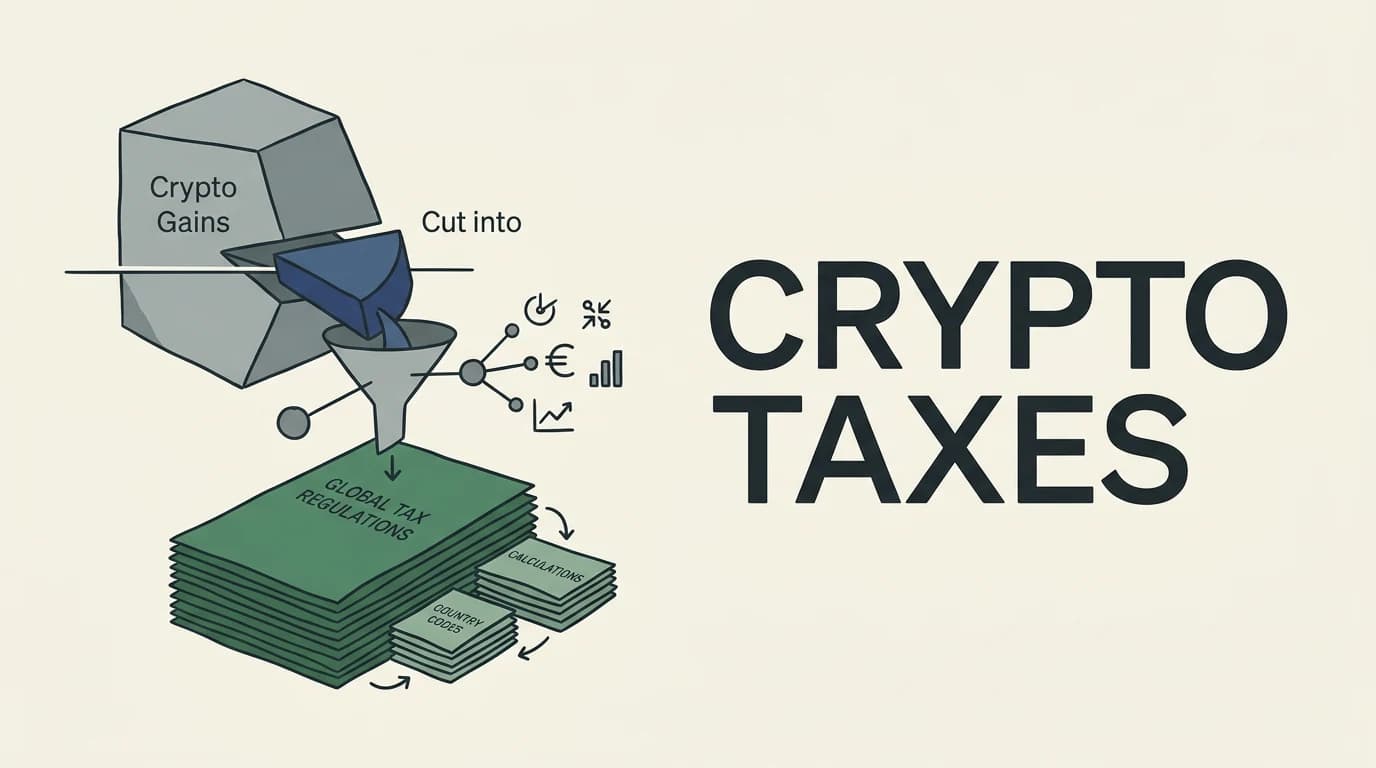
Crypto taxes are not one law with one number. Sell the exact same Bitcoin, on the exact same day, from Mumbai and from Berlin, and one seller can owe just over 31% of the gain while the other owes nothing at all. Nothing about the trade changed. Only the tax office did.
In short: there's no global crypto tax rate, because there's no global tax authority. The US, UK, Canada and Australia tax it as property, with a capital gains bill due on almost every sale, trade or spend. Germany and Portugal drop that bill to zero once you've held for over a year. The UAE, Singapore and El Salvador (for Bitcoin specifically) charge individuals nothing at all. India charges a flat 31.2% with no loss offset, and Japan can take up to 55% because it taxes crypto gains as regular income. China, Egypt and Bangladesh don't tax it, because they've banned it outright. If your country falls anywhere on that spectrum, five tools — Koinly, CoinLedger, Blockpit, CoinTracker and TokenTax — will actually calculate the bill for you, and each one covers a different slice of the map.
What actually counts as a taxable crypto event
The mistake almost everyone makes first: assuming tax only shows up when you cash out to your bank account. In most of the countries below, it shows up much earlier than that.
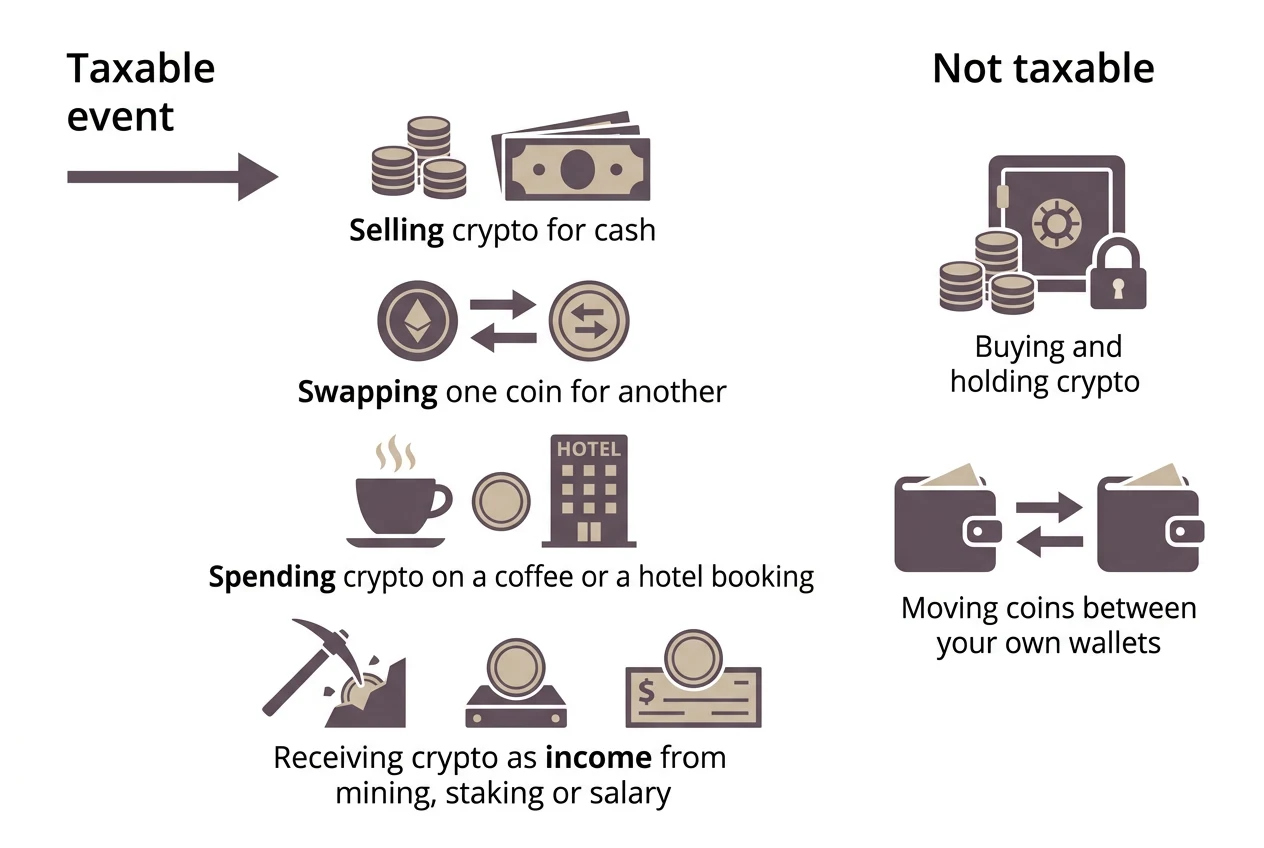
A taxable event usually fires the moment you dispose of the asset, not the moment you touch fiat currency. That covers four things: selling crypto for cash, swapping one coin for another, spending it on a coffee or a hotel booking, and — in most jurisdictions — receiving it as income from mining, staking or a salary. Simply buying and holding is, almost everywhere, a non-event. So is moving your own coins between your own wallets.
Practical rule: if you traded coin A for coin B and never touched a bank, most tax authorities still see that as a sale of A followed by a purchase of B. The IRS says it plainly: crypto is "considered property, not currency," and disposing of it — including trading it for another digital asset — is what creates the taxable moment, not the presence of dollars in the transaction (irs.gov).
How crypto taxes actually work, country by country
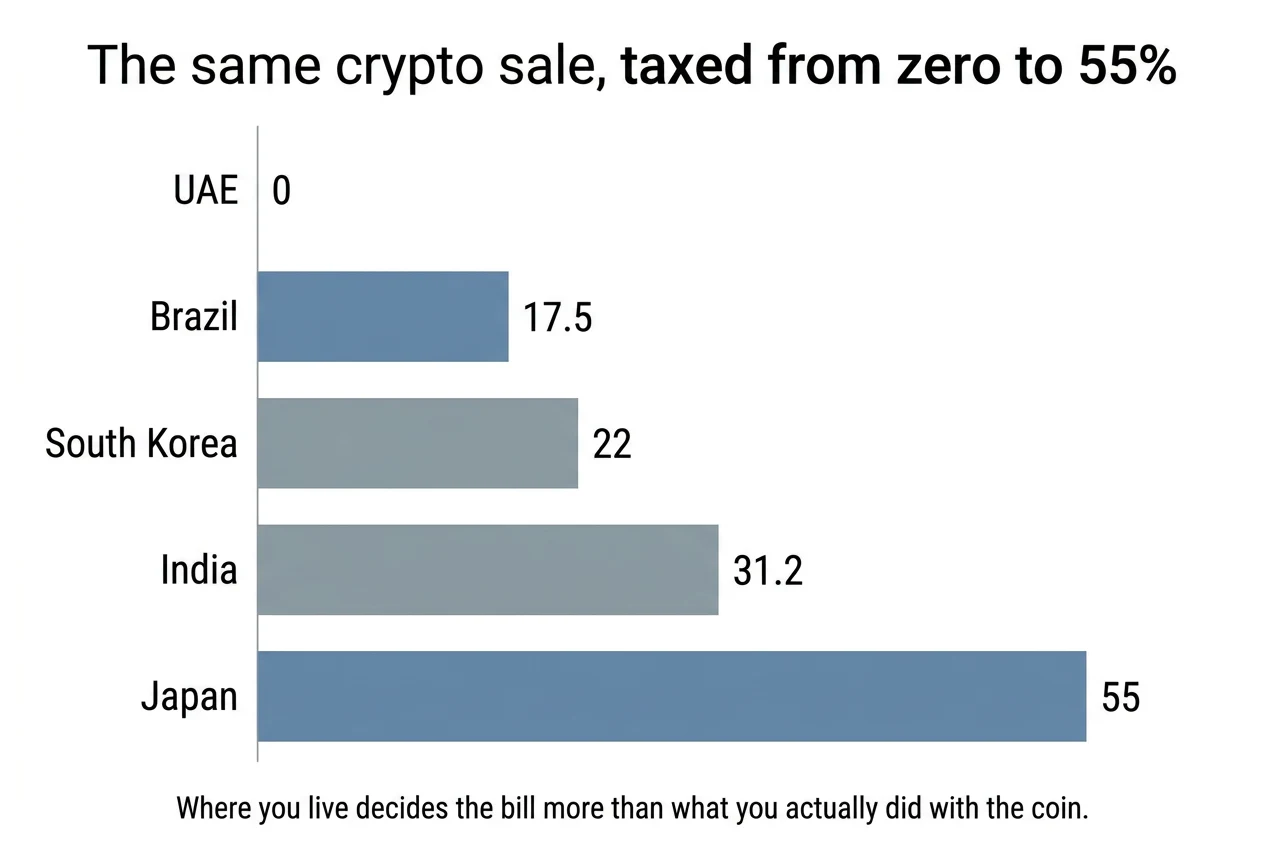
Here's where the story splits hardest. The same trade, run through sixteen different tax codes, produces sixteen different bills — and in three of them, it's not legal to make the trade at all.
| Country | How crypto is classified | What you actually pay | Who runs it |
|---|---|---|---|
| United States | Property, not currency | Short-term gains at ordinary income rates (10–37%); long-term gains (held over a year) at 0/15/20% | IRS |
| United Kingdom | Chargeable asset (income tax instead, if trading counts as a business) | Capital gains tax at 18% (basic rate) or 24% (higher rate), after a £3,000 annual exempt allowance | HMRC |
| Germany | Private asset | 0% if held over 12 months; if sold sooner, the full gain is taxed at your personal rate once total gains pass a €1,000 yearly threshold | BZSt |
| Portugal | Capital gain / Category G income | 28% flat if held under 365 days; 0% if held longer, unless it counts as professional trading | Autoridade Tributária |
| India | Virtual Digital Asset | Flat 30% plus a 4% cess (31.2% total), with no offsetting of losses against gains or other income, plus 1% TDS withheld on larger transfers | Income Tax Department |
| Japan | Miscellaneous income | Progressive national plus local tax that can reach roughly 55% combined; a flat 20% reform has been passed but its start date isn't confirmed yet | National Tax Agency |
| Singapore | Intangible property, not legal tender | No capital gains tax regime exists, so personal investment gains generally go untaxed; frequent, business-like trading can be taxed as income up to 24% | IRAS |
| United Arab Emirates | No specific tax category | 0% personal income or capital gains tax; a 9% corporate tax can apply above AED 375,000 profit if the activity counts as a business | Federal Tax Authority |
| Australia | CGT asset | Added to your assessable income at your marginal rate (up to 45%, plus a 2% Medicare levy), with a 50% discount if held over 12 months | Australian Taxation Office |
| Canada | Commodity | 50% of a capital gain is included in taxable income at your marginal rate; business income is included at 100% | Canada Revenue Agency (canada.ca) |
| France | Movable/digital asset property | A flat tax of 30%, rising to 31.4% from January 2026, for occasional investors; up to 45% if trading counts as a professional activity | DGFiP |
| Switzerland | Private movable asset | 0% capital gains tax for private individuals; cantonal wealth tax applies to what you hold; income from mining, staking or lending is taxed separately | Federal Tax Administration and cantons |
| South Korea | Other income | 20% national plus 2% local (22% combined) above an annual exemption, though implementation has been delayed repeatedly and is now targeted for January 2027 | National Tax Service |
| Brazil | Capital asset | A flat 17.5% on all crypto capital gains, with no exemption threshold, since a June 2026 reform replaced the previous tiered system | Receita Federal |
| El Salvador | Legal tender (Bitcoin only) | 0% capital gains tax on Bitcoin under its Bitcoin Law | Ministry of Finance |
| China | Banned | All trading, exchange services and mining have been illegal since September 2021 | People's Bank of China |
| Egypt | Banned without a licence | Issuing, trading or promoting crypto without a Central Bank licence is prohibited, and none has ever been issued | Central Bank of Egypt |
| Bangladesh | Banned | Not recognised as legal tender; trading and use are banned outright | Bangladesh Bank |
The zero-tax countries aren't a loophole, they're a rule about time and residency
Look closely at the "0%" rows above and a pattern shows up: almost none of them are actually "crypto is free money here." They're a rule about how long you held it, or who you are.
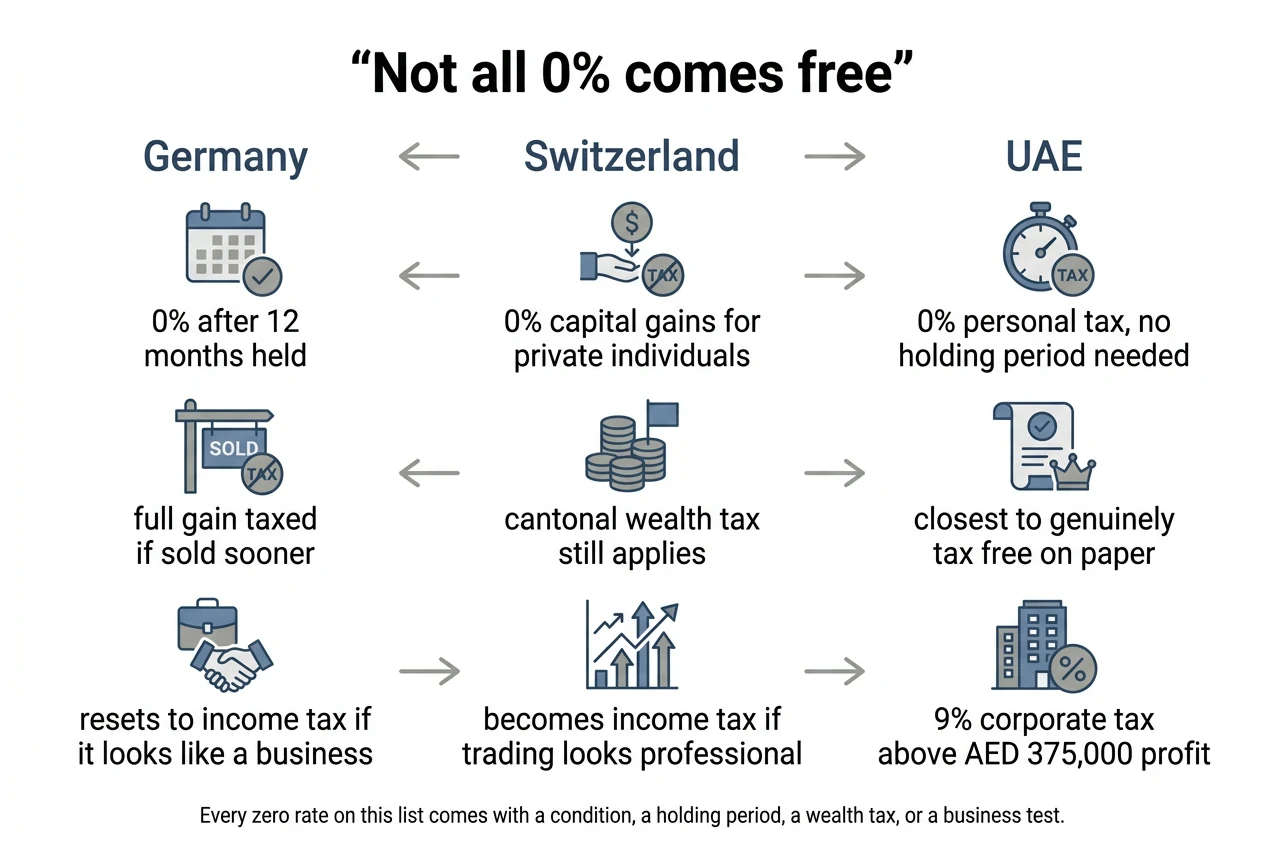
Germany and Portugal both drop to 0% only after holding for a year — sell one day early and the whole gain gets taxed, in Portugal's case at a flat 28%. Switzerland's exemption is for private individuals only; trade often enough or with enough leverage and the authorities can decide you're running a business, which is taxed as income instead. El Salvador's 0% is specific to Bitcoin under its Bitcoin Law, not to crypto generally. The UAE and Singapore are the closest thing to genuinely tax-free on paper, and even they draw a line the moment your trading starts to look like a business rather than an investment.
None of this is a reason to relocate for tax purposes on the strength of a blog post. Residency rules, exit taxes, and what counts as "professional trading" vary by country and change often — Japan's flat-rate reform and Brazil's 2026 overhaul are both proof that the rules under your feet can move.
Japan Just Made Bitcoin Legally Equal to Stocks. Crypto Tax Drops From 55% to 20% · CRYPTO LADY · Watch on YouTubeWhere it's taxed hardest, and where it's banned outright
India's structure is arguably the toughest anywhere, not because 31.2% is the highest number on this list, but because of what it doesn't let you do: you can't offset a losing trade against a winning one, or against any other income, and 1% gets withheld at the point of transfer regardless of whether you made money at all. Japan's current regime can take a bigger absolute bite, up to roughly 55% when national and local rates combine, because it treats crypto gains the same as salary rather than as a separate, lower-taxed category of capital gain.
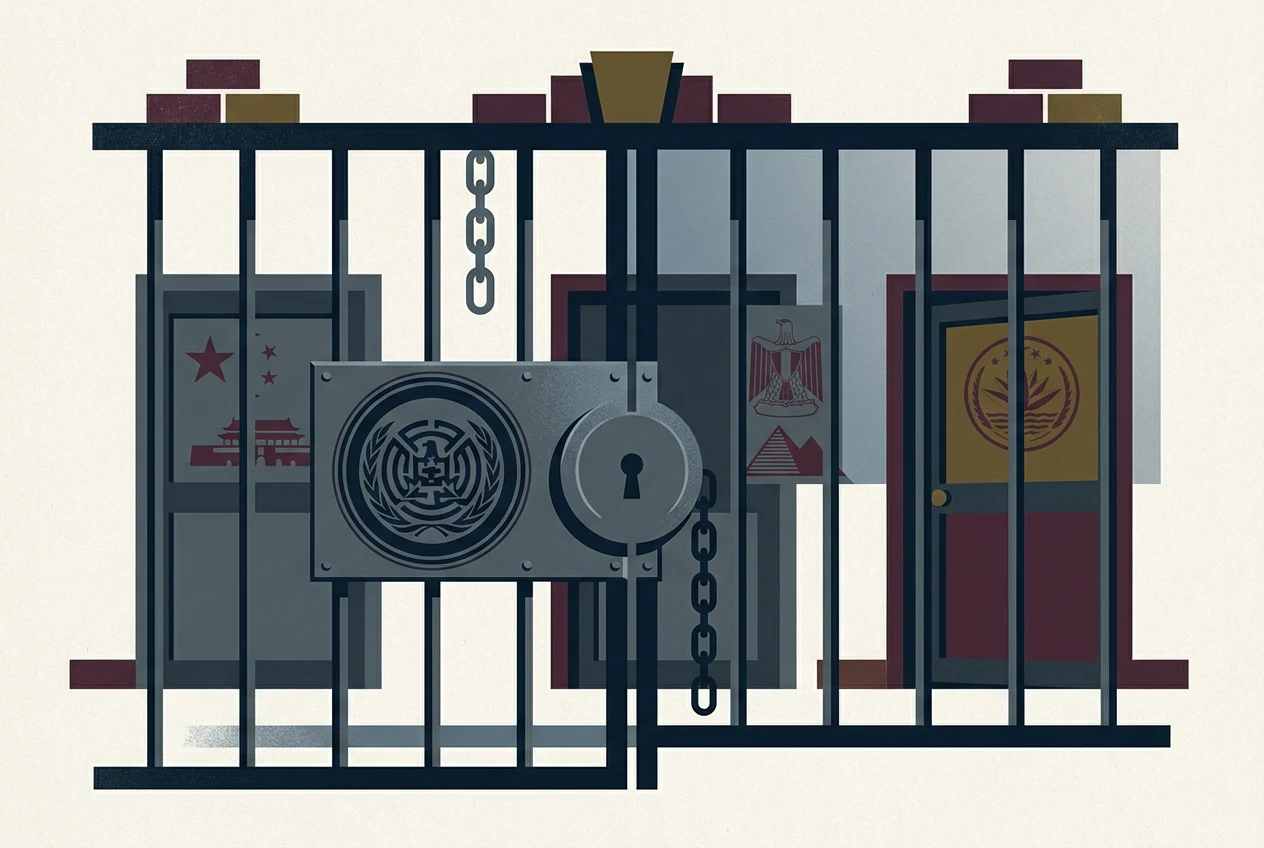
Three countries skip the tax question entirely by skipping the legality question first. China outlawed crypto trading, exchange services and mining in September 2021 and hasn't reopened the door. Egypt requires a central bank licence to trade or promote crypto and has never granted one. Bangladesh doesn't recognise it as legal tender and bans its use outright. No tax authority collects on an asset its own government says you can't hold.
The five tools that actually calculate crypto taxes for you, by country
Reading the table above is one thing. Turning a year of exchange statements, wallet transfers and DeFi swaps into a filing your country's tax office will accept is another job entirely, and it's the reason a small industry of crypto tax software exists. Here are the five most established, and which part of the map each one actually covers.
| Tool | Countries it actually supports | Starting price |
|---|---|---|
| Koinly | Localised, full tax reports for 20+ countries, including the US, UK, Canada, Australia and Germany; broader transaction reports for many more using standard cost-basis methods | Free to track; paid reports from $49 |
| CoinLedger | Explicitly built for the US, UK, Canada, Australia, "and more," with a version built specifically around Germany's rules | Free to import and preview; paid reports from $49 |
| Blockpit (formerly Accointing) | The widest declared list of any of the five: Germany, Austria, Switzerland, France, Spain, Italy and most of the rest of the EU, plus the UK, US, Canada, Australia and Israel | DIY software from €49 |
| CoinTracker | Portfolio tracking marketed broadly, but its downloadable tax forms and its TurboTax/H&R Block integrations are built around US filing | Free for up to 100 transactions a year; paid plans from $59 |
| TokenTax | Says it "calculates capital gains and losses for any country," though that claim isn't backed by a published country list the way Koinly's or Blockpit's is; its workflow still centres on US IRS forms | Plans from $49 a year |
A quick honesty check on that table, since two of the claims in it are softer than the rest. CoinTracker's own country-by-country coverage is harder to pin down than its US tooling — the TurboTax and H&R Block exports are the part it's actually built and marketed around. TokenTax's "any country" line is broad marketing language rather than a list you can check your own country against, so treat it as a starting point to verify yourself, not a guarantee.
The pattern worth noticing: if you're filing in the US, UK, Canada or Australia, all five tools claim to have you covered, and it's worth comparing them on integrations and price. If you're filing somewhere else — India, Japan, Brazil, South Korea — check the specific country list before you pay for a plan, because "works globally" on a landing page and "generates a form your tax office recognises" are two different promises.

So what does this mean for you
If the question that brought you here was simply "how much tax do I owe on my crypto," the honest answer is: it depends entirely on which tax office is asking, and for most people it's more than they expect, because it usually applies the moment they trade or spend, not just when they cash out. Check your own country in the table above, and check it again if you're planning a trade near a holding-period cutoff like Germany's or Portugal's — timing by even a day changes the bill.
If you're trying to understand what you actually own before worrying about what you owe on it, what crypto currency actually is is the place to start. If spending it rather than holding it is the plan, pay with crypto covers where that's actually legal and how the payment itself moves. And if you're tracking the regulatory side in the US specifically, the Clarity Act is the piece that will most directly decide how crypto gets classified there going forward.
A note before you go: none of the above is tax advice, and none of it should be treated as final for your own situation. Rates, thresholds and holding-period rules change by country, sometimes mid-year, and residency rules can shift which country's rules even apply to you. Check with a tax professional in your own jurisdiction before filing, rather than relying on this table alone.
GeckoScreener Team
Written for the GeckoScreener community. Join us on Telegram →
Related Articles


Start screening cryptocurrencies for free
Apply strategies like this one in real-time across 250+ coins.
Try GeckoScreener →