What Is Crypto Currency? Its Origin and What Comes Next
What is crypto currency, in plain terms: how it began with Bitcoin's 2008 whitepaper, and where the market and its regulation actually stand now.
GeckoScreener Team
Sep 10, 2026 · 9 min read
Updated about 2 months ago

What is crypto currency? It's digital money that runs on a shared, tamper-resistant ledger instead of a bank's private database. No central authority controls it. Transactions settle directly between wallets, and code enforces the rules instead of a company. That's the short version. The longer one below covers where the idea came from, how far it has actually gotten seventeen years later, and what's realistic to expect next.
In short: Crypto currency is digital money secured by cryptography and recorded on a public, distributed ledger called a blockchain, with no bank or government running the database. It started with Bitcoin's 2008 whitepaper, written in the middle of a banking collapse. Today the total market is worth roughly $2.7 trillion, spread across more than 18,000 tracked coins, and most of those have already failed or gone inactive. What comes next isn't another speculative mania. It's quieter, more institutional plumbing: regulated stablecoins and tokenized traditional assets, with rules increasingly written by actual legislatures instead of enforcement lawsuits.
Table of contents
- How it actually works
- Where it actually came from
- Where it stands today
- What the future scope realistically looks like
- So what does this mean for you?
How it actually works
Strip away the price charts and it's really just an answer to one question: how do two strangers move value to each other without a bank standing in the middle to vouch for the transaction?
The answer is a blockchain. It's a ledger that isn't stored in one place. No head office. Copies sit on thousands of independent computers, and they all agree on the same record through rules anyone can inspect. Ownership isn't a database row a bank can freeze or reverse; it's a cryptographic key. Whoever holds the private key controls the coins, and a network of unrelated participants, not a head office, decides whether a new transaction is valid.
A few features fall out of that design, and they're worth understanding on their own:
- No central issuer. Nobody prints more Bitcoin the way a central bank prints currency.
- Transparent but pseudonymous. Every transaction is visible on the public ledger, but wallet addresses aren't tied to a name by default. Exchanges are usually the point where a real identity gets attached, through the account you signed up with.
- Irreversible by design. There's no customer service line to reverse a mistaken transfer.
- Programmable. Later networks, Ethereum being the obvious one, let the ledger run actual code. That's how stablecoins and on-chain lending got built directly on top of a currency network, instead of needing a separate company's servers.
You don't need to trust a specific institution for any of that to work. What it needs instead is trust in math and open code, plus the economic incentive that keeps a large, decentralized network honest.
Where it actually came from
This didn't start in a Silicon Valley pitch deck. It started as a reaction to failure. A banking system had just spectacularly collapsed, and governments were writing the bailout checks.
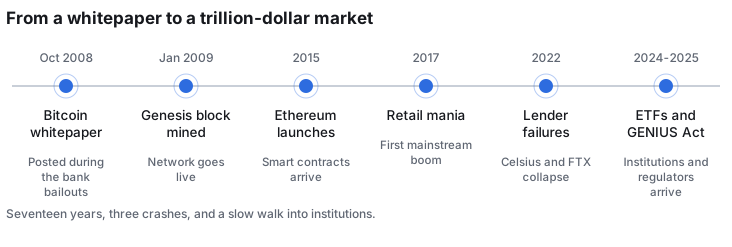
On October 31, 2008, weeks after Lehman Brothers collapsed and while governments were bailing out the banks that caused the crisis, a pseudonymous author or group calling themselves Satoshi Nakamoto posted a nine-page paper to a cryptography mailing list. Its title was "Bitcoin: A Peer-to-Peer Electronic Cash System." It proposed digital cash that didn't need a trusted third party to stop someone spending the same coin twice.

On January 3, 2009, Nakamoto mined the first block of the Bitcoin network, the genesis block. Embedded inside it was a line from that day's Times of London: "Chancellor on brink of second bailout for banks." Whether that was commentary or just a timestamp, it has stuck as the founding joke of the whole asset class. A currency born as a rebuttal to the system that needed rescuing.
For the first couple of years, Bitcoin was a hobbyist curiosity with close to no market value. The famous 2010 pizza buy, 10,000 BTC for two pizzas, is the usual marker of how little anyone thought it was worth. That changed slowly, then quickly, as exchanges appeared and other coins launched, and in 2015 Ethereum introduced smart contracts: code that runs on the blockchain itself, the idea that eventually made stablecoins and the 2020–2021 speculative boom possible. That's the pivot point. Along the way came a 2014 exchange collapse (Mt. Gox), a 2017 retail mania, a 2022 wave of lender failures (Celsius, FTX), and a slow, uneven climb toward institutions actually taking part instead of just watching from outside.
Where it stands today
Seventeen years past that whitepaper, it isn't a fringe experiment anymore. But it isn't the settled, mainstream asset class its biggest backers describe, either. Both things are true at once, and the current numbers show why.
The total crypto market was worth roughly $2.7 trillion as of early September 2026, according to CoinGecko's own tracker. That's well off the roughly $4.27 trillion peak reached in October 2025. Down by more than a third in under a year. CoinGecko tracks more than 18,000 coins, but that headline count is misleading on its own, because industry estimates put well over half of all cryptocurrencies ever listed as dead or inactive, most of them low-effort tokens that never had real use behind them, and the market's actual weight sits in a small number of assets, Bitcoin foremost among them.
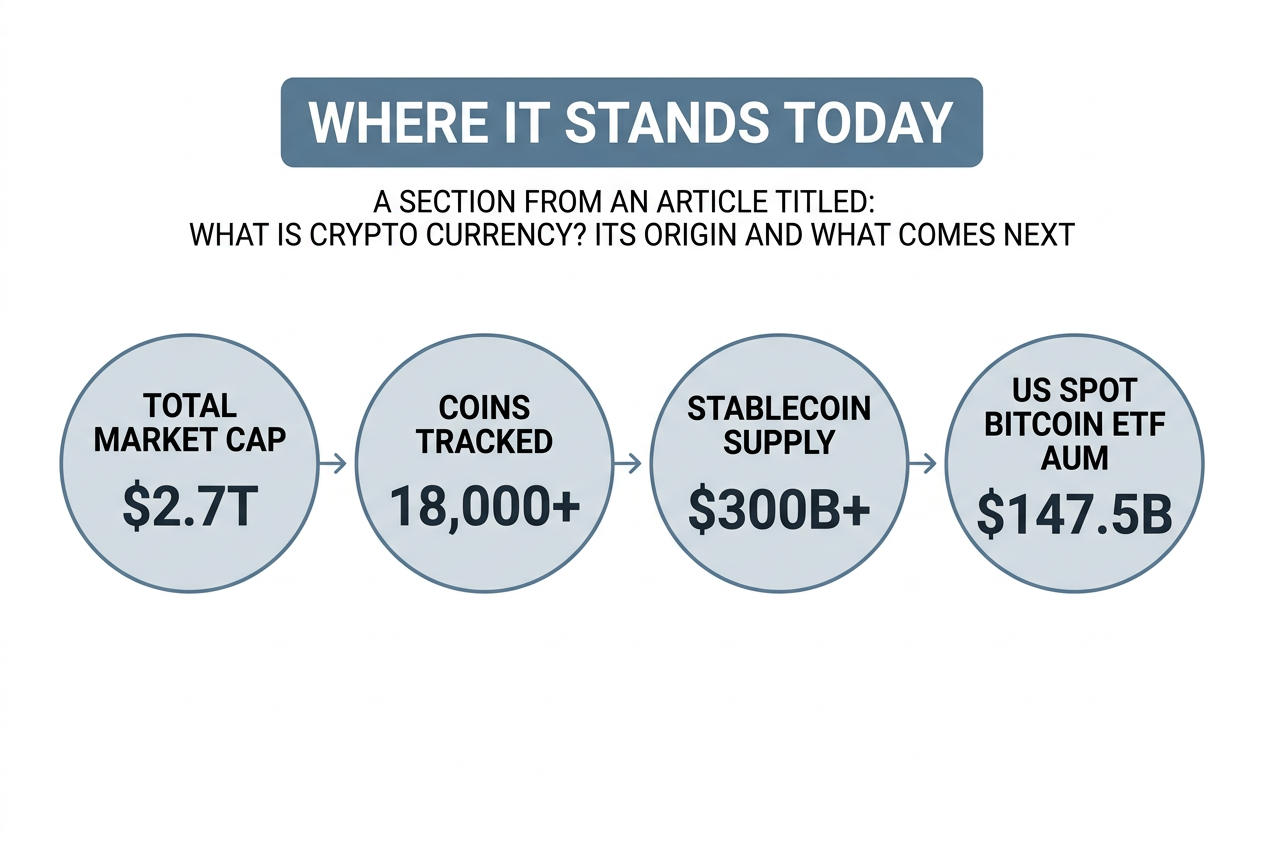
What's genuinely new since the early speculative years is institutional plumbing. US spot Bitcoin ETFs, approved in January 2024, had pulled in roughly $147.5 billion in combined assets by late September 2025, with BlackRock's IBIT alone reported near $70 billion. That's a channel that lets a pension fund or a brokerage account hold Bitcoin exposure without touching a crypto exchange directly. Stablecoins are tokens pegged to the US dollar and backed by reserves. They have grown into their own $300 billion-plus category, led by Tether's USDT, and now work less like a trading tool and more like dollar rails for payments and settlement.
Bitcoin ETF Inflows Are Back? What the Data Says About BTC · Coin Radar · Watch on YouTubeRegulation has caught up unevenly. The GENIUS Act, signed into law in July 2025, gave stablecoin issuers a federal licensing framework for the first time. Regulators, though, had still not finished the implementing rules by its own mid-2026 deadline. A broader market-structure bill, the CLARITY Act, would settle which US agency oversees which kind of token. It has cleared the House and is waiting on a contested Senate vote, which tells you how unresolved even the basic question of who regulates this still is in the world's largest market.
Practical rule: Any crypto currency headline is really about one of two things: the asset itself, or the rules and custody layer built around it. Knowing which one you're reading about tells you how much it should actually move your view.
What the future scope realistically looks like
The next phase looks less like another speculative cycle and more like infrastructure quietly getting adopted by the institutions that spent the last decade dismissing it.
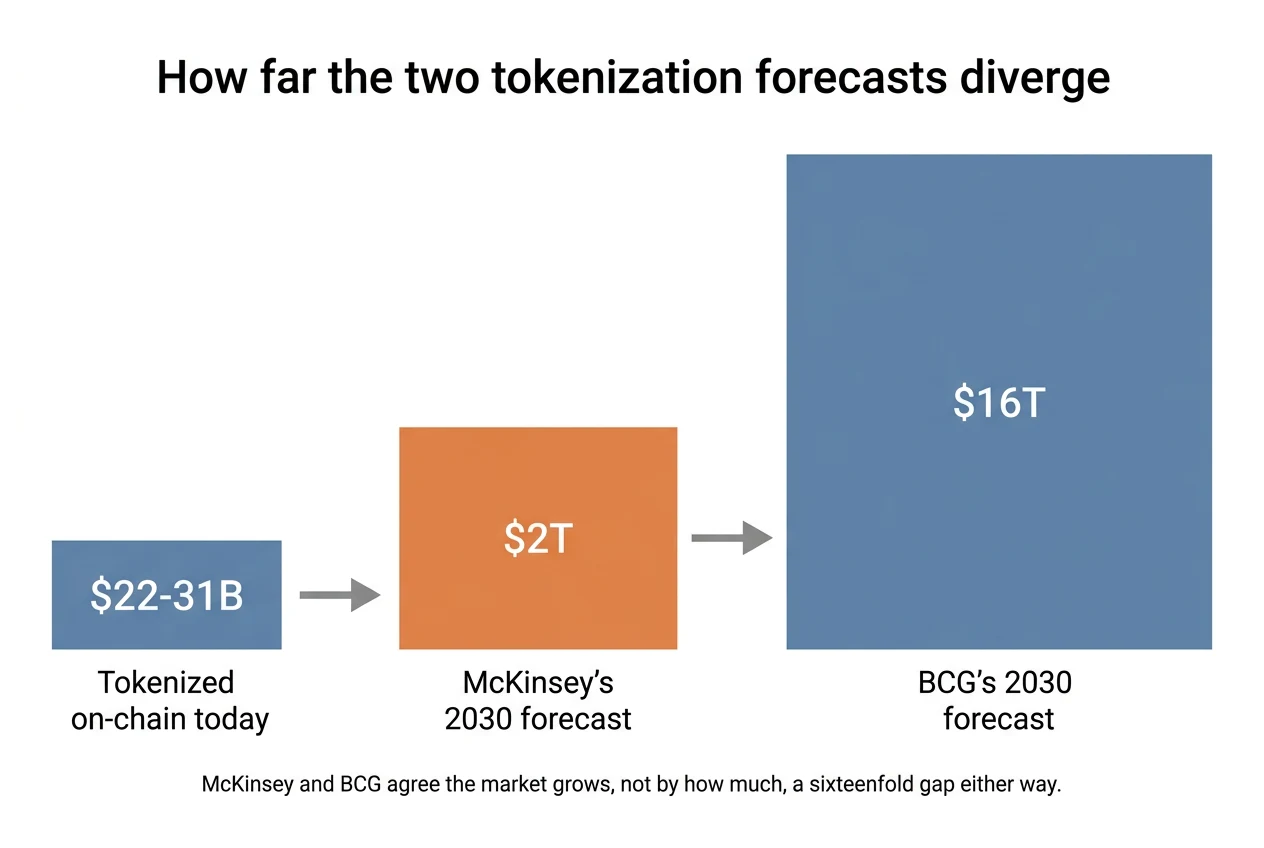
Tokenization of real assets is the clearest trend already underway. Treasuries and private credit, tokenized and recorded on a blockchain, reached roughly $22 to $31 billion on-chain by mid-2026, up more than 400% from early 2025, with BlackRock and Franklin Templeton among the institutions driving it. McKinsey has projected that market could reach around $2 trillion by 2030; Boston Consulting Group has floated a far larger $16 trillion figure. Both numbers are real projections, not commitments, and the gap between them is a fair measure of how much uncertainty is still baked into any forecast this far out.
Stablecoins are becoming payment infrastructure, not just trading collateral, now that they have an actual US legal framework behind them, with banks and payment companies exploring their own issuance.
Regulatory clarity, if it actually lands, becomes the unlock for the institutional money still sitting out. A settled answer to which US agency oversees which asset, the exact question the CLARITY Act is trying to resolve, is what large asset managers have cited as the missing piece before committing more client money.
Ownership keeps broadening, unevenly. Estimates of global crypto ownership vary a lot by methodology. One widely cited industry report put it near 561 million people in 2026; another put it closer to a billion. Every source agrees on the direction, though: up, with the US and India among the largest markets by number of holders.
What isn't realistic is treating any of this as a straight line. A market that lost over a third of its value between late 2025 and mid-2026 isn't done being volatile just because the word "institutional" now attaches to it, and a regulatory bill can still fail a Senate vote the same way it has before. Nothing here is guaranteed.
So what does this mean for you?
If you came here to understand what crypto currency actually is, the honest summary is this: it's a real, working answer to moving value without a central intermediary, it emerged directly out of the 2008 financial crisis, and it has grown from an anonymous whitepaper into a multi-trillion-dollar market that traditional finance now takes part in rather than ignores. It's also still volatile, and it's still full of assets that will go to zero. Both are true.
That's less a reason to jump in or stay out, and more a reason to treat any specific coin the way you'd treat any other claim on your money: checked against real data rather than a headline. If you're looking at a specific asset next, the mechanics of actually buying and holding one are covered in crypto investment. And if you want to track how an asset is actually behaving rather than how it's being described, that's what crypto market analysis tools are built for.
GeckoScreener Team
Written for the GeckoScreener community. Join us on Telegram →
Related Articles


Start screening cryptocurrencies for free
Apply strategies like this one in real-time across 250+ coins.
Try GeckoScreener →