Pay With Crypto: Where It's Legal, and How It Works
Pay with crypto: which countries actually allow it, how a payment moves from wallet to merchant, and where using it legally makes practical sense right now.
GeckoScreener Team
Sep 11, 2026 · 10 min read
Updated about 1 month ago
Can you actually pay with crypto? In dozens of countries, yes. At a hotel, an online store, even a real estate closing, though that closing still settles in local currency. In other countries it's legal to own but no law forces a till to take it. Here's the actual map, and how the payment itself moves once you try it.
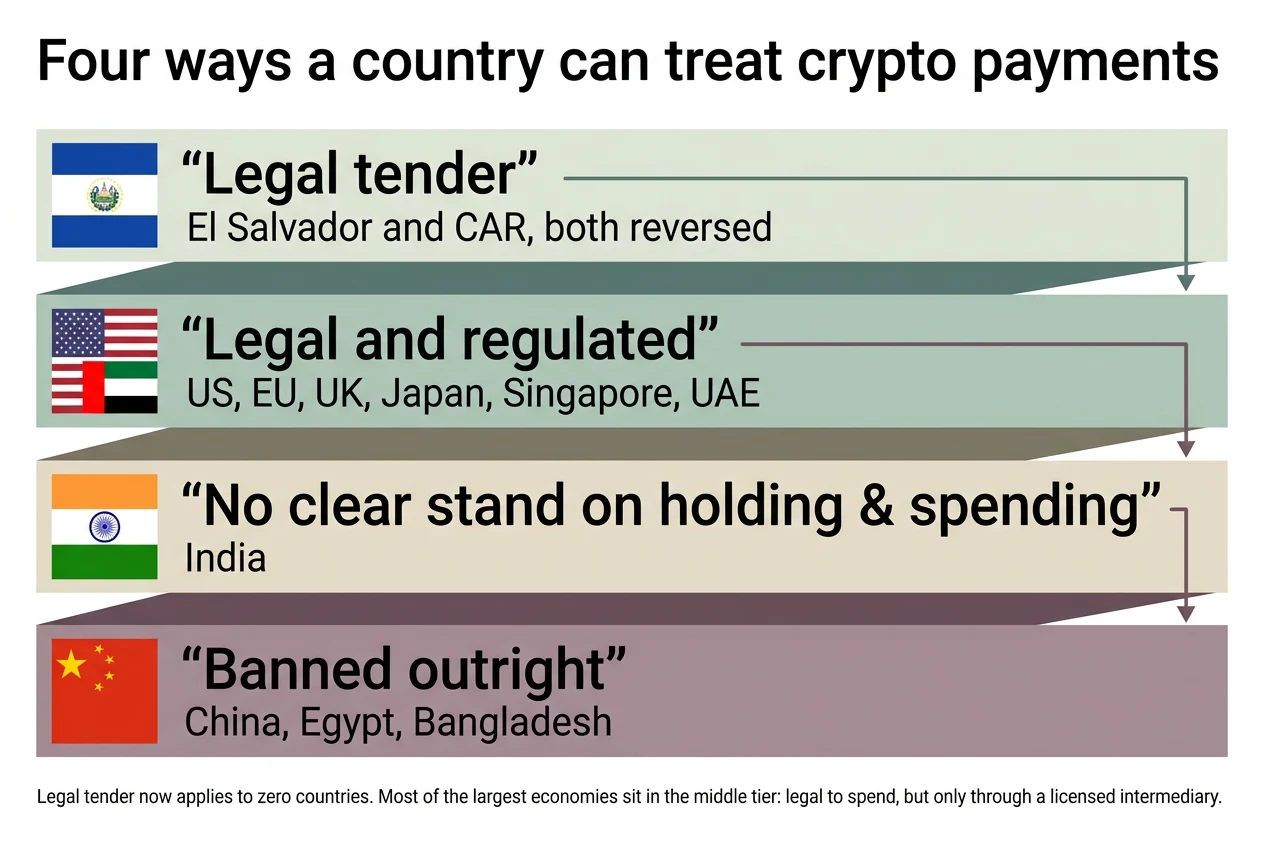
In short: Only El Salvador and the Central African Republic ever made Bitcoin legal tender, and both have walked that back under IMF pressure. So nowhere on earth now requires a merchant to accept it. What's far more common, in the US, the EU, the UK, Japan, Singapore and the UAE among others, is crypto being legal to hold and spend through a licensed intermediary, without the government backing it the way it backs the dollar or the euro. A crypto payment almost never lands as crypto in a merchant's account. A payment processor or a card issuer converts it to fiat within seconds, at the price quoted the moment you paid, so the volatility risk sits with you for a few minutes at most, not with the shop. It's most useful today for travel bookings and everyday spending through a crypto debit card, plus cross-border transfers. For anything a government already runs well in its own currency, it's close to pointless.
Table of contents
- What "legal" actually means when you pay with crypto
- Where you can actually pay with crypto, country by country
- How a crypto payment actually happens, step by step
- Where paying with crypto is actually worth it
- So what does this mean for you?
What "legal" actually means when you pay with crypto
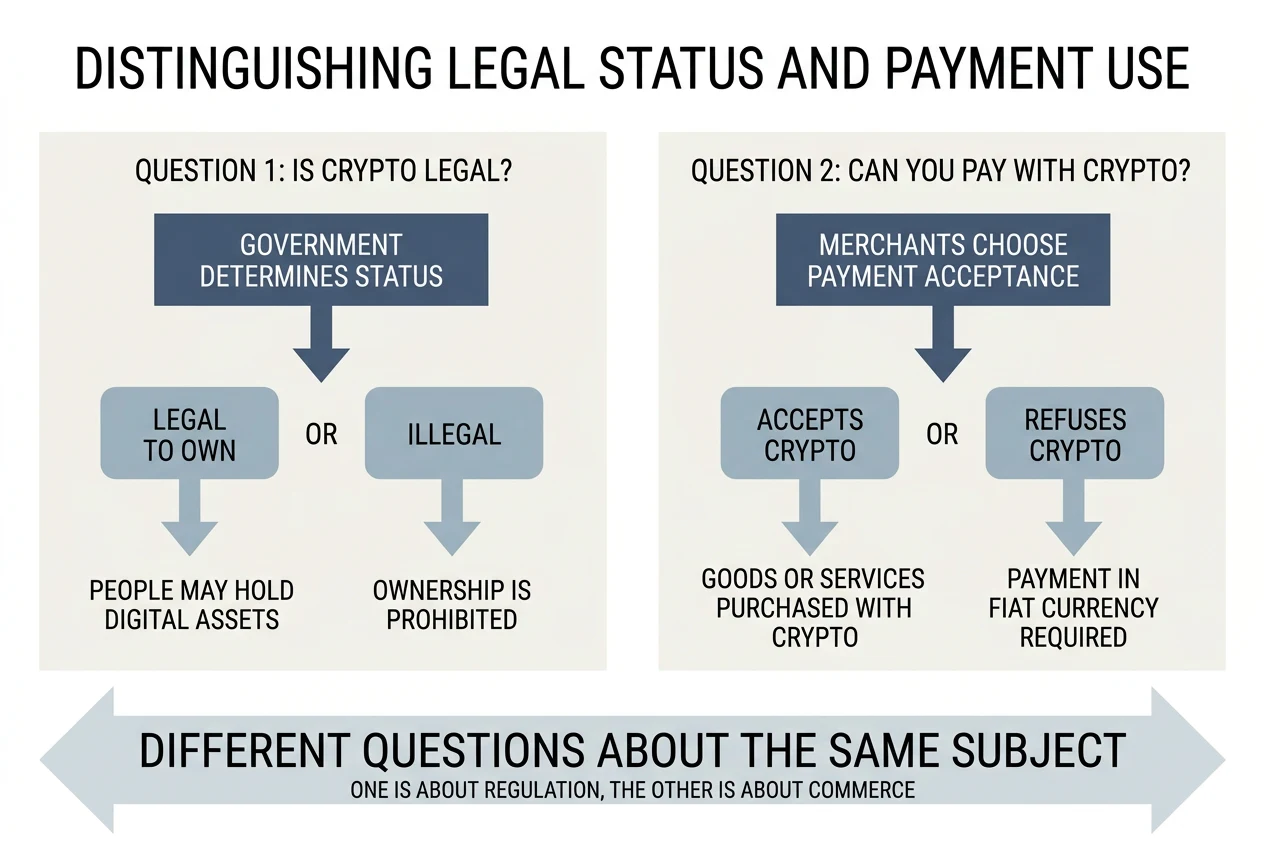
Two different questions get flattened into one all the time: is crypto legal, and can you pay with crypto. They're not the same question, and mixing them up is where most of the confusion starts.
"Legal tender" is a specific, narrow status. It means a government has declared a currency official, and by law, creditors must accept it to settle a debt. Almost nothing has that status except a national currency. Briefly, Bitcoin had it too, in two countries.
"Legal to use for payment" is a much lower bar. A merchant is allowed to take crypto if they want to, usually by converting it through a licensed exchange or payment processor, but nothing forces them to. That's the situation in most of the world's largest economies. Crypto is legal property there. It's taxable, increasingly regulated, and just isn't money in the sense a court will treat it as when you owe someone rent.
Practical rule: if a country's headline says crypto is "legal," check whether that means legal tender (rare, and now zero countries in practice) or legal to buy, hold and optionally spend through an intermediary (common). Almost every real answer is the second one.
Where you can actually pay with crypto, country by country
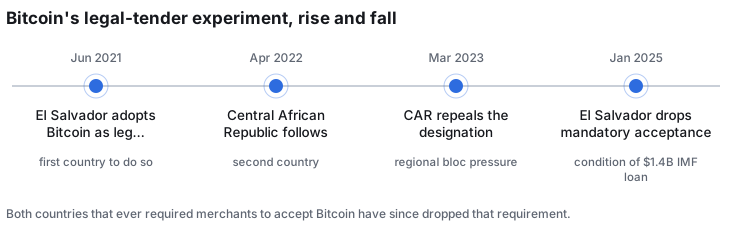
Legal tender, on paper, nowhere in practice. El Salvador made Bitcoin legal tender in June 2021, the first country to do so. The Central African Republic followed in April 2022. Both have since reversed the part that mattered most. CAR's parliament repealed the designation in March 2023 after pressure from its regional monetary union. El Salvador amended its own Bitcoin Law in early 2025 to secure a $1.4 billion IMF loan, dropping the rule that businesses had to accept it and removing it as a tax-payment option. Bitcoin is still legal to hold and use voluntarily in both countries. It just isn't compulsory currency anymore.
Legal and regulated, increasingly paying through licensed rails. In the US, crypto is legal but regulated by a patchwork of agencies: the SEC, the CFTC, and the IRS, which taxes every crypto transaction as property, including when you buy something with it. The EU's MiCA framework made licensing mandatory for crypto service providers across all 27 member states, starting July 2026. Its stablecoin rules, in force since mid-2024, let regulated "e-money tokens" move payments across the bloc once a single issuer is authorized. Japan runs crypto payments through its Payment Services Act; Singapore does the same through the Monetary Authority of Singapore, which had licensed roughly 30 major payment institutions handling crypto by early 2026. The UAE allows it too, with a catch worth knowing. Dubai's property market accepts crypto-funded buys, but the deal itself has to settle in dirhams, through a CBUAE-licensed dirham stablecoin, not directly in Bitcoin or Ether.
Legal to hold, not legal to spend. India is the case that trips people up most often, especially given how large its crypto-holding population is. Crypto is fully legal to buy, sell and hold there, and it's taxed as a "virtual digital asset." But the Reserve Bank of India doesn't recognize it as currency, and there's no legal path to using it as payment for goods, services or wages. India's own digital rupee, not Bitcoin, is what actually carries legal tender status there.
Banned outright, or close to it. China's ban covers trading, mining, and marketing, not just payments, and it hasn't loosened. Egypt treats crypto as an unregulated foreign currency, which makes using it to pay for anything illegal. Bangladesh's central bank has told the public plainly that crypto is illegal. Algeria, Morocco, Tunisia, Nepal, Bolivia, Qatar and Iraq are named across nearly every regulatory tracker as banning or heavily restricting it. If you're traveling, this is the list worth checking before you assume a crypto card will work the way it does at home.
How a crypto payment actually happens, step by step
There are really only two mechanics in use, and almost everything you'll meet is one of them.
Direct wallet-to-wallet. You send crypto straight from your wallet to the recipient's address. Your wallet software signs the transaction with your private key and broadcasts it to the network. A set of independent computers (miners or validators, depending on the chain) confirm it's valid and add it to the ledger. No bank sits in the middle. This is also the slowest and least forgiving option for retail use: a Bitcoin confirmation can take minutes, there's no chargeback, and if you send to the wrong address, that's final. It's why almost no shop does this at the register anymore, though it's still how most cross-border and wallet-to-wallet transfers work.
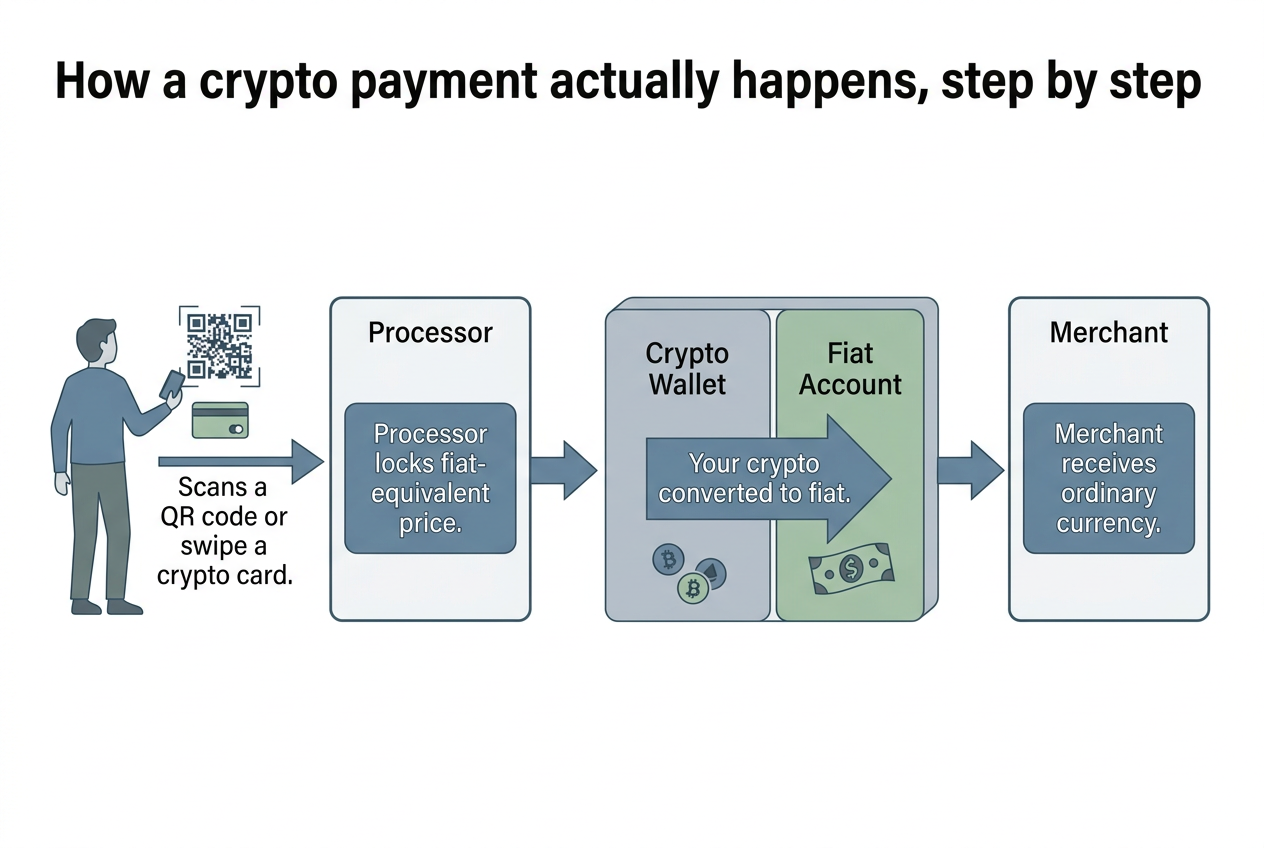
The Easiest Way to Spend Bitcoin (No Cashing Out Needed) · CoinGecko · Watch on YouTubeThrough a payment processor or card, with fiat doing the settling. This is what's really behind most "pay with crypto" checkouts and cards today. A gateway like BitPay or a card like the Crypto.com Visa or Coinbase Card sits between you and the merchant. You scan a QR code or swipe the card; the processor locks in a fiat-equivalent price for a short window (BitPay, for instance, quotes and holds a price for around 15 minutes); your crypto moves to the processor, gets converted, and the merchant receives ordinary currency, usually within the day. The merchant never touches volatility, and increasingly, neither do you for more than a few minutes. Every one of those card swipes is also a taxable event in the US and several other jurisdictions, because converting crypto to fiat, even to buy a coffee, counts as a disposal.
Stablecoins are quietly becoming a third lane worth naming separately. A token like USDC, or a MiCA-licensed euro e-money token, moves like the first mechanic: wallet to wallet, no bank needed. But the price doesn't swing under your feet while the transaction confirms. That's the main thing that made direct crypto payments impractical for everyday buys in the first place.
Where paying with crypto is actually worth it
The honest answer is narrower than the marketing around it suggests.
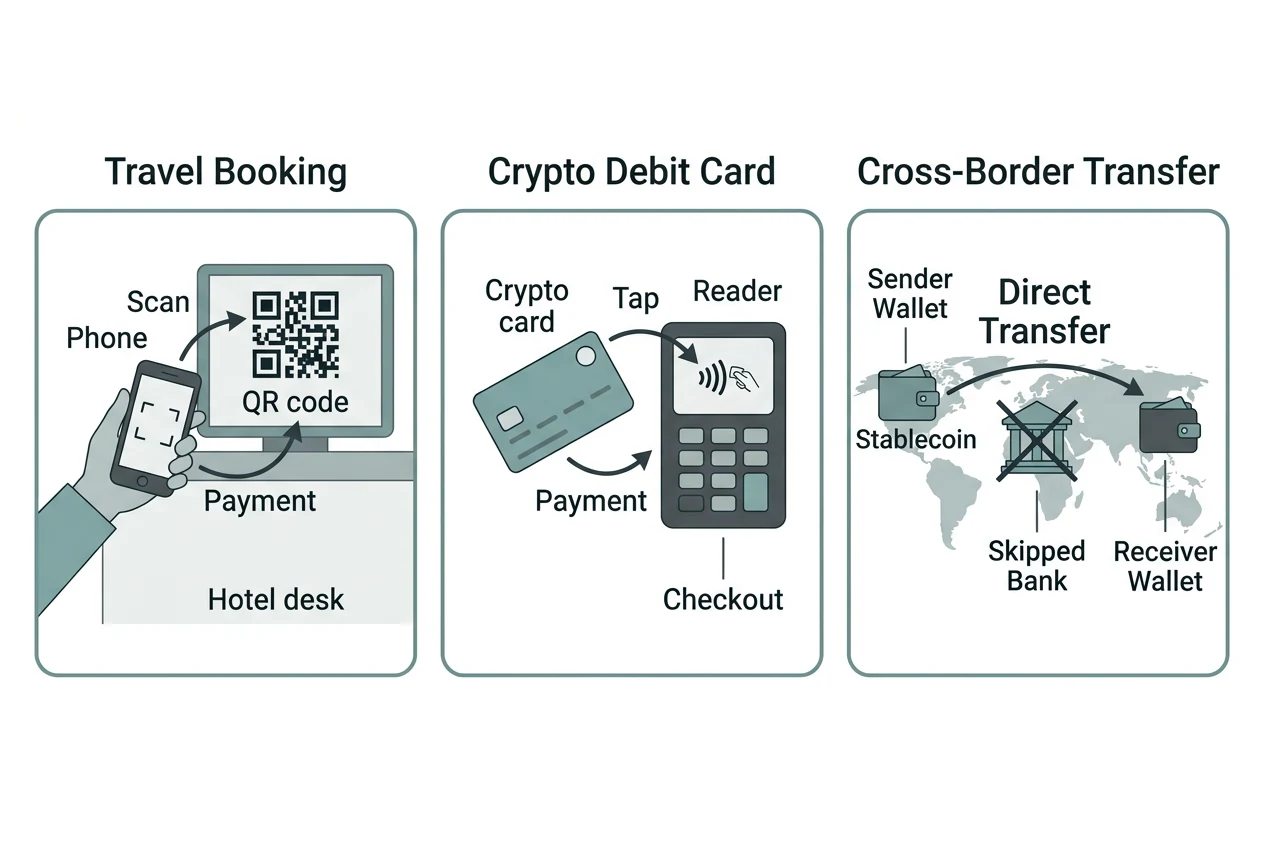
Travel is the clearest real use case. Platforms like Travala let you book flights, hotels and car rental with over a hundred cryptocurrencies, scanning a wallet QR code at checkout the same way you'd use a bank transfer. This works well because travel spending is often cross-border, where card foreign-exchange fees and settlement delays are the actual pain point crypto removes.
A crypto debit card is the practical everyday version. It converts your balance to fiat at the point of sale and works anywhere the card network does, which means you get the spending experience of a normal card with the holdings sitting in crypto until the moment you spend. The tradeoff is that tax paperwork, not the payment itself, becomes the friction.
Cross-border transfers and remittances, especially in stablecoins, are where the wallet-to-wallet mechanic genuinely beats the alternative. No correspondent-bank chain, no multi-day settlement. And increasingly a regulated rail on both ends, now that the US GENIUS Act and the EU's MiCA both give stablecoin issuers an actual legal framework.
Where it's close to pointless: paying a bill in a country whose banking and card infrastructure already works well and cheaply, just to say you used crypto. The conversion step exists whether you like it or not, and outside travel, remittances and card-linked spending, you're usually adding a step, a tax event, and a small fee to something that already worked.
So what does this mean for you?
If the question that brought you here was simply "can I pay with crypto," the answer is: probably yes, through a card or a processor, in most of the world's major economies. But almost nowhere as legal tender, and nowhere without a conversion step happening somewhere in the chain. Check the specific country before you travel with the assumption that a crypto card behaves the same way it does at home. China, Egypt and Bangladesh are not the same situation as the US, the EU or Singapore. And every card swipe is a taxable event. It's not simply a convenient way to pay.
If you're trying to understand the asset itself before deciding whether any of this is worth using, what crypto currency actually is is the place to start. If spending isn't really the goal and holding is, crypto investment covers buying and holding it properly instead of just moving it around. And if the regulatory side is what you're tracking, the US market-structure fight covered in the Clarity Act is the piece that will most directly decide how far stablecoin-based payments can go from here.
A note before you go: nothing above is a recommendation to use any specific app, card, or processor named in it. Rules change by country, and sometimes by city, faster than any article can track. Check your own local law before making or accepting a crypto payment, rather than relying on this piece alone.
GeckoScreener Team
Written for the GeckoScreener community. Join us on Telegram →
Related Articles

Start screening cryptocurrencies for free
Apply strategies like this one in real-time across 250+ coins.
Try GeckoScreener →