Stop Loss vs Trailing Stop Loss: Best Crypto Strategy
Compare stop loss vs trailing stop loss to protect crypto profits. Learn which strategy suits your trading style and risk tolerance.
GeckoScreener Team
Aug 2, 2026 · 20 min read
Updated about 2 months ago

You're long, the chart is finally doing what you wanted, and then one ugly pullback wipes out half the open gain while you sit there hoping it bounces before your stop gets touched. That's the core exit problem in crypto, not entry timing. The hard part isn't finding a coin that moves, it's deciding whether you want a static risk cap or a ratcheting profit lock before the market reminds you how fast it can reverse.
| Criterion | Stop Loss | Trailing Stop Loss |
|---|---|---|
| Core purpose | Caps loss at a fixed level | Follows price only in the favorable direction |
| Behavior after entry | Stays where you place it unless you move it | Moves up with new highs, never moves down |
| Best use case | Defined-risk trades, ranges, mean reversion | Trend-following, breakout runs, momentum holds |
| Profit protection | Limited | Stronger, because it can lock in open gains |
| Main weakness | Doesn't protect unrealized profit | Can get shaken out by normal pullbacks |
| Execution risk | Usually simpler to reason about | Trigger logic is clear, fill quality still isn't guaranteed |
Table of Contents
- The Exit Problem Every Crypto Trader Faces
- How Fixed and Trailing Stops Function
- Comparing Stop Loss Strategies Across Key Criteria
- Equity Curve Impact and Position Sizing Examples
- When Each Strategy Outperforms the Other
- Implementation and Calibration Best Practices
- Crypto's volatility pattern drives the debate
The Exit Problem Every Crypto Trader Faces
You buy a coin after a clean breakout. It moves fast, your unrealized PnL looks great, and you tell yourself you'll let it run. Then a normal pullback hits, your confidence wobbles, and you either dump too early or watch profit melt because your stop was too loose to matter. That emotional gap between “up nicely” and “sold too soon” is where a lot of crypto edge gets lost.
Same entry, different exit, different trade
The entry often gets too much credit. Two traders can buy the same candle, at the same time, and end with completely different outcomes because one used a fixed stop loss and the other used a trailing stop loss. The first trader has a known maximum loss, but if the market trends in their favor, the stop stays where it was placed unless they manually change it. The second trader gives the position room to grow, but pays for that freedom when the market retraces and knocks them out before the move is over.
That difference matters more in crypto than a lot of people admit. Crypto doesn't just trend, it can surge, stall, and whip back hard enough to make a cautious exit look smart and a tight trailing stop look absurdly expensive. A fixed stop can keep you alive in chop, while a trailing stop can keep you from giving back a winner that already paid you.
Practical rule: if your exit rule changes the whole distribution of wins and losses, it's not a detail. It's part of the strategy.
Why the same trade can feel right and still be wrong
The painful part is that both exits can look correct in the moment. A fixed stop saves capital when a breakout fails, but it also leaves all the profit management work to you. A trailing stop automatically handles the “should I give this more room?” decision, but it can be too eager in crypto's noisy intraday swings.
That's why the comparison isn't just loss control versus profit protection. It's capital preservation versus trend capture. If you trade momentum and don't respect that trade-off, you'll keep cutting your best ideas too early or holding dead money too long. If you trade mean reversion and use a trailing stop like it's magic, you'll often exit right where a rebound was most likely to start.
The SEC's investor bulletin on trailing stops explains the one-directional ratchet clearly, the stop moves up with favorable price action and stays fixed when price reverses, which is exactly why it behaves so differently from a regular stop loss (SEC investor bulletin). That's the whole game in one mechanic.
How Fixed and Trailing Stops Function
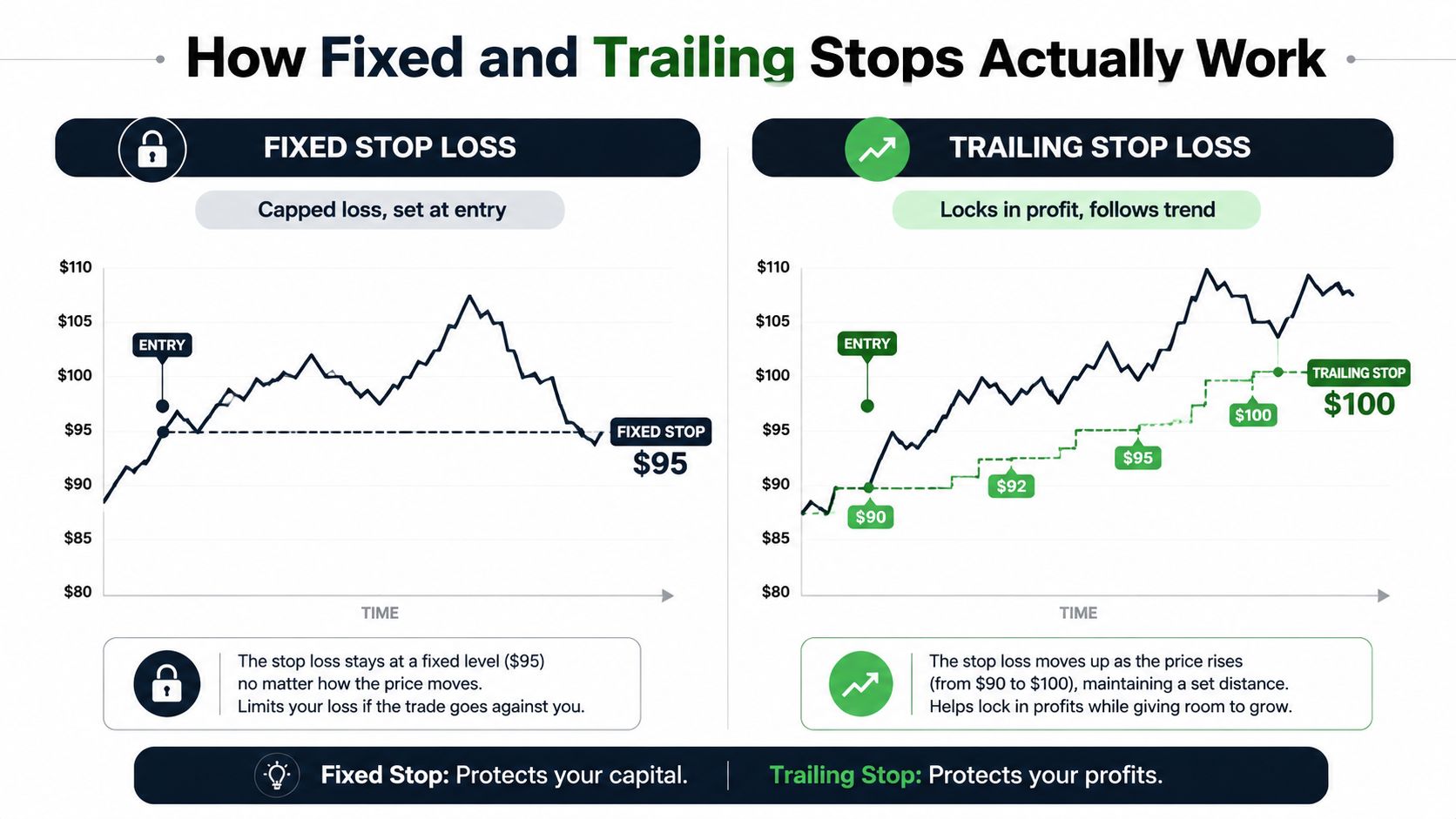
A fixed stop loss is simple. You set a price level where you admit the trade is no longer working, and if price reaches it, you exit. It does not care whether you are up, down, or still flat, the stop stays where you placed it unless you change it manually. That makes it a clean risk cap, especially when you already know how much you are willing to lose on the setup.
A trailing stop loss works differently because the trigger price is not fixed. It sits at a defined percentage or dollar offset from the current market price and only trails in the favorable direction. The SEC describes that one-way behavior as a ratchet, and Investopedia explains the basic pattern clearly, the stop rises as price climbs, stays put when price stops rising, and triggers if price later falls to that level (Investopedia trailing stop loss explanation).
Market order or limit order changes everything
The detail that trips traders up is the difference between a trailing stop order and a trailing stop-limit order. A trailing stop order turns into a market order when the stop is hit, so you are more likely to get out, but not at a guaranteed price. The SEC bulletin on investor protections covers how stop orders can be used, and CMC Markets notes that execution and price are not guaranteed once the stop converts, which matters a lot in fast or gap-prone markets (SEC investor bulletin, CMC Markets trailing stop-loss orders).
A trailing stop-limit order changes that. It turns into a limit order instead of a market order, so if price moves too fast through your limit, you may not get filled at all. That is the trade-off, better price control on paper, weaker certainty of exit in practice. In crypto, where candles can accelerate through obvious levels, that distinction is not theoretical.
A stop that “protects” you but does not fill when the market is moving is just a plan to stay exposed longer than you wanted.
Why offset size matters more than the label
The stop type matters, but the offset matters just as much. CMC Markets notes that traders often set the trailing distance as a fixed currency amount or a percentage of price, then calibrate it to the asset's normal intraday volatility (CMC Markets trailing stop-loss orders). Too tight, and ordinary noise knocks you out. Too wide, and the trailing stop stops behaving like protection and starts acting like a delayed exit.
A useful example is the classic 10% trailing stop on a $100 stock, which would start at $90 and move to $108 if the stock later reached $120. The stop is measured from the peak after entry, not from the original entry price (YouTube example of a 10% trailing stop). That is the mental model to keep in your head, the stop is always chasing the high, never the original buy.
Crypto makes that model harder to use. A move that looks like a healthy pause in an equity can turn into a stop-out in a thin altcoin almost immediately, and that is where the hidden cost shows up on the equity curve. A trailing stop can preserve capital during a strong trend, but if it is calibrated too tightly for crypto volatility, it can cut off a position during a normal pullback and leave you with a smaller gain than the trade deserved.
For a broader framework on sizing risk and reward around exits, this lines up with a practical risk-reward ratio guide, because the stop choice changes the whole payoff shape.
Comparing Stop Loss Strategies Across Key Criteria
The right way to judge stop loss vs trailing stop loss is by the job you want the exit to do. If you need a hard line that says “this trade was wrong,” fixed stops are cleaner. If you need the exit to follow a trend and protect open profit, trailing stops do more for you, but they ask you to tolerate more noise and more false exits.
What each one does well and where each one fails
A fixed stop is strongest when your priority is predictable maximum loss. That's valuable when you're trading a tight book, scaling across several coins, or managing positions where you need the risk on each trade to be easy to calculate. The drawback is obvious, it protects capital, but not accrued profit.
A trailing stop is strongest when the market is already moving in your favor and you want the exit to adapt. The downside is equally obvious in crypto, because healthy trends often include sharp pullbacks that are still normal behavior. If the offset is too tight, the stop can get hit by routine volatility, which turns a strong trend into a small realized gain instead of a larger one.
For readers who want a broader framework for sizing risk and reward around exits, the logic pairs well with this risk-reward ratio guide, because the stop choice changes the whole payoff shape.
Side by side trade-offs that matter in crypto
| Criterion | Fixed Stop Loss | Trailing Stop Loss |
|---|---|---|
| Capital protection | Strong and easy to define | Stronger only after price moves in your favor |
| Profit preservation | Weak unless you manually adjust | Better, because it follows the trend |
| Whipsaw exposure | Lower if placed intelligently | Higher if the offset is too tight |
| Execution reliability | Usually straightforward | Trigger is clear, fill can still slip |
| Management overhead | Low after placement | Lower than manual management, but more sensitive to calibration |
| Fit for crypto chop | Often better | Often worse |
| Fit for momentum runs | Can leave profit on the table | Usually the better fit |
The hidden cost in crypto is premature exit during normal pullbacks. A trend can look healthy, pull back hard, and still be intact. A trailing stop that's tuned for equities can be too sensitive in that environment, so the trade exits before the next impulse leg even starts.
What the market condition tells you
The more directional the move, the more valuable a trailing stop becomes. The more range-bound and mean-reverting the market, the more a fixed stop tends to fit the structure. That's why the same exit logic can look brilliant on one pair and clumsy on another.
The main thing to avoid is thinking of a trailing stop as a “better” stop by default. It isn't. It's a different exit mechanism with a different purpose, and in crypto the wrong offset can distort an otherwise good strategy.
Equity Curve Impact and Position Sizing Examples
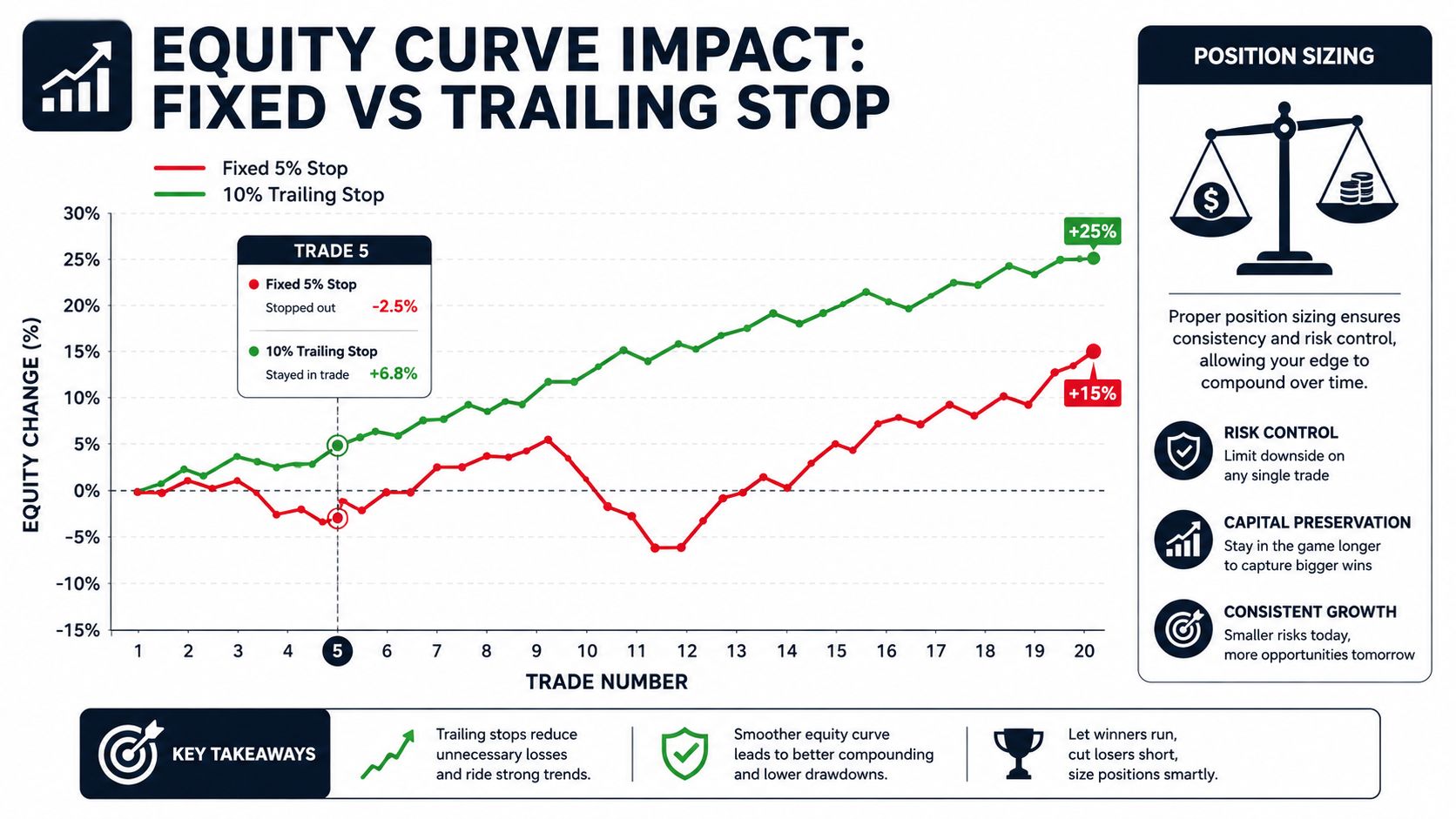
A stop choice doesn't just change one trade, it changes the shape of the equity curve. A fixed stop tends to produce more consistent loss control, while a trailing stop tends to protect open winners better, especially when trends keep extending. But the cost of that protection shows up during consolidation, where the trailing stop can turn a still-valid trend into a realized exit.
Why the equity curve looks better until it doesn't
The comparison chart highlights the core illusion traders run into. A trailing stop can look smoother because it avoids giving back too much of a winner, but it also creates more small exits when a trend pauses. A fixed stop can look choppier because it doesn't adapt after price moves up, which means it can let more unrealized profit swing around until you intervene manually.
That's where a lot of crypto traders misread the result. They see a trailing stop holding onto gains and assume it's automatically superior. In practice, the equity curve can improve in a trending phase and deteriorate in a choppy one, because the stop is always responding to the last favorable price, not to the structure of the next move.
The best-looking exit rule in a screenshot can still be the wrong one if it forces too many exits during ordinary consolidation.
Position size has to match stop width
This part is simple but too often ignored. Wider stops require smaller position sizes if you want to keep risk per trade consistent. Narrower fixed stops allow larger size, but only if the setup really deserves that tighter leash.
If you widen a trailing stop to survive crypto volatility and don't reduce size, you've increased your dollar risk whether you admit it or not. If you keep size constant while moving the stop farther away, your portfolio risk per trade rises. The stop and the size are one system, not two separate choices.
That's also why testing matters before money goes on the line. A backtest shows whether your exit logic is just reducing losses or improving the equity curve over a sequence of trades, instead of relying on one profitable chart snapshot. For that kind of workflow, backtesting trading strategies is where the answer comes from, not from intuition alone.
Trending versus choppy periods tell different stories
In a strong trend, the trailing stop usually gets the better outcome because it can stay with the move longer and let winners compound. In a choppy period, the same logic can bleed small exits as price oscillates around the trailing offset. The fixed stop doesn't solve chop either, but it can produce a more stable risk profile when the market keeps reverting instead of expanding.
That's the hidden cost of “let winners run” when the market doesn't cooperate. Winners don't always run in a straight line, and the stop that looks smartest on the final balance sheet is the one that matched the regime you were trading.
When Each Strategy Outperforms the Other
A fixed stop works best when the market is range-bound, mean-reverting, or uncertain enough that you want the exit to stay put. That fits day trades, failed breakouts, and setups where the cleanest decision is to get out fast instead of sitting through noise. It also suits traders who need a hard risk budget, because the maximum loss is easy to map before the order goes live.
A trailing stop works best when price is already doing the work for you. Momentum trades, breakout continuations, and swing positions in strongly trending altcoins usually give the trailing mechanism enough room to justify itself. The stop follows the move, so it can protect more of the advance without constant manual intervention. For a practical way to frame the placement of either exit, see how to set a stop loss.
Crypto's pattern is the real reason the debate exists
Crypto often surges in a straight line, then spends a long stretch chopping sideways. That combination is why no single exit tool wins everywhere. During the trend phase, a trailing stop can keep you in a move that still has fuel. During the consolidation phase, the same logic can produce a string of exits that look reasonable in the moment and frustrating later.
Equities can show the same behavior, but crypto's intraday volatility makes the trade-off harder to ignore. A stop distance that feels conservative on a liquid large-cap equity can be too reactive on a coin that whips around on ordinary flow. In crypto, that means the trailing stop often looks brilliant on the equity curve during the run, then gives back edge through repeated premature exits when the market is pulling back within the trend.
That hidden cost matters. A trader can preserve more upside on paper and still end up with a flatter result if the stop keeps taking them out before the move finishes.
A quick decision filter
If the market is trending and your setup is meant to ride that trend, trailing stops deserve a look. If the market is ranging and your edge comes from entering near exhaustion or support, fixed stops are usually the cleaner tool.
A trailing stop behaves like a live vote on whether the trend still deserves capital. In crypto, that vote gets cast more often because normal pullbacks are wider and faster than many equity traders are used to. That is why a trail that is too tight can turn a strong equity curve into a sawtooth, with a series of small exits that protect you from reversal but also cut off the natural breathing room of the position.
The best traders do not marry one exit style. They use the one that matches the setup, the timeframe, and the market condition. That is less tidy than a universal rule, but it fits how crypto trades.
Implementation and Calibration Best Practices
A stop only helps if the level reflects the trade, not your comfort level. Fixed stops belong where the setup is invalidated, which usually means beyond obvious support or resistance where crowded orders tend to sit. Put it exactly on the visible level and you invite a stop run.
How to calibrate without guessing
Trailing stops need enough room to absorb normal crypto volatility, but not so much room that they become a passive exit you never really use. The practical starting point is to size the offset around the asset's usual intraday movement, then test whether that distance survives ordinary pullbacks without handing back too much open profit. If you need a broader reference for setting the initial stop itself, how to set stop loss is a useful implementation guide for turning a trade idea into a defined risk point.
The mistake is usually calibration, not the order type. Set the trail too tight and normal noise takes you out before the move has room to mature. Set it too wide and the stop no longer protects much of the gain you were trying to keep.
Execution details matter as well. A trailing stop order can get you out through a market conversion, while a trailing stop-limit gives you price control but can leave you unfilled if the market moves too fast. In a sharp crypto tape, that trade-off decides whether you are flat or still exposed while price keeps moving away from you.
Keep the mechanics boring
Fixed stops should stay mechanical. Once the level is chosen, change it only if the trade structure changes, not because the position is underwater and you want more room. Trailing stops should be mechanical too, because frequent manual adjustments usually mean the rule is no longer doing the work for you.
A few errors show up again and again:
- Too-tight trailing distance: ordinary pullbacks trigger the stop before the larger move resumes.
- Too-wide trailing distance: the stop stops protecting open profit in any meaningful way.
- Ignoring fill risk: a stop that triggers but does not fill cleanly can leave you worse off in fast conditions.
- Using the same offset everywhere: a high-liquidity BTC setup and a thin altcoin need different treatment.
Tools should enforce the rule, not replace judgment
The cleanest workflow is one that makes the stop part of the plan from the start. Set the entry, stop, and exit rules together, then let the platform enforce them once the trade is live. That reduces the chance of improvising in the middle of a move, which is usually where exit discipline breaks down.
Backtesting and trade history are what tell you whether the calibration works before real money is on the line. Look at the equity curve, not just individual winners, and ask whether the exit kept you in enough of the move to matter after normal pullbacks. Consistency matters here. One loose exception can distort the whole result.
Crypto's volatility pattern drives the debate
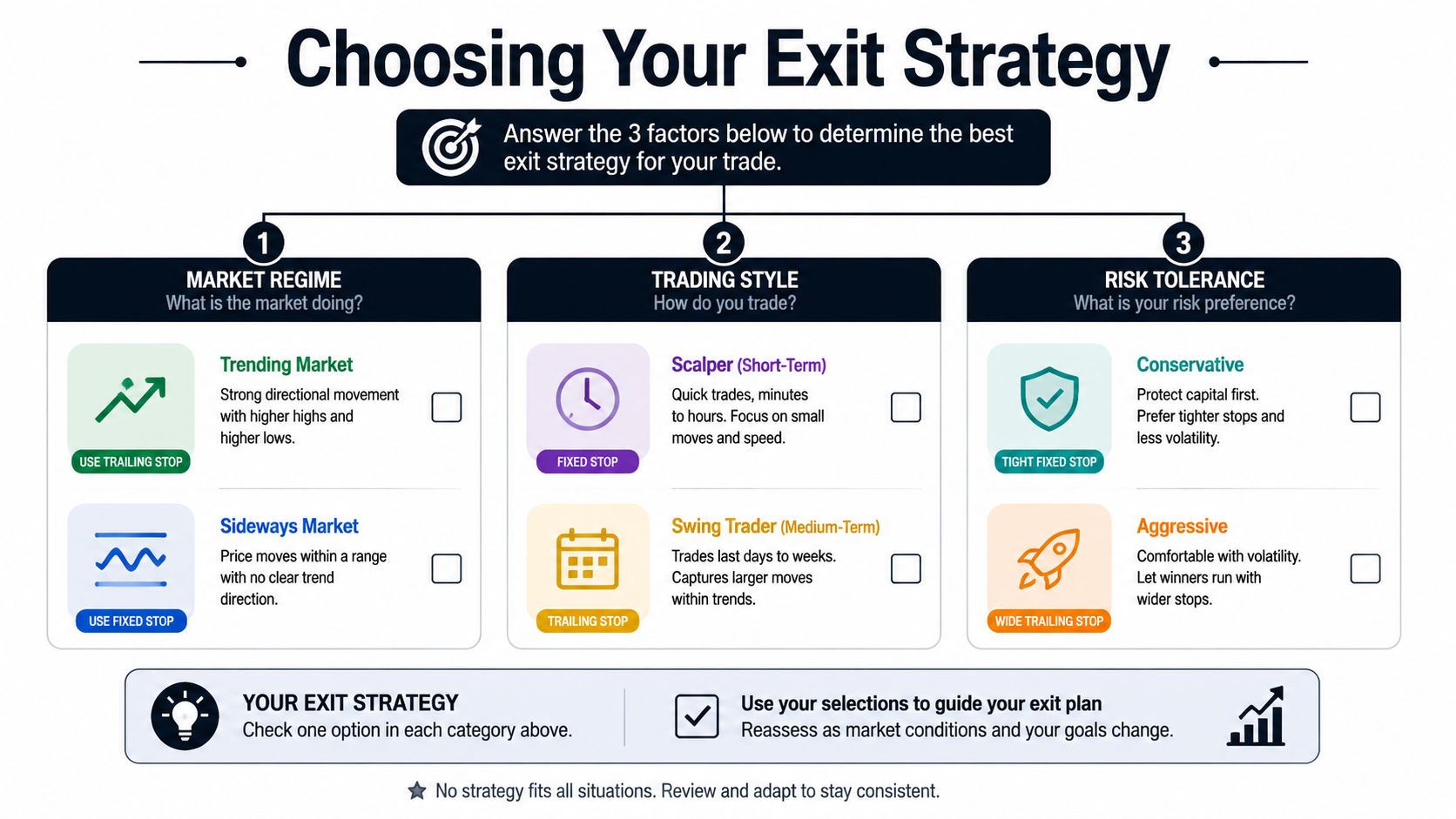
Use a fixed stop loss when the market is choppy, your setup is mean-reversion based, or your risk budget is tight enough that you need a clean ceiling on loss. Use a trailing stop loss when the market is trending and your real problem is keeping more of the winner without babysitting every candle. If you trade both conditions, you probably need both tools.
Match the exit to the timeframe
Day traders usually benefit from fixed stops because the session structure is cleaner and the trade thesis often dies quickly if the level breaks. Swing traders in trending altcoins usually get more value from trailing stops because the position has time to breathe and extend. Position traders can use either, but the decision should follow regime, not habit.
A hybrid approach often works well. Start with a fixed stop to define the initial risk, then switch to a trailing stop once price has moved far enough in your favor that the original loss cap no longer reflects the current trade. That gives you a hard line at entry and a dynamic line after the market proves you right.
In crypto, that switch matters more than it does in equities. A trailing stop that looks reasonable on a stock can get clipped by a normal pullback in BTC or a sharp wick in an altcoin, then leave you watching the move continue without you. Equity curves often show the hidden cost clearly, the account stays smooth at first, then the stop keeps taking you out before the larger leg finishes. The result is not one bad exit, it is a series of partial winners that never reach their full contribution.
Use your temperament as a filter
If watching open profit round-trip makes you exit too early, a trailing stop can remove some of that hesitation. If you know you get shaken out by normal crypto noise, a fixed stop with careful placement may be the more durable choice. Both exit styles interact with how you behave under pressure, regardless of personality.
The cleanest answer is usually situational rather than ideological. Trend trades want one kind of exit, range trades want another, and your own tolerance for drawdown decides how much wiggle room you can afford. A trader who can sit through a 4% pullback in a clean uptrend will usually hold a trailing stop differently from someone who reacts to every red candle. That difference shows up in the equity curve long before it shows up in trade journaling.
If you're serious about stop loss vs trailing stop loss in crypto, test the rules before you trust the feel of a single trade. GeckoScreener gives you a way to screen, define exits, and backtest those choices across multiple coins so you can see how they behave in trend, chop, and everything in between. Start there, then visit GeckoScreener and build a setup that fits the way you trade.
GeckoScreener Team
Written for the GeckoScreener community. Join us on Telegram →
Related Articles



Start screening cryptocurrencies for free
Apply strategies like this one in real-time across 250+ coins.
Try GeckoScreener →