7 Best Crypto Screener Tools for Smarter Research
Compare the 7 best crypto screener tools for real-time data, technical filters, pattern detection, speed, and practical trading use cases.
GeckoScreener Team
Aug 24, 2026 · 15 min read
Updated about 1 month ago

If you want fast top-100 screening with indicator and candlestick filters in one workflow, GeckoScreener is the strongest fit. Its 100+ asset coverage and 60-second refresh target setup discovery, while TradingView, altFINS, and the other tools are better for specific charting, pattern, research, market-discovery, DEX, or on-chain needs.
The popular advice is to find one “best crypto screener” and use it for everything. That approach breaks down because screening problems differ. A day trader may need fresh momentum data, a researcher may care more about asset metrics, and a DEX trader may need newly active pairs that never appear in a top-asset list.
This comparison ranks each platform by the job it performs best. The criteria are practical: market coverage, refresh speed, technical filters, pattern detection, chart access, research depth, and workflow fit. GeckoScreener's current focus is screening and chart-based analysis. Trading and backtesting features aren't available yet, although backtesting and alerts are expected soon.
Table of Contents
- 1. GeckoScreener
- 2. TradingView
- 3. altFINS
- 4. Messari
- 5. CoinGecko
- 6. DEX Screener
- 7. Santiment
- Top 7 Crypto Screeners, Feature Comparison
- Choose the Screener That Matches Your Workflow
1. GeckoScreener
GeckoScreener is the strongest choice for traders who want to move from a broad market scan to a clearly defined technical setup without switching between several tools. Its sortable table covers 100+ cryptocurrencies and refreshes every 60 seconds, according to the platform's own product description at GeckoScreener. That makes it a practical benchmark for short-horizon screening, especially for traders who monitor major assets rather than obscure micro-cap tokens.
The screener combines RSI, MACD, ADX, EMA, volume, and price-action conditions with 19 candlestick detectors, including patterns such as Doji and Hammer. The important distinction is that these signal families solve different problems. Momentum filters can identify acceleration, trend filters can reduce countertrend setups, volume can help assess participation, and candlestick conditions can describe the shape of a potential reversal or continuation.
Practical rule: Use indicators to narrow the market, then use the chart to decide whether the setup makes sense in context.
The plain-language strategy builder is the platform's most distinctive workflow feature. Instead of writing syntax, a trader can describe a screening idea and turn it into a precise query. That reduces the friction between an idea such as “find oversold assets in an established trend” and a repeatable market scan.
Where GeckoScreener fits, and where it doesn't
GeckoScreener is best for retail swing traders, day traders, technical analysts, and no-code strategy users who want a focused top-asset workflow. Its current product emphasis is screening and chart-based analysis. Built-in trading and backtesting aren't available yet, and backtesting and alerts are expected soon. Traders should therefore evaluate it today as a discovery and analysis tool, not as an execution or validation platform.
Coverage is also intentionally narrower than the entire crypto universe. That's useful when focus matters, but it won't suit someone whose primary objective is finding newly launched, very small-cap tokens across every chain.
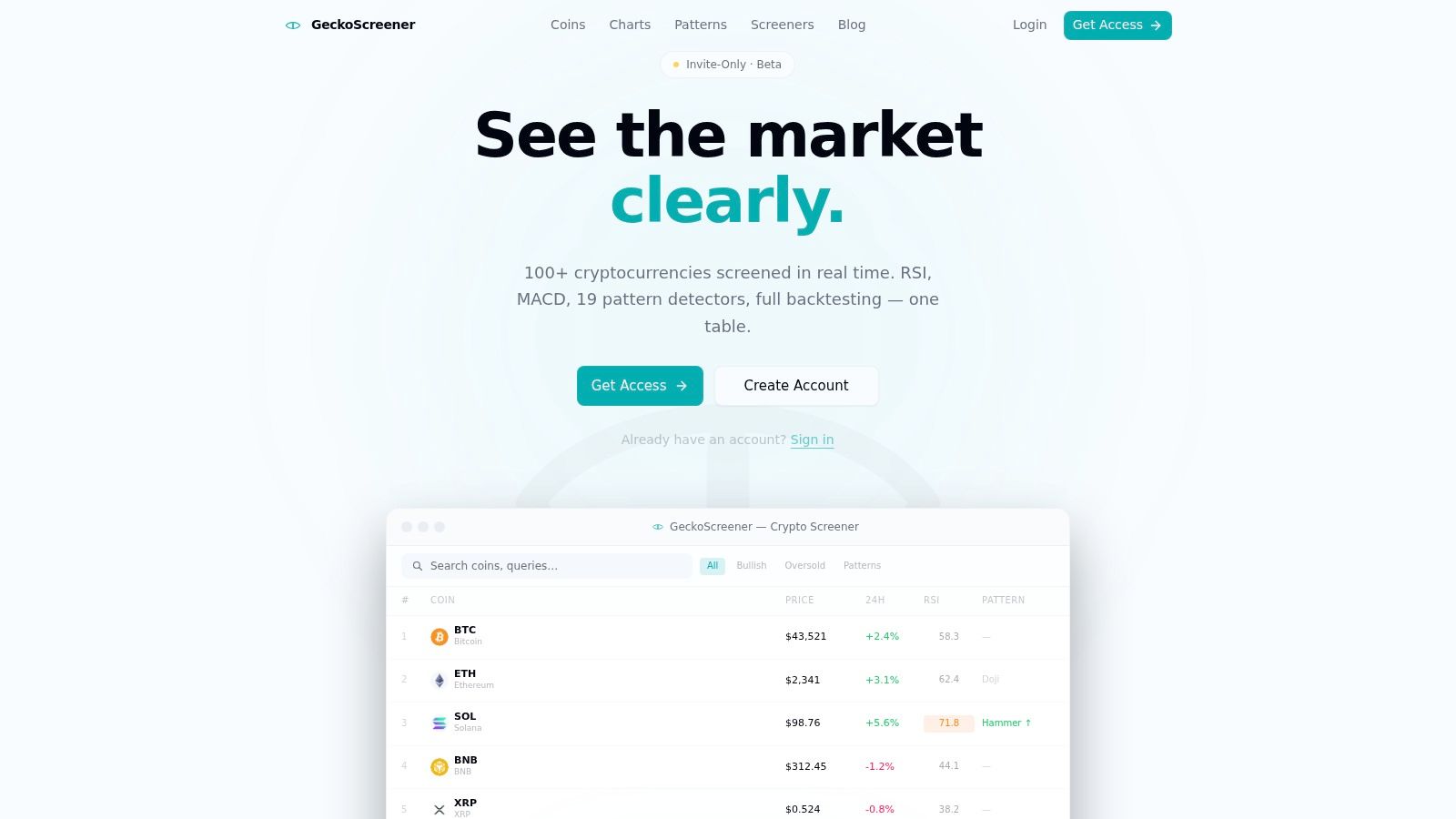
For a practical walkthrough of the interface and workflow, see this complete GeckoScreener guide. The key takeaway is simple: choose GeckoScreener when your first question is, “Which major assets match my technical conditions right now?”
Website: GeckoScreener
2. TradingView
TradingView is the better choice when screening must lead directly into professional chart review, alerts, watchlists, and community-based idea discovery. Its crypto tools include screeners for coins, centralized-exchange pairs, and decentralized-exchange pairs, so the platform can support both asset-level and pair-level research through TradingView's crypto screener.
The main advantage is integration. A trader can filter a market, open a chart, compare timeframes, configure alerts, and use the broader Pine Script ecosystem without rebuilding the workflow elsewhere. That connection matters more than a long filter list when the trader's process depends on visual confirmation and ongoing monitoring.
TradingView's crypto screeners provide 500+ technical fields, along with pre-built filters, custom columns, and multi-timeframe conditions. Because advanced refresh rates and features can depend on the selected plan, users should compare their required monitoring cadence with the available tier rather than assuming every screening function operates identically.
The best TradingView workflow is chart-first. Screening finds candidates, but the chart determines whether the structure is clean enough to investigate.
TradingView also benefits from a large community and ideas library. That can help users discover ways to frame a market, but community visibility shouldn't replace independent validation. A popular idea may still use a timeframe or risk framework that doesn't match the trader's plan.
Choose TradingView if you want the tightest connection between market scanning, charting, alerts, and technical publishing. Choose GeckoScreener instead if you prefer a more focused top-asset table built around indicator and candlestick conditions. For broader platform context, compare it with these crypto market analysis tools.
Website: TradingView crypto screener
3. altFINS
altFINS is the strongest fit for traders who want a crypto-first technical screener with AI-based chart-pattern recognition and multi-timeframe context. Its platform combines moving averages, EMA conditions, RSI variants, MACD, volume, relative volume, and pattern detection with saved scans and alerts through the altFINS crypto screener.
The differentiator isn't just the presence of technical indicators. It's the attempt to identify chart structures across different intervals, including 15-minute, 1-hour, 4-hour, and daily views. That helps a trader separate a short-term trigger from the higher-timeframe trend surrounding it.
A useful scenario is a momentum trader looking for a breakout candidate. The screener can narrow assets using trend and volume conditions, then add a pattern filter and compare the result across timeframes. That's more targeted than scanning a long list of coins and manually deciding whether each chart resembles a familiar formation.
Best use case
altFINS makes the most sense for traders who want saved scans, alert-driven idea discovery, and a technical workflow designed specifically for crypto. It's particularly relevant when the trader wants more than a price notification and needs a signal based on a combination of trend, momentum, volume, or pattern conditions.
The trade-off is complexity. A platform with multiple filter families and timeframes can require a learning period, especially for users who haven't defined which conditions confirm a setup and which conditions merely generate an alert. Public pricing and plan structures can also change, so buyers should verify current access before committing.
Avoid indicator stacking for its own sake. Add a filter when it answers a specific question, such as trend direction, participation, or volatility.
Choose altFINS for AI-assisted pattern discovery and multi-timeframe technical scans. If your priority is a simpler top-asset table with a 60-second refresh, GeckoScreener is the more direct fit.
Website: altFINS
4. Messari
Messari is the best option in this list for research-grade fundamental, thematic, and asset-universe analysis. Its Asset Screener is designed for a broad, filterable dataset rather than a narrow intraday technical workflow, with metrics that help analysts compare networks, projects, and market themes through Messari.
The platform supports advanced filtering across 50+ metrics and 30,000+ assets, according to the product description supplied for this comparison. It also offers transformations such as averages, sums, percentage changes, and minimum or maximum values over custom periods. Those functions are more useful for research questions than for a trader who only wants to identify an RSI condition on a current chart.
A fundamental analyst might use Messari to build a thematic screen, compare asset characteristics, or examine how a metric changes across a selected period. Customizable columns and research-focused sample screens can reduce the time needed to turn a broad universe into a structured shortlist.
The trade-off is focus. Messari is less suited to a pure intraday process where the user needs rapid technical scanning, chart-linked execution decisions, or a compact list of current candlestick signals. Its richer data model can also make the platform feel more enterprise-oriented, with fuller functionality potentially requiring paid access.
Messari belongs on a shortlist when the question is, “Which assets fit this fundamental or thematic framework?” It shouldn't be the default choice for every technical trader. A good research workflow may use Messari to define the universe, then use a technical screener to examine current market structure.
Website: Messari Asset Screener
5. CoinGecko
CoinGecko is the most accessible choice for basic market filtering and initial coin discovery. Its web and app experience lets users narrow assets by categories such as DeFi and layer-two networks, chains, market capitalization, volume, and price changes through CoinGecko.
That simplicity is the product's strength. A user researching a sector can begin with a category or chain, compare basic market information, and verify an asset before moving to a deeper analytics platform. CoinGecko also supports portfolio and wallet tracking, app-based alerts, and a public API and CLI for users who want to build external screening or automation workflows.
It's a useful starting point for a trader who hasn't yet formed a technical hypothesis. For example, someone exploring a particular blockchain ecosystem can first identify relevant assets, then transfer the shortlist to GeckoScreener, TradingView, or altFINS for chart-based analysis.
The limitation is filter depth. CoinGecko's market filters are lighter than dedicated technical-analysis screeners, and the Premium upgrade is positioned more around user experience and portfolio benefits than advanced TA conditions. Users looking for combined RSI, MACD, trend, volume, and candlestick logic will likely outgrow the basic workflow.
Use CoinGecko to define what deserves attention, not necessarily to make the final technical decision.
Choose CoinGecko when you want fast, accessible market discovery and basic verification. It's especially practical for free users and researchers who need broad orientation before applying more specialized filters.
Website: CoinGecko
6. DEX Screener
DEX Screener is the specialist choice for discovering activity in decentralized-exchange token pairs. It tracks pairs across multiple blockchains and DEXs, presenting pair pages with on-chart information such as liquidity, fully diluted valuation, price, and volume through DEX Screener.
Its value comes from speed and market discovery. Traders can examine new listings, trending pairs, and views that highlight shifting attention across chains. That's a different job from screening established top assets by RSI or moving-average structure.
A DEX-focused trader may use DEX Screener to investigate where activity is emerging, then inspect liquidity and volume before deciding whether a pair deserves further research. The tool's mobile availability also supports monitoring when the user isn't at a desktop charting setup.
The trade-off is equally clear. DEX Screener is less suitable for a top-100, centralized-exchange-focused technical workflow, and its historical and indicator screening is more limited than that of professional charting suites. Early discovery also demands additional diligence. A visible pair can still require checks of liquidity quality, contract risk, holder distribution, and execution conditions before any decision.
For users tracking speculative tokens, a dedicated meme coin tracker can complement DEX discovery, but it doesn't turn pair visibility into a trading recommendation.
Choose DEX Screener when your central question is, “Which DEX pairs are attracting activity now?” Choose GeckoScreener or TradingView when the question is instead about technical conditions across a defined asset universe.
Website: DEX Screener
7. Santiment
Santiment is the best fit for analysts who want signals beyond price, volume, and conventional technical indicators. Its Sanbase workflow combines on-chain, social, and behavioral metrics, including development activity, holder balances, funding, and social trends, through Santiment.
That data can add context to a technical screen. A trader may find a momentum setup and then ask whether network activity, holder behavior, or social attention supports further research. An analyst studying a longer-term thesis may start with behavioral data instead of waiting for a chart pattern to appear.
Santiment also connects screening with alerts, watchlists, Charts, Social Trends, Sansheets, and an API. Clear plan structures, API quotas, alert limits, and trial access help users evaluate whether the platform matches their research intensity before adopting it as a primary tool.
The main limitation is that the free experience restricts screening depth, filters, and sorting. The strongest value also depends on learning how to interpret on-chain and social inputs without treating them as standalone predictions. Data can lag price action, and social attention can reflect noise as easily as useful information.
A practical workflow is to use Santiment as a confirmation and context layer, not as a replacement for every other screener. Technical tools can identify what price is doing. Santiment can help investigate the behavior around that move.
Choose Santiment when your research question involves network behavior, social momentum, or holder activity. It's less direct for traders who only want a fast table of technical setups.
Website: Santiment
Top 7 Crypto Screeners, Feature Comparison
| Tool | Implementation complexity 🔄 | Speed / resource efficiency ⚡ | Expected outcomes ⭐ | Ideal use cases 📊 | Key advantages / Tips 💡 |
|---|---|---|---|---|---|
| GeckoScreener | Low, no‑code, plain‑language strategy builder; simple backtest workflow | Moderate, 60s refresh, top‑100 coverage; not an execution platform | High for TA-driven setup discovery and strategy validation; limited long history | Retail swing/day traders, technical analysts, strategy validation | No‑code strategy builder, portfolio & per‑coin backtests, shareable strategies |
| TradingView, Crypto Screeners | Moderate, powerful UI with optional Pine scripting for advanced flows | Fast UI and broad coverage; higher refresh/features on paid tiers | High for chart‑integrated signals, alerts and community idea validation | Chart‑centric traders, alerting/workflow integration, multi‑exchange screening | Pro‑grade charts + screeners, large community, Pine script ecosystem |
| altFINS, Technical + AI Pattern Screener | Moderate, many technical filters + AI pattern detection; some learning curve | Moderate, crypto‑focused filters and multi‑timeframe scanning; paid features likely | Good for momentum and pattern detection with multi‑timeframe context | Momentum/pattern traders wanting AI assistance and saved scans/alerts | AI chart‑pattern recognition, crypto‑first presets, API mirroring screener logic |
| Messari, Asset Screener (research‑grade) | High, research‑grade transforms and complex metric modeling | High resource needs, large asset coverage and enterprise features; paid access common | Excellent for thematic/fundamental research and deep quantitative screens | Analysts, researchers, institutional/thematic research across many assets | Powerful transforms (AVG/SUM/%Change), extensive docs and sample screens |
| CoinGecko, Free filters with Premium | Low, simple category/chain/market filters and app features | Very efficient, fast, broad free coverage; Premium for UX/portfolio perks | Moderate for discovery and basic metric checks; not TA‑deep | Casual discovery, sector/chain filtering, portfolio tracking | Wide free coverage, public API, easy verification of basic stats |
| DEX Screener, Real‑time DEX discovery | Low, focused, specialized UI for DEX pairs and trending views | Very fast, real‑time tracking across chains; free web & mobile | High for early/trending DEX token discovery; limited historical indicator depth | Finding new listings, monitoring DEX liquidity/trends, mobile monitoring | Real‑time pair pages, trending/metas views, broad multi‑chain coverage |
| Santiment (Sanbase), On‑chain/social screener | Moderate, requires familiarity with on‑chain and social metrics | Moderate, trial and clear plan quotas; some data lag possible | Good for behavioral/on‑chain signals that complement TA | Analysts combining on‑chain, social and behavioral research with TA | Differentiated on‑chain & social metrics, alerts/watchlists and API integrations |
Choose the Screener That Matches Your Workflow
The right tool depends on the first decision you need to make. If you're scanning established assets for current technical conditions, GeckoScreener offers the clearest fit with 100+ cryptocurrencies, 60-second refreshes, indicator filters, and 19 candlestick detectors. Its current role is screening and chart-based analysis. Trading and backtesting features aren't available yet, while backtesting and alerts are expected soon.
TradingView is the stronger choice when charts, alerts, watchlists, and community ideas sit at the center of the process. altFINS is better for traders who want AI pattern discovery and multi-timeframe technical scans. Messari suits broad fundamental and thematic research, while CoinGecko provides an accessible first pass for categories, chains, volume, and market changes.
DEX Screener serves a different market entirely. It's the specialist for fast DEX-pair discovery, new listings, and shifting attention across decentralized markets. Santiment adds on-chain, social, and behavioral context that price-based screeners can't provide on their own.
Use this selection checklist before choosing:
- Asset coverage: Does the platform include the coins, pairs, chains, or networks you research?
- Refresh speed: Is the update cadence suitable for your trade horizon?
- Filter type: Do you need technical indicators, market metrics, fundamentals, DEX data, or on-chain signals?
- Chart access: Can you move from a scan to a chart without rebuilding the analysis?
- Pattern detection: Do you need candlestick or AI chart-pattern recognition?
- Alerts: Are alerts available now, and do they match your monitoring workflow?
- Pricing needs: Which filters, refresh settings, API access, or research features require a paid plan?
- Validation requirements: Do you need screening only today, or future strategy validation and backtesting as those capabilities become available?
A broader market context explains why screening matters. Major providers now track more than 10,000 coins and over 300,000 crypto and fiat trading pairs, with minute-by-minute history, according to DYOR's crypto market data coverage. CoinDesk's data history reaches back to 2010, which supports longer-run analysis of price and volume behavior. Meanwhile, CoinMarketCap reports 262,906,061,281.24 dollars in 24-hour total market volume on its global metrics page at CoinMarketCap, reinforcing the practical need to filter for liquidity and meaningful activity rather than manually inspect every chart.
The most useful conclusion isn't that one platform has the longest feature list. Technical-analysis guidance separates indicators into momentum, trend, volatility, and volume roles, and notes that RSI, MACD, and Bollinger Bands have different blind spots in this technical-analysis overview. Test your shortlist against one real research scenario, such as finding a volume-confirmed trend setup or investigating a newly active DEX pair. The tool that produces a clear, repeatable decision path is usually a better choice than the tool with the most impressive menu.
GeckoScreener offers fast screening across 100+ cryptocurrencies, 60-second data refreshes, indicator filters, and 19 candlestick pattern detectors in a focused workflow. Visit GeckoScreener to test whether its setup-discovery process matches the way you research crypto markets.
GeckoScreener Team
Written for the GeckoScreener community. Join us on Telegram →
Related Articles

Start screening cryptocurrencies for free
Apply strategies like this one in real-time across 250+ coins.
Try GeckoScreener →